TSMC’s US$165-billion Arizona plan: what’s running and what’s still promised
TSMC says it will invest US$165 billion in the U.S.: six fabs, two packaging plants and an R&D centre. Its first Arizona fab has been in volume production since late 2024.

When people talk about where the world’s most advanced AI chips are made, the answer is still mostly Taiwan. TSMC’s Arizona project is the biggest bet on changing that. With TSMC now set to take stakes in Anthropic and OpenAI, it’s worth separating what is actually running in Arizona from what has only been promised.
The numbers
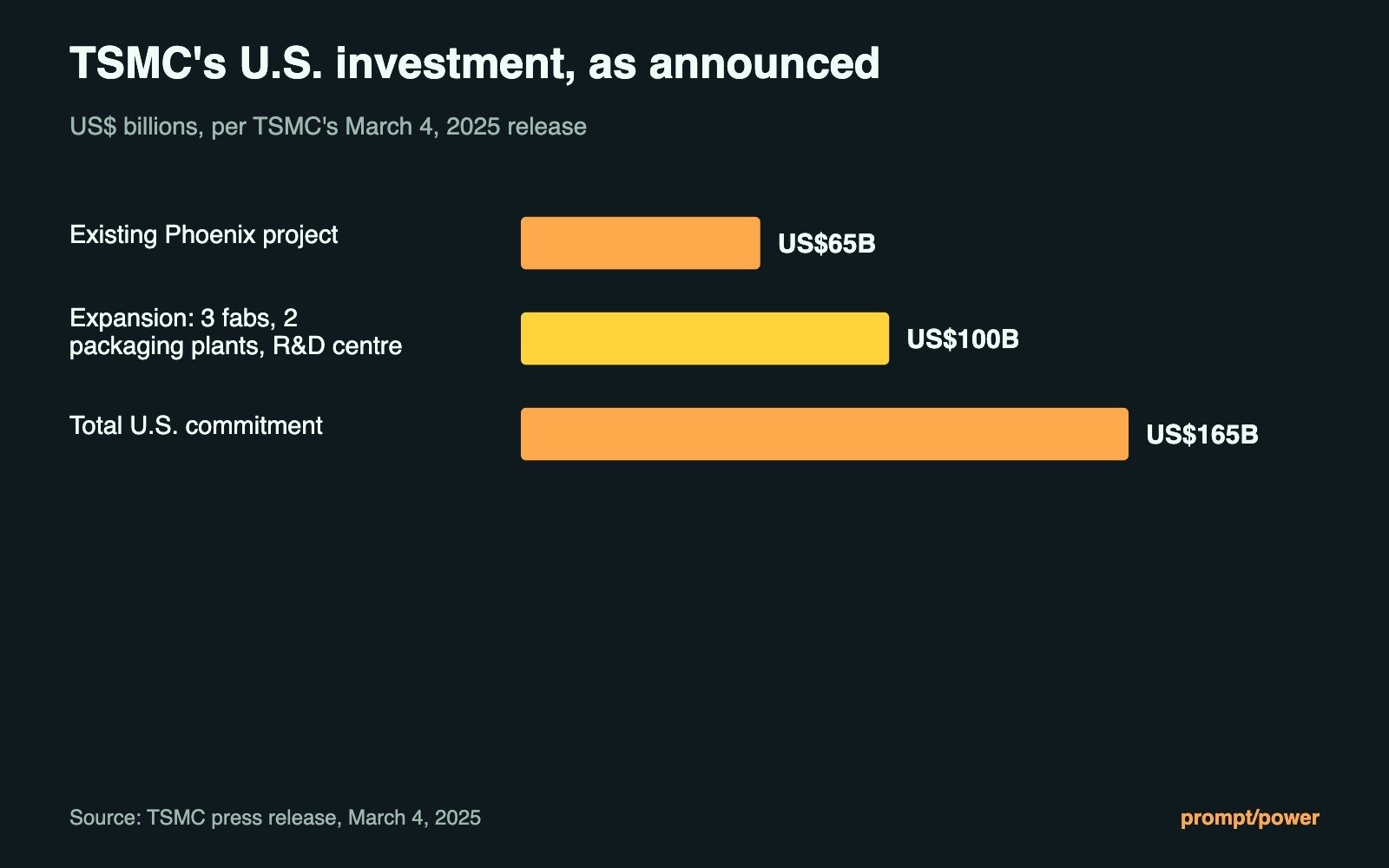
On March 4, 2025, TSMC said it intended to raise its total U.S. investment to US$165 billion. That figure combines an existing US$65-billion project in Phoenix with US$100 billion of new spending on three more fabrication plants, two advanced packaging facilities and a major research and development team centre.
TSMC said the expansion would support about 40,000 construction jobs over four years and tens of thousands of high-tech jobs in chipmaking and R&D, and generate more than US$200 billion in indirect economic output over a decade. Those are the company’s own projections.
What’s actually running
At the time of the announcement, TSMC said its first Arizona fab had been in volume production since late 2024, employed more than 3,000 people and sat on a 1,100-acre site. “This vision is now a reality,” chairman and chief executive C.C. Wei said of the company’s U.S. manufacturing.
Everything else in the US$100-billion expansion was described as planned. TSMC has not attached completion dates for each new plant in that release.
What’s changed since then?
The second fab is built. On TSMC’s Oct. 15, 2026 earnings call, chairman and CEO C.C. Wei said: “In Arizona, we have completed the construction of our second fab, and are in the process of tool move-in and installation.” He added: “Volume production will begin in 3Q’27, slightly ahead of our previous schedule,” AZ Big Media reported. That fab is expected to make 3-nanometre chips, a generation beyond the 4-nanometre process the first fab runs.
Further out, the same report says a third fab, for 2-nanometre chips, is under construction and expected to be fully running before the end of the decade, and that early construction has started on a fourth fab and on TSMC Arizona’s first advanced-packaging plant. It also puts the planned Arizona investment at US$265 billion, a figure we couldn’t match to a TSMC filing; the last number in a TSMC release we’ve seen is the US$165 billion above. Wei also said TSMC is evaluating further U.S. expansion, including Texas, with no decision announced.
| Arizona site | Process | Status (as reported) |
|---|---|---|
| Fab 1 | 4nm | In volume production since late 2024 (TSMC) |
| Fab 2 | 3nm | Built; tools moving in; volume production 3Q 2027 (Wei, Oct. 15, 2026) |
| Fab 3 | 2nm | Under construction; before 2030 (AZ Big Media) |
| Fab 4 | — | Early construction (AZ Big Media) |
| Advanced packaging | — | Early construction (AZ Big Media) |
Why packaging matters
The two advanced packaging plants may matter as much as the fabs. Today’s AI accelerators are not single chips; they combine processors and high-bandwidth memory in complex packages. If the chips are made in Arizona but have to be shipped to Asia to be packaged, the U.S. supply chain still depends on Taiwan. Packaging in Arizona would close that loop.
What to watch
Timelines. TSMC reports quarterly, and each earnings call is a chance to check whether the Arizona schedule is holding.
Costs. Building and running fabs in the U.S. is more expensive than in Taiwan. Watch for any sign of how that affects pricing for customers such as Nvidia.
Policy. U.S. tariffs and subsidies for domestic chipmaking will shape how quickly the rest is built, and how much of TSMC’s most advanced work moves to Arizona rather than staying in Taiwan.
For Canadian and British readers, the practical point is simple: the AI chips in the data centres you use, wherever those are, still depend on a handful of fabs. Arizona is the first serious attempt to add a North American one at the leading edge.
Last checked Nov. 24, 2026.
Sources
- TSMC, TSMC intends to expand its investment in the United States to US
More from prompt/power:65 billion
, March 4, 2025 - AZ Big Media, TSMC Arizona accelerates production timeline as earnings soar, Nov. 11, 2026
- The Next Web, TSMC posts a sixth straight record profit but turns cautious on 2027, Oct. 17, 2026
More from prompt/power: TSMC will buy Anthropic stock at the IPO price · TSMC Q3 revenue beat its forecast · ASML can’t build enough
Researched and drafted with AI tools, fact-checked against primary sources and approved by a human editor before publishing. Prices and dates are as of publication. Our standards →
Sources- azbigmedia.com — AZ Big Media reported
- pr.tsmc.com — TSMC intends to expand its investment in the United States to USMore…
- thenextweb.com — TSMC posts a sixth straight record profit but turns cautious on 2027

Jeff Cameron writes about the business and policy side of AI for prompt/power. A chief operating officer by trade, he also writes for Not An Atlas and The Remote.
All stories by Jeff →Keep reading




Latest from prompt/power
- How to turn off AI features on your iPhone, Android phone, Windows PC and in Google and Meta appsNov 26
- The WHO’s 40-plus rules for AI in health care, and why they matter nowNov 26
- Celestica and Nvidia now share the lead in AI network switches as Ethernet sales more than double, Dell’Oro saysNov 26
- Can you return a tech gift? Your rights in Canada, the U.S. and the U.K. are not the sameNov 26
- Anthropic’s prospectus describes its AI models breaking into real computer systems. What it told investors about safetyNov 25