
ASML earnings for the third quarter of 2026 came in at a record €11.7 billion in net sales and €5.0 billion in net income, the Dutch chip-equipment maker said before European markets opened on Oct. 14. That is about US$13.1 billion in sales, up 55% from a year earlier. The bigger news sat lower in the release: ASML now expects that the machines it plans to build in 2027 and 2028 “will not fully meet the demand of our customers,” and it is studying how to add even more capacity than the 30% increase it had already planned. TSMC, its largest customer, reported on Oct. 15 and said demand still outruns its own supply.
Updated Oct. 19, 2026: TSMC, ASML’s largest customer, reported on Oct. 15 and backed up the supply warning. Chief executive C.C. Wei said demand “is still far above our capability today to supply,” according to TSMC’s call transcript, while the company held its 2026 capital budget at US$60 billion to US$64 billion and declined to give a 2027 figure.
ASML is the only company that sells the extreme ultraviolet (EUV) lithography machines needed to print the most advanced chips, including the AI accelerators TSMC makes for Nvidia, AMD and Google. When ASML says it can’t build enough of them, it is putting a ceiling on how fast the AI chip supply can grow. We laid out why the two companies move together in our ASML and TSMC earnings preview.
ASML earnings by the numbers: Q3 2026
Here is what the results release and investor presentation show:
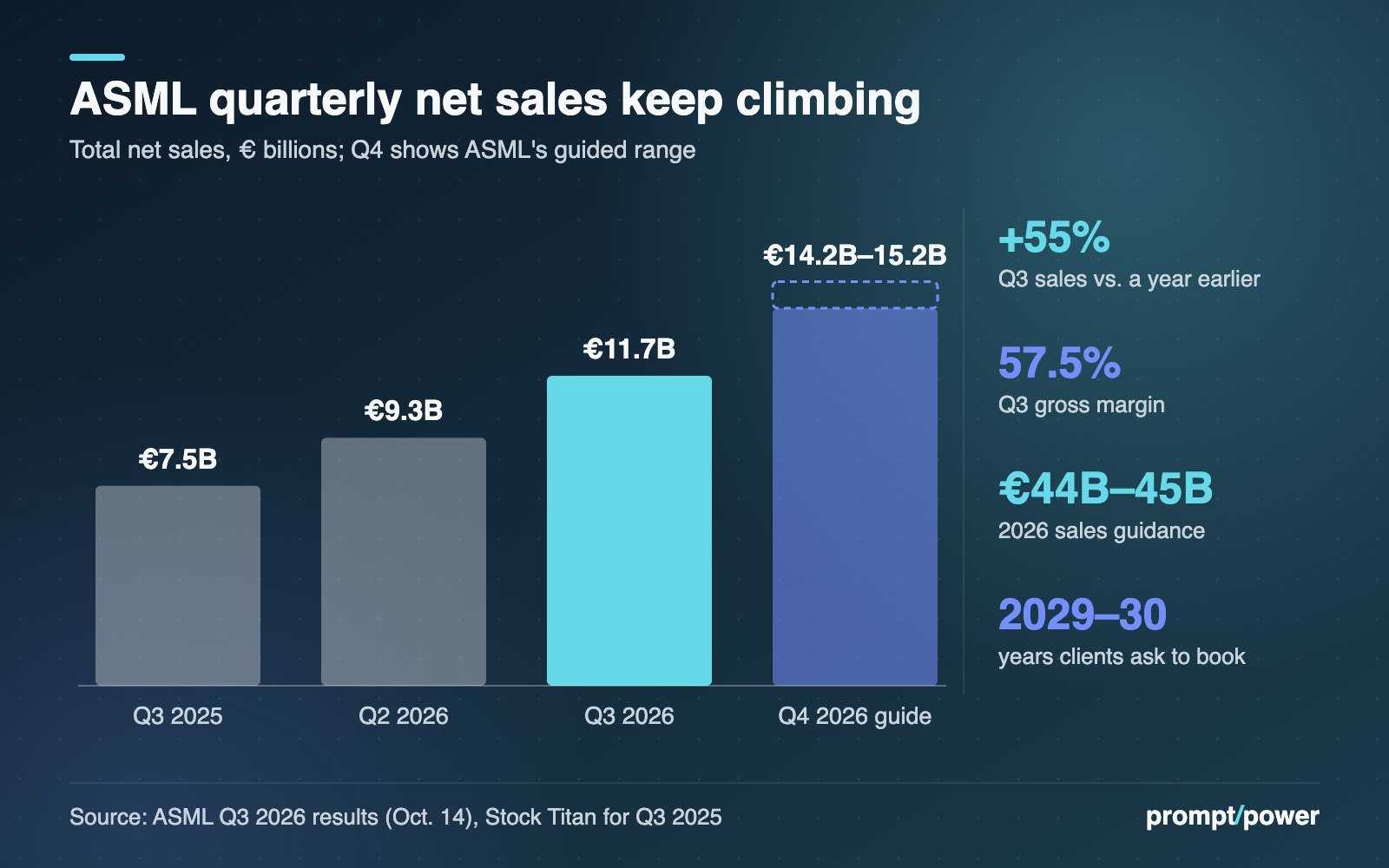
- Net sales: €11.66 billion, up from €9.33 billion in Q2 and €7.52 billion in Q3 2025, per ASML’s Q3 2025 results, as also compiled by Stock Titan.
- Net income: €4.96 billion, or €12.95 per share, against €2.12 billion a year earlier.
- Gross margin: 57.5%, up from 54.0% in Q2 and 51.6% a year ago.
- Machines: 121 lithography systems sold, 113 new and 8 used. Stock Titan counts 17 EUV machines among them, against 9 a year earlier.
Against Wall Street, revenue landed on the line: a whisker under a US$13.12 billion Koyfin consensus, per Stocktwits on Yahoo Finance, and a hair over the US$13.16 billion figure Investing.com used. Earnings per share beat both.
Guidance moved up. ASML now expects full-year 2026 sales of €44 billion to €45 billion, about US$49 billion to US$50 billion, narrowing a range that previously started at €43 billion. The gross-margin forecast rose to about 56%, from 54% to 56%. Fourth-quarter sales are guided at €14.2 billion to €15.2 billion; that would be its biggest quarter yet. Chief financial officer Roger Dassen described that on the call as “an overall 36% increase of 2026 in comparison to 2025,” as quoted by Stock Titan.
ASML’s 2027 and 2028 supply warning
In July, ASML said it planned to lift its 2026 capacity for low-NA EUV and DUV immersion machines by 30% in 2027, and was looking at another 30% in 2028. On Oct. 14 chief executive Christophe Fouquet said that isn’t enough. “Our customers continue to increase their short- and medium-term equipment demand forecasts with us,” he said in the release, and the company is now investigating ways to go “beyond the 30% increase we previously communicated” for 2028.
On the call he was blunter. “30% in 2027, 30% in 2028 will not allow us to meet our customer demand,” Fouquet said, according to Investing.com’s transcript. “We have to do more.”
Some customers are expressing an interest in placing orders with us for 2029 and even 2030. Christophe Fouquet, ASML CEO
Our read: a supplier sold out years ahead is the strongest demand signal the AI build-out can send, and a risk. If EUV output is the bottleneck, it caps how many leading-edge wafers TSMC, Samsung and Intel can add in 2027, no matter how much money hyperscalers and the SpaceX-scale chip buyers raise. Investors were not surprised, though. “While positive, an increase in both 2027 and 2028 was broadly expected,” Jefferies analysts wrote, as reported by Investing.com.
The market’s verdict was split along the Atlantic. ASML’s US-listed shares fell about 3% in overnight trading after the release, according to Stocktwits. In Amsterdam the stock rose more than 2%, Investing.com reported.
What ASML stopped telling investors
Missing from the release: a bookings figure. ASML stopped publishing quarterly bookings after 2025; its last figure was €13.2 billion in orders for Q4 2025, with a €38.8 billion backlog at year end, according to Stock Titan’s review of the filings. The Q3 release describes orders only in words: “an order book momentum that continues to increase quarter on quarter this year.”
The closest hard number is money customers have paid or been billed ahead of delivery. Stock Titan puts ASML’s contract liabilities at €9.3 billion at the end of Q3, up from €3.6 billion a year earlier. Crude, but it nearly tripled.
China, meanwhile, is shrinking as a share of the business. It took 23% of system sales in Q3, down from 42% a year earlier, per Stock Titan, and Dassen said China should be around 20% of total sales for 2026. ASML has said memory makers are expanding as shortages push up DDR and HBM prices, the same squeeze that pushed Samsung to a record quarter and is raising prices on laptops and consoles.
What’s happened since: TSMC’s Oct. 15 results back ASML up
TSMC’s third quarter read like the other half of ASML’s. Revenue was US$46.72 billion, up 41.2% in US-dollar terms, with a 66.4% gross margin and diluted earnings of NT$29.43 a share, according to TSMC’s results release. It guided fourth-quarter revenue to US$52.3 billion to US$54.3 billion. Chips made at 7nm and below, the nodes that depend most on ASML’s EUV machines, were 79% of wafer revenue.
On supply, Wei told analysts that “the demand actually is still far above our capability today to supply,” according to the transcript TSMC posted. Chief financial officer Wendell Huang added that “the tool supply is tight,” and said TSMC plans with its equipment makers well in advance.
What TSMC did not give is a 2027 budget. Huang reiterated 2026 capital spending of US$60 billion to US$64 billion, called a later number “a bit too early,” and said spending from 2026 to 2028 is expected to be “significantly higher than the past three years.”
Two remarks bear directly on ASML. Wei said TSMC plans to use High-NA EUV, ASML’s newest and most expensive machine, in 2030. He also said TSMC is “working very closely with ASML to establish a 12-inch photomask by 2031,” which fits Fouquet’s account of the larger-reticle consortium. Our read: a customer scheduling its High-NA debut four years out is exactly the kind asking ASML about 2030 delivery slots.
What ASML earnings mean for TSMC on Oct. 15
TSMC held its third-quarter earnings conference on Oct. 15 from 2 p.m. to 3:30 p.m. Taipei time, according to its investor calendar, which was 2 a.m. to 3:30 a.m. ET. It held back a 2027 spending figure but echoed ASML on tight supply, as set out above. Fouquet also said on the call that TSMC had asked ASML to lead a consortium bringing larger reticles to the industry.
For anyone watching AI chip supply rather than the share price, the number to remember is the date in Fouquet’s quote. Customers want to reserve machines for 2030, and in Q3 they were already paying €9.3 billion up front. More on chips and hardware as the 2027 numbers firm up.

James Whitfield covers hardware for prompt/power: chips, semiconductors, laptops, components and the benchmarks behind the launch-day claims. He thinks the most important number on any spec sheet is usually the one in the footnote.
Keep reading



Latest from prompt/power
- Meta Q3 Earnings Oct. 21: The Capex, Ads and Cash Numbers to WatchOct 21
- Anthropic’s 5% Pledge Is Worth About US$48B. Here’s the Fine PrintOct 21
- Commons AI Study Meets Parliament’s Interpreter Math: 44 Passes in 5 YearsOct 21
- CNN All Access Canada Price Is CA$7.99. Americans Pay About 23% MoreOct 20
- DeepSeek Federal Ban: DHS Order Also Covers Apps Built on Its ModelsOct 20
Leave a Reply