AirPods 5 Make Noise Cancellation Standard, and Squeeze the Pros
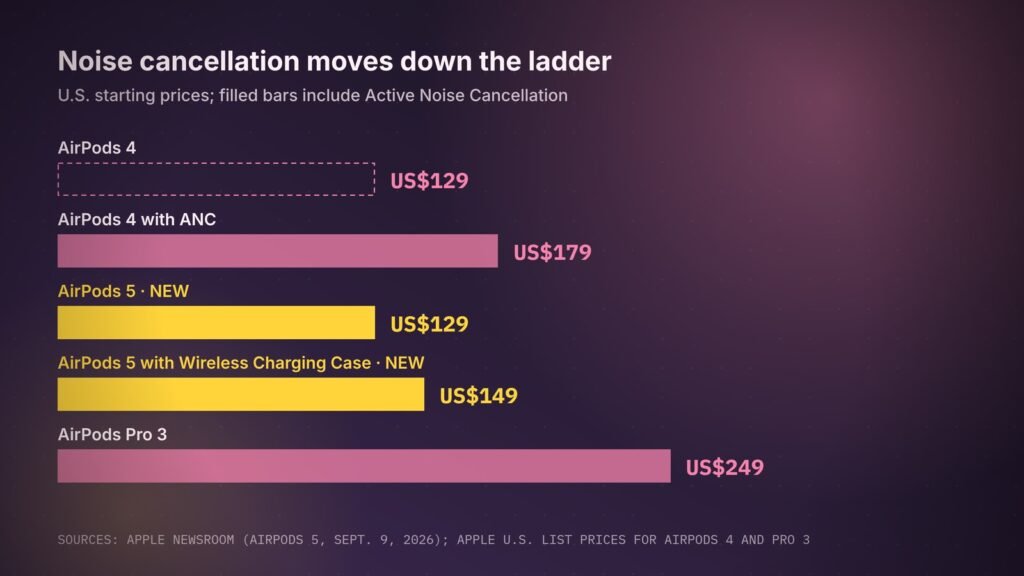
Active noise cancellation usually depends on a seal: a silicone tip that plugs your ear canal and gives the electronics a closed space to work in. Apple’s regular AirPods have never had that seal. They just rest in the ear, which is exactly why so many people prefer them. In 2024, AirPods 4 with Active Noise Cancellation showed that open-ear ANC could work, but only as a US$179 upgrade over the US$129 base model.
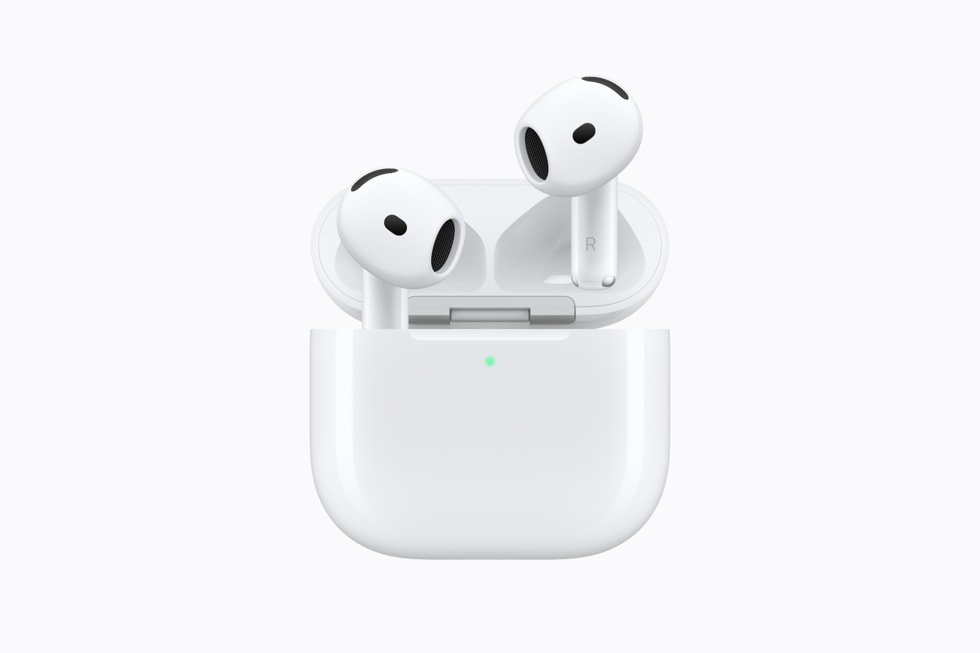
With AirPods 5, announced September 9, that upgrade is now the baseline. Both new models include ANC, and Apple says a new multiport acoustic architecture, borrowed from the design of AirPods Pro 3, removes up to 50 percent more external noise than AirPods 4 with ANC.
Pricing is the story
“We’re thrilled that with AirPods 5, we’re able to bring Active Noise Cancellation — one of our most beloved features — to our most affordable AirPods,” said Dave Pakula, Apple’s vice president of hardware engineering.
The key word there is “affordable.” AirPods 5 start at US$129 (CA$179). AirPods 5 with Wireless Charging Case, which adds on-stem volume control and up to five hours of listening with ANC on a single charge (an hour more than AirPods 4 with ANC), cost US$149 (CA$209). That’s the same entry price as the old AirPods 4 without noise cancellation, and a full US$100 below AirPods Pro 3.
For Apple’s own lineup, that’s a bigger shift than any single spec. Noise cancellation used to be a reason to pay more. Now the case for the Pros has to rest on everything else, and for a lot of people that gap just got much smaller.
About that “industry’s best”
Apple bills AirPods 5 as having “the industry’s best Active Noise Cancellation in an open-ear design.” The footnote is worth reading: testing was “conducted by Apple in July 2026,” following the IEC 60268-24 standard, against “the bestselling wireless open-ear headphones commercially available at the time of testing.” That’s a real methodology. It’s also a comparison Apple chose, ran and is reporting, so treat it as a manufacturer claim until independent reviewers measure it in a noisy subway car.
The software moat
The rest of the package leans on Apple’s ecosystem:
- Siri AI hands-free, with head gestures that let you nod yes or shake no to respond.
- Live Translation, powered by Apple Intelligence, which uses the buds and a paired iPhone to translate conversations across languages. It’s the most futuristic feature here and the one with the most fine print: it needs compatible devices running the latest software with Apple Intelligence turned on, and it isn’t available in every language or region. Check your language before buying for that reason alone.
- Adaptive Audio, which blends Transparency mode and noise cancellation on the fly, and Conversation Awareness, which lowers your music when you start talking.
- Better durability, with improved dust, sweat and water resistance.

Pre-orders opened September 9 in Canada and more than 65 other countries and regions, with availability in stores Friday, September 18.
The bottom line
This is an unusually clean AirPods story. Apple took noise cancellation without a seal, one of the harder problems in personal audio, says it made it much better, and put it in its cheapest buds. If the noise cancellation holds up outside Apple’s lab, AirPods 5 are the value pick of this launch and a quiet demotion of the case for the Pros. If it doesn’t, they’re still the most capable open-ear AirPods yet, at a price that makes the gamble easy.
Prices are Apple’s U.S. and Canadian list prices. Noise-cancellation claims are based on Apple’s own testing, pending independent review.
Sources

Andrew Lovesey is the editor-in-chief of prompt/power and the founder of Loveseyland, a Toronto studio that builds worlds and the companies inside them. Before that he spent 12 years at Canadian Geographic and the Royal Canadian Geographical Society, finishing as Director of Digital and Video, and later led the digital practice at Navigator. He is a Fellow of the RCGS and received its Quest Medal for his part in the expedition that located the wreck of Shackleton's Endurance. At prompt/power he covers Apple and writes the big-picture analysis. He has helped find a ship lost for more than a century, and still can't reliably find a phone charger that works.
Keep reading
Latest from prompt/power
- Gemini’s Free Tier Shrinks Oct. 9: What You Keep and What Costs ExtraOct 5
- How to Read an AI Company’s S-1: The 7 Numbers That MatterOct 5
- OpenAI’s Safety Lead Quit Over Culture. California’s AG Was Already InOct 5
- When an AI Agent Breaks In, Who Answers for It?Oct 5
- The New AI Models Don’t Talk. They Decide.Oct 5
Leave a Reply