ChatGPT Will Show Ads While It Makes Your Images. Here’s Who Sees Them
Ask ChatGPT for a picture of your dream reading nook, and some time this month a free user in the United States may get a sponsored armchair along with it. OpenAI announced on Oct. 5 that it will start testing a visual ad format later in October, with a select group of US advertisers, and that the first place it will run is image generation.
“Initially, we’ll test this new ad format during image generation in ChatGPT. Ads will be clearly labeled, and remain separate from the image being created,” the company wrote, as quoted by BleepingComputer. The format is built to show “product inspiration, product usage, or the experiences a product makes possible,” according to Unite.AI’s summary of the post, which also repeats OpenAI’s claim that ChatGPT now reaches 1.2 billion people each week. That number is OpenAI’s own.
What the ChatGPT image ads look like, and where they sit
Early reports describe the placement differently. Android Headlines says a sponsored banner appears below the progress bar while the image renders. TechCrunch describes ads that appear after users receive their generated images. Both agree on the part OpenAI stressed: the ad is labelled and is not baked into your picture.
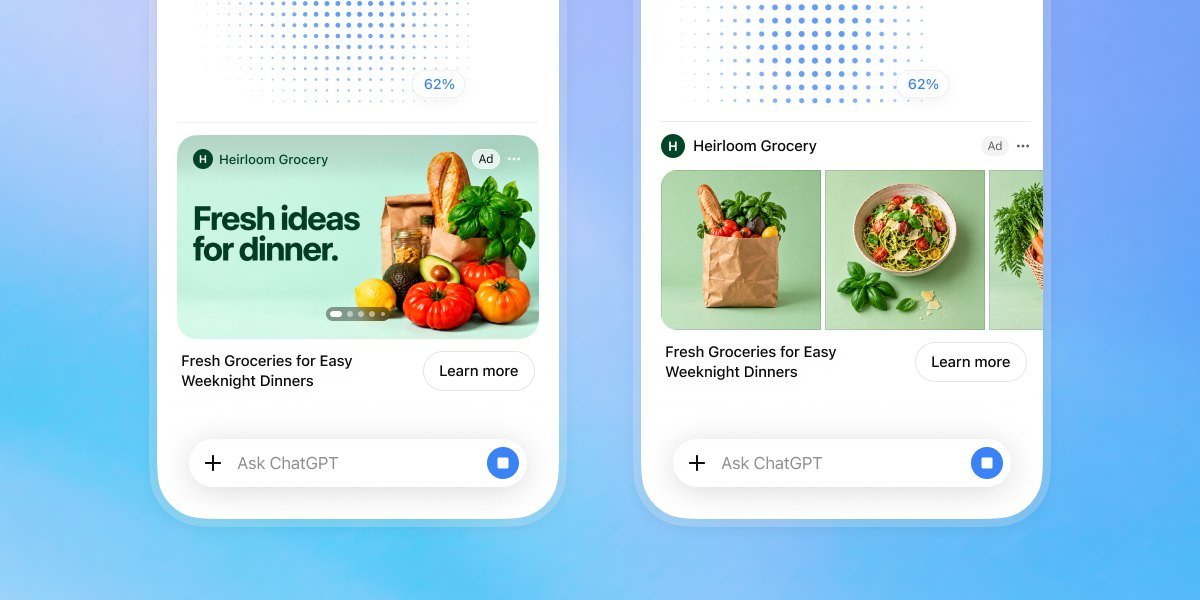
The wait is the point. Image generation is one of the few moments in ChatGPT when a user stares at a screen with nothing to read, usually right after describing something they want: a room, an outfit, a trip. That is prime inventory for a “here’s how this would look in your life” ad.
OpenAI says ads do not change what ChatGPT answers. Engadget reports the company has safeguards to keep ads away from sensitive topics such as personal health and mental wellbeing. Ad-verification firms DoubleVerify and Integral Ad Science are running pilot evaluations of OpenAI’s brand-safety standards in a controlled testing environment, “without access to private user conversations,” per Unite.AI.
Who sees ChatGPT ads: Free and Go, not Plus
OpenAI’s Ads in ChatGPT help page says ads are shown on the Free and Go plans. Plus, Pro, Business, Enterprise and Edu accounts don’t get them, and neither do accounts OpenAI identifies as belonging to someone under 18. When ads first arrived on Feb. 9, Go cost US$8 a month (about CA$11), which makes it the only paid plan that still carries ads.
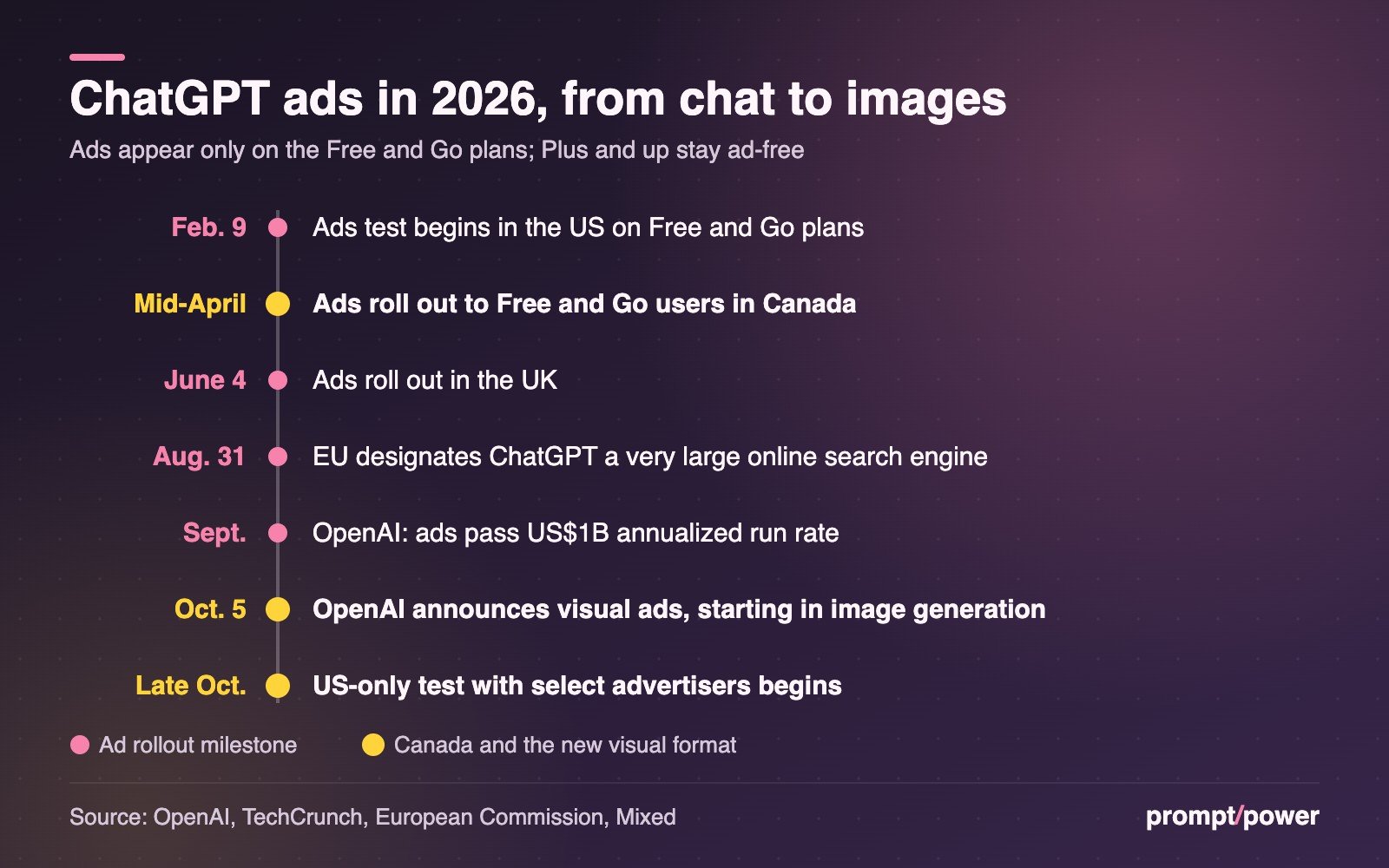
For Canadians, the important detail is that ChatGPT ads are not new here. OpenAI rolled out ads in Canada, Australia and New Zealand in mid-April, as The Keyword reported at the time. What is US-only, for now, is the visual image-generation format. OpenAI has not said when, or whether, it will expand that test beyond the United States.
Our read: expansion is a matter of when. OpenAI said in September that ChatGPT ads hit US$1 billion in annualized revenue run rate in under 200 days, Mixed reported, as ads reached more than 60 countries. And the competition is free: we’ve covered how Meta is pushing its Muse app to the same casual users.
ChatGPT ad controls: what you can switch off
In Settings, then Ads controls, the help page lists these options:
- Turn ad personalization off.
- Stop “Past chats and memory” from shaping which ads you see.
- Hide an individual ad, report it, or see why it was shown.
- Clear your ads data, which OpenAI says it keeps for up to 30 days before removal.
Turning personalization off does not remove ads. It changes how they are picked. OpenAI also says your conversations are not shared with advertisers. If you want a broader privacy reset, our guide to stopping ChatGPT from training on your chats covers the separate data controls.
How to avoid ChatGPT ads, and what it costs
There are three routes. One has a catch.
- Pay for Plus or Pro. Plus is US$20 a month (about CA$28) and Pro runs US$100 or US$200 a month (about CA$139 or CA$278), per CloudZero’s September price tracker. Taxes apply in Canada. Go does not remove ads.
- Use a temporary chat. Notebookcheck reports temporary chats never show ads, though they also don’t use your memory or history.
- Switch to the ad-free Free option. In the same Ads controls menu, OpenAI offers an ad-free version of the free tier with “lower usage limits” and “reduced feature access.”
Here is the catch. The help page’s own example of a feature you lose on that ad-free tier is image generation. So a free user who wants pictures from ChatGPT without a sponsored banner has one real option, which is to pay at least US$20.
The Europe question: an ad library by January
The new format arrives weeks after the European Commission designated ChatGPT a very large online search engine under the Digital Services Act on Aug. 31. OpenAI reported about 159.1 million average monthly EU recipients for ChatGPT search, more than triple the 45 million threshold, Search Engine Journal reported. OpenAI has four months from notification to comply, and one obligation is a public ad repository.
The Next Web points out that repository must show who paid for each ad, how long it ran, its targeting parameters and its reach. OpenAI’s help page already says personalized ads are not available, initially, in the European Economic Area and Switzerland.
That leaves an odd split. By early 2027, a researcher in Brussels should be able to look up which brands bought ChatGPT ads and who they aimed them at. A free user in Toronto watching a sofa ad load under a half-finished image gets a “why am I seeing this” button.

Lauren Smith covers consumer apps and services for prompt/power: streaming, subscriptions, e-commerce and everyday tech worth your money. She keeps a running tally of every free trial that quietly turned into a subscription.
Keep reading


Latest from prompt/power
- AI Safety Hearing: MPs Will Question OpenAI, Anthropic, Google and Meta on 13 OctOct 11
- National Medal of Science Goes to Musk, Brin, Huang and Su. Nvidia Pledged US$1BOct 10
- TikTok Placebo Safety Test: New York Says Teens Got a Fake Feed ResetOct 10
- Waymo Takes Its First Loan, US$5 Billion, as Robotaxis Head OverseasOct 10
- Claude Haiku 5.5 Price: 90% Cheaper Until Your Prompt Hits 100K TokensOct 10
Leave a Reply