
The Competition and Markets Authority (CMA), Britain’s competition regulator, proposed on 20 October that Apple should let other companies use the iPhone’s contactless chip on “fair, reasonable, transparent and non-discriminatory terms”. The consultation covers a draft conduct requirement for Apple’s mobile platform, and it closes at 11:59pm on 17 November 2026. If the CMA adopts it, banks, fintechs and other app makers in the UK could build their own tap-to-pay wallets, digital keys and tickets on the iPhone, and pay Apple less to do it. Nothing changes for iPhone owners until the CMA makes a final decision, for which it has set no date.
The detail sits in a 147-page consultation document that sets out the requirement and the CMA’s provisional view that it would be effective and proportionate. The regulator’s press release gives the headline terms. Here is what they mean.
What the CMA’s NFC proposal would require from Apple
NFC, or near field communication, is the short-range radio that lets a phone pay at a card terminal, open a hotel door or pass a ticket gate. On the iPhone, Apple Pay has had it largely to itself.
The CMA wants Apple to open access through what it calls the two main international standards for contactless:
- Secure element (SE). Card credentials are stored in a dedicated, tamper-resistant chip inside the phone. Apple Pay works this way. Apple already offers UK developers a route to it, on its terms.
- Host card emulation (HCE). The credentials live in the app or in the cloud, and the phone’s software emulates a contactless card. Many banking apps on Android phones use this method.
Apple currently offers only secure element access for contactless in the UK, according to the CMA. On security, which is likely to be Apple’s main objection, the regulator says the evidence suggests neither standard raises inherent concerns.
The CMA is not setting a price. It proposes principles for how Apple’s charges should be worked out, with the expectation that they will be “substantially lower” than Apple’s current fees while still rewarding Apple fairly for its technology.
What Apple charges now, and why the CMA wants it lower
Apple opened its secure element to outside developers in late 2024. Its announcement on 14 August 2024 said the new NFC and SE tools would arrive with iOS 18.1 in Australia, Brazil, Canada, Japan, New Zealand, the UK and the US. The catch was in one sentence: developers must “enter into a commercial agreement with Apple, request the NFC and SE entitlement, and pay the associated fees.”
Apple did not publish those fees in its announcement, and the CMA’s release does not put a number on them either. It says businesses have told the regulator that Apple’s fees and terms are onerous and may not be commercially viable. The CMA’s evidence for that is a market outcome: no UK firm has launched a wallet-type product to compete with Apple’s.
About six months after Apple agreed to open NFC payments in the EU, Norway’s Vipps launched the first rival payment app. No UK firm has launched one yet.
That comparison comes from the CMA itself. After Vipps, it says, PayPal, Klarna, Curve and BBVA followed in Europe.
Why the UK contactless figures matter
The CMA’s case leans on how British people already pay. Contactless now makes up 39% of all UK payments, up from 3% a decade ago. UK Finance estimates there were 19.2 billion contactless payments in 2025, a rise of 2%. Which? found that 62% of UK adults use a digital wallet, with Apple Wallet the most popular at 50%.
The regulator also points to the UK’s fintech sector, which it puts at about £214bn in turnover (about US$285bn) and more than 360,000 jobs, as the main group that stands to gain. The use cases it lists run well beyond payments: digital IDs and age checks, car, hotel and workplace keys, tickets and travel passes, and loyalty schemes.
“These proposals open the door to more innovation, more choice and economic growth,” said Sarah Cardell, the CMA’s chief executive, in the release. David Geale, managing director of the Payment Systems Regulator, said the changes should bring more competition and support open banking, which lets people pay straight from their bank account.
Apple’s response was not included in the CMA’s release. Apple’s other running argument with regulators, over who checks users’ ages, is in our explainer on the app store age-check fight.
EU, UK, US and Canada: four routes to iPhone tap-to-pay
The same chip is being opened up, or not, by four very different mechanisms.
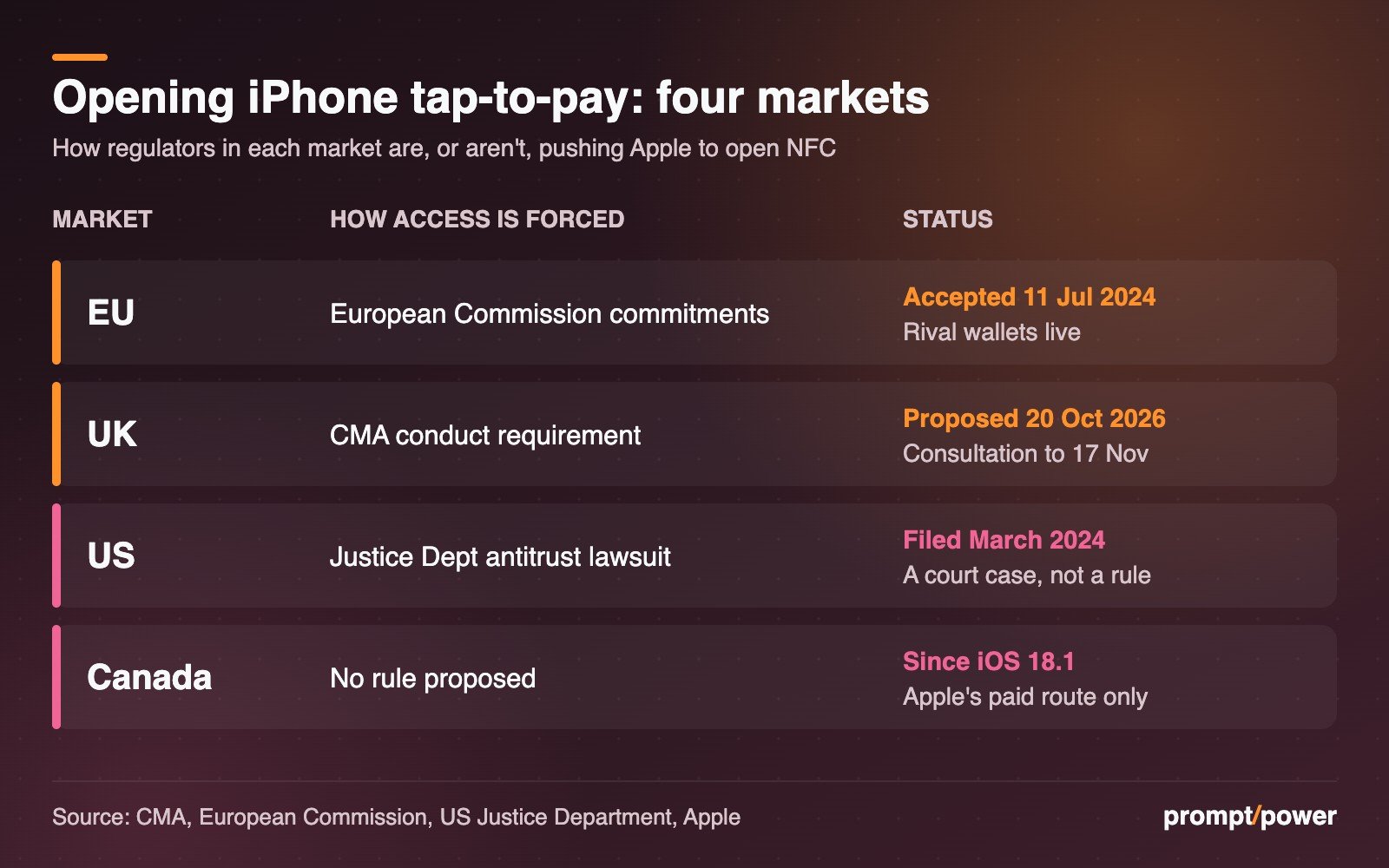
- European Union. The European Commission accepted commitments from Apple on 11 July 2024 to open tap-and-go access to rivals in the European Economic Area, closing an antitrust case, as TechCrunch reported. Those commitments, not a new law, produced the Vipps app.
- United Kingdom. The CMA is using the Digital Markets, Competition and Consumers Act 2024. It designated Apple with strategic market status in mobile platforms in October 2025, which lets it impose conduct requirements like this one.
- United States. The Justice Department’s antitrust lawsuit against Apple, filed in March 2024, includes claims that Apple blocks third-party tap-to-pay wallets. It is a court case, not a rule.
- Canada. Canadian developers have had the same paid secure-element route as the UK since iOS 18.1, according to Apple’s 2024 announcement. Canada has no digital-markets law comparable to the UK’s, and no regulator has proposed an NFC rule.
For Canadian iPhone users and banks, that means the status quo holds: Apple Pay, plus whatever apps sign Apple’s commercial terms. Our explainer on Canada’s coming real-time payment rail covers the other side of that market.
What happens next, and what it means for you
Responses go through the CMA’s consultation site until 17 November. The CMA says any non-disclosure agreement a party has with Apple “should not prevent them from responding”, and that Apple has confirmed it will not use any other confidentiality provision to stop a party responding to this consultation. That matters, because the companies with the most detail on Apple’s terms are the ones that have signed them.
After that, the CMA will assess responses and make a final decision. Light Reading was among the trade outlets to note that the regulator wants access through the main international contactless standards.
- If you use Apple Pay, nothing changes. A final requirement would add options, not remove Apple’s wallet.
- If you bank with a UK bank or fintech, watch for tap-to-pay inside its own app on iPhone, as many already offer on Android.
- If you run a business that issues cards, keys or passes, the consultation is your chance to put Apple’s current fees on the record.
For more on the regulators reshaping Big Tech’s business in Britain, see our report on the £1.2bn Google Play class action and our policy coverage.
The CMA’s own benchmark for success is already written down. In Europe it took about six months for the first rival wallet to reach iPhones. The UK clock starts only when the requirement is final.

Andrew Lovesey is the editor-in-chief of prompt/power and the founder of Loveseyland, a Toronto studio that builds worlds and the companies inside them. Before that he spent 12 years at Canadian Geographic and the Royal Canadian Geographical Society, finishing as Director of Digital and Video, and later led the digital practice at Navigator. He is a Fellow of the RCGS and received its Quest Medal for his part in the expedition that located the wreck of Shackleton's Endurance. At prompt/power he covers Apple and writes the big-picture analysis. He has helped find a ship lost for more than a century, and still can't reliably find a phone charger that works.
Keep reading




Latest from prompt/power
- SK hynix Memory Is Sold Out Through 2029. PCs and Phones Pay the PriceOct 29
- GPT-6.1 Terra Price: US$1 In, US$5 Out. What Agents Cost Now, and the CatchOct 29
- Australia’s Chatbot ‘Intimacy’ Ban Is for Kids Only. Canada’s Bill Isn’tOct 29
- Cohere Caught Qwen Trying a Beijing Upload. How to Lock Down AI AgentsOct 29
- Cloudflare’s AI Leaked Other Customers’ Data in 155 Replies. What to CheckOct 29
Leave a Reply