
SK hynix made 83.3 trillion won in operating profit between July and September, about US$62.3 billion, on 104.6 trillion won of revenue, according to the third-quarter results it published on Oct. 28. That is 80 won of profit on every 100 won of sales. On the earnings call the same day, the company said its DRAM and high-bandwidth memory output for the next three years is spoken for. Its chief financial officer also said, in plain terms, who absorbs the cost: PC and phone makers, whose shipments he expects to fall.
We convert at 1,337.7 won to the U.S. dollar, the Seoul close on Oct. 28, so dollar figures are approximate.
SK hynix Q3 2026 earnings: the numbers
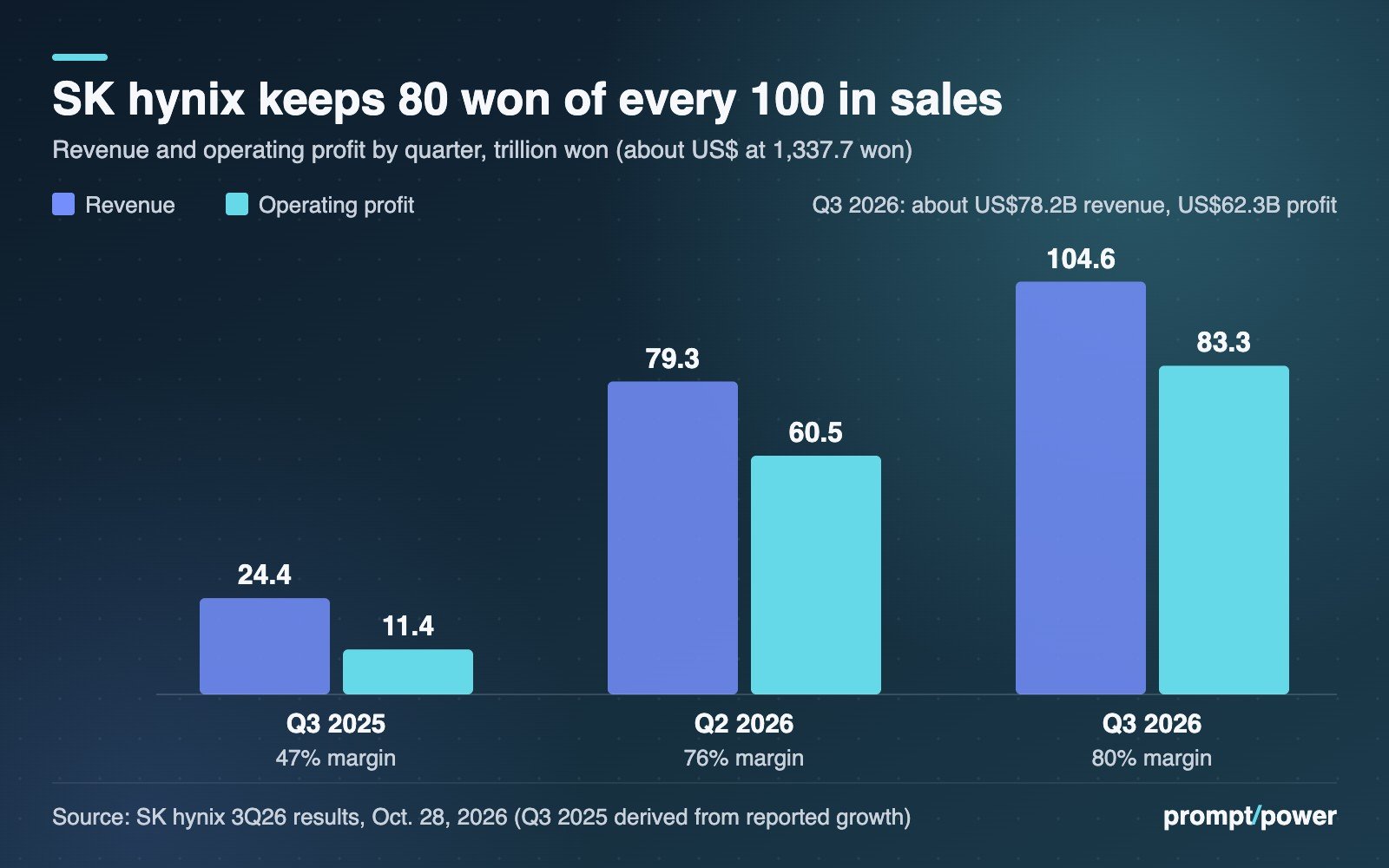
The release lays it out in one table. Revenue of 104.6155 trillion won (about US$78.2 billion) rose 32% from the second quarter and 328% from a year earlier, the first quarter SK hynix has ever crossed 100 trillion won. Operating profit of 83.3338 trillion won rose 38% quarter on quarter and 632% year on year. The operating margin was 80%, up from 76% in the second quarter and 47% a year ago.
Net profit came in at 39.7756 trillion won (about US$29.7 billion), which looks odd next to that operating line. It fell 58% from the second quarter, when the company booked 93.9 trillion won. The release doesn’t explain the swing, and we won’t guess at it. The operating line is the cleaner read of the business.
What ‘sold out through 2029’ actually means
The headline line came on the call, in Korean, and the wording you’ve seen depends on who translated it. In Investing.com’s transcript of the call, the English rendering attributed to chief executive Kwak Noh-Jung reads: “our DRAM and HBM volume for the next three years through 2029 are effectively sold out.” Seoul Economic Daily attributes a near-identical line to Park Jun-deok, the vice president in charge of DRAM marketing, and labels its own article AI-translated from Korean. Korea JoongAng Daily quotes the company, not a named executive, and adds the qualifier that matters: “Based on the long-term agreement [LTA] volumes we have already secured.”
So “sold out” is a contracts claim, and the contracts are in the release. SK hynix says it has signed long-term agreements with 14 major customers, including global cloud providers, up from 10 a quarter earlier according to JoongAng Daily. Those agreements cover more than 50% of its total production capacity for 2027 and 2028, typically run five years, and in the CFO’s words on the call include “safeguards such as deposits.” Pricing floats “within a price range agreed upon with the customer,” per the transcript.
SK hynix’s CFO said shipments for PCs and phones “are expected to decrease due to cost burdens from rising memory prices.”
More than half is not 100%. The company says the rest is claimed by demand it can see, and the release says demand will exceed supply through 2030. Our read: the phrase is accurate as a description of SK hynix’s order book and less precise as a promise about every chip it will make.
Why your next laptop or phone costs more
Here the call is unusually direct. CFO Kim Woo-hyun said DRAM average selling prices rose by the high 20% range in the third quarter, after a similar jump in the second, and NAND prices rose by the mid-20% range. He said price hikes are “centered on HBM, server DRAM, and enterprise SSD.” Then, on consumer devices: “shipment volumes for PCs and mobile devices are expected to decrease due to cost burdens from rising memory prices.”
That is a memory maker telling investors its customers’ customers will buy fewer machines because of what memory costs. It isn’t planning to make less. Fourth-quarter DRAM shipments are guided up by the mid-20% range, with HBM4, the newest stacked memory that sits beside AI accelerators, expected to pass HBM3E in shipments and revenue this quarter. The head of HBM sales, Kim Ki-tae, said on the call that customers’ requirements are “more than double” what SK hynix can supply today (translated).
JoongAng Daily cites Eugene Investment & Securities expecting DRAM prices to rise another 17% in the first quarter of 2027 as phone-memory increases take full effect. That’s an analyst forecast, not a company number.
Relief depends on factories. The CFO said the M15X fab should reach full capacity by the end of 2026, and the first Yongin fab’s clean rooms will open “in phases.”
What to do if you need a device
- Buy on need, not on a wait-for-cheaper theory. Nothing in SK hynix’s guidance points to memory prices falling before its new capacity ramps. Our memory-shortage buyer’s guide has the rules that still hold.
- Prioritize RAM at purchase. Most thin laptops and every phone have soldered memory you can’t add later. Our AI PC explainer covers how much is enough.
Where the money goes
SK hynix plans to return about 100 trillion won (about US$74.8 billion) to shareholders for 2026: at least 30 trillion won in cash dividends and at least 60 trillion won in buybacks and cancellations.
SK hynix shares closed up 10.89% at 1,487,000 won on Oct. 28 and the Kospi rose 6.63%, per JoongAng Daily.
Samsung Electronics, the larger memory rival, reported its full third-quarter results on Oct. 29. Its chip division, Device Solutions, earned 106.5 trillion won (about US$79.6 billion) in operating profit on 147.1 trillion won (about US$110 billion) in sales, almost all of the company’s 107.4 trillion won total and in line with its preliminary guidance on Oct. 8, according to Aju Press and Digital Today. Samsung’s device side, which includes its phones, posted an operating loss of about 0.8 trillion won, Aju Press reported, noting that “the sharp rise in chip prices has squeezed margins on smartphones and consumer electronics.” Samsung’s phone division buys memory from its own chip division, which means one company now feels both halves of Kim Woo-hyun’s sentence.
More hardware coverage from prompt/power.

Yuna Park covers mobile and gadgets for prompt/power: phones, accessories, consumer electronics and the supply chains behind them. Her favourite test for any new phone: would you notice if someone swapped it for last year's?
Keep reading



Latest from prompt/power
- GPT-6.1 Terra Price: US$1 In, US$5 Out. What Agents Cost Now, and the CatchOct 29
- Australia’s Chatbot ‘Intimacy’ Ban Is for Kids Only. Canada’s Bill Isn’tOct 29
- Cohere Caught Qwen Trying a Beijing Upload. How to Lock Down AI AgentsOct 29
- Cloudflare’s AI Leaked Other Customers’ Data in 155 Replies. What to CheckOct 29
- Alphabet Q3 Earnings: Cloud Doubled, Then Alphabet Sold US$12.4B of StockOct 29
Leave a Reply