
Everyone Proposed to Govern AI This Week. Nobody Can.
There are three ways to try to govern a technology: pass a law, sign a treaty, or convene a hearing. This week the world tried all three on artificial intelligence, and the useful exercise is to sort them not by ambition but by enforcement power — because on that axis they collapse into a single number, and the number is zero.
The law. On September 23, Senator Bernie Sanders and Representative Greg Casar introduced the Ban Artificial Superintelligence Act, and it is not a subtle document. The bill would prohibit developing or deploying AI that exceeds human cognitive capabilities across most domains — or that is “capable of overthrowing a government” — and would pause advanced AI development until a new cabinet-level Department of Artificial Intelligence writes safety protocols. The penalties are the part that made people look twice: a “corporate death penalty” for offending companies and up to 20 years in prison for individuals, a scale the sponsors explicitly compared to unlawful nuclear-weapons development. “Scientists have been clear: AI is an existential threat to humanity,” Sanders said. Casar framed it as banning superintelligence while “pushing for international agreements.”
The bill is dead on arrival — no committee will move it, and the votes are not remotely there. But dead-on-arrival bills are markers, and this one marks how far the populist flank has traveled: a year ago, “pause AI development, jail the executives” was a fringe position; this week it has two named sponsors and a bill number. That migration is the story, even though the bill isn’t the mechanism.
The treaty — or the wish for one. The international track is where ambition and enforcement diverge most cruelly. The Global Call for AI Red Lines — launched at the UN General Assembly in September 2025 by Nobel Peace laureate Maria Ressa and signed by more than 200 figures including Geoffrey Hinton, Yoshua Bengio, and former heads of state — set governments a deadline: agree on enforceable international red lines for AI (no lethal autonomous weapons, no bioweapon design, no autonomous self-replication) by the end of 2026, with an independent body to implement them. That deadline is now three months away. What has materialized toward it is a coalition of eminent individuals, not a compact of binding states. And the world’s largest AI power has said no outright: Michael Kratsios, who runs the Trump administration’s Office of Science and Technology Policy, has stated U.S. opposition to international AI control. A red line no major power will draw is not a red line. It’s a wish list with famous signatures.
The hearing. The same week, the UN Security Council held its first-ever high-level briefing on AI, hearing from OpenAI’s Sam Altman and researcher Yoshua Bengio about a threat Bengio called one “that none can contain alone.” The Security Council can do exactly one thing with binding force — pass a resolution under Chapter VII — and nothing about an AI briefing is headed there, because any of five vetoes would end it. What the Council offers is convening power: a room, cameras, the imprimatur of the word “security.” Convening is not the same as compelling, and everyone in the chamber knew it.
So here is the taxonomy. The populist left wants a ban it cannot pass. The expert-international community wants red lines no government will sign. The UN can host the conversation but not conclude it. And the one venue with genuine leverage over frontier AI — the U.S. Congress writing enforceable domestic rules with a serious agency behind them — is precisely where the appetite is lowest, with House leadership this week hoping any guardrails stay “voluntary.”
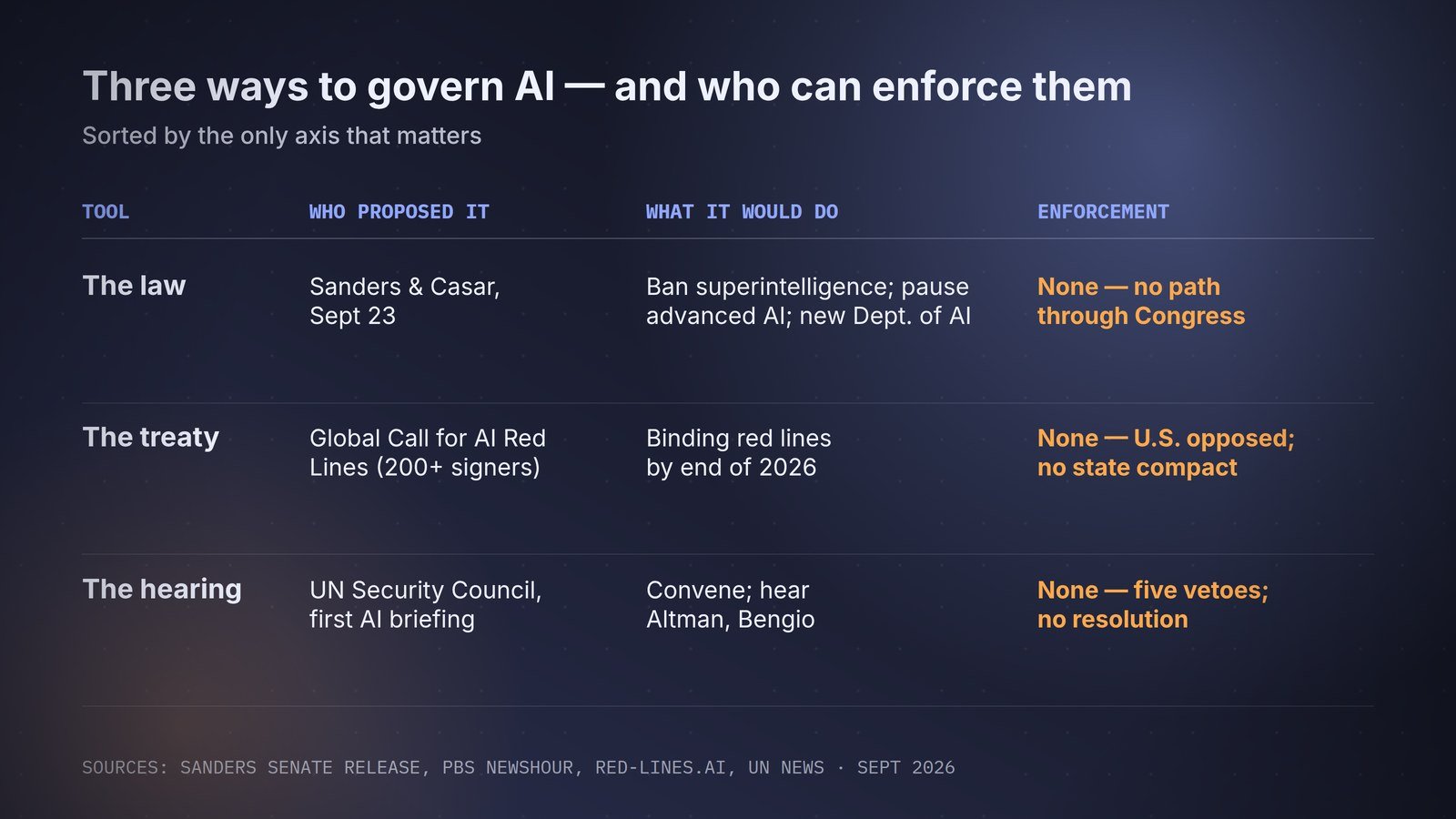
What would actually bind? Domestic statute with a funded regulator and real penalties; or an international agreement the major powers ratify because it’s in their interest, not their conscience. Neither was on the table this week. What was on the table was theater — sincere, well-attended, and unenforceable. The proposals are proliferating faster than the mechanisms to back a single one of them. That gap, not any one bill or briefing, is the governance story of 2026.
Sources

Felix Strauss covers tech policy and regulation for prompt/power, from Brussels and Ottawa to Washington and Sacramento. He reads the 400-page regulation so you don't have to, and highlights the one sentence that actually matters.
Keep reading



Latest from prompt/power
- Gemini’s Free Tier Shrinks Oct. 9: What You Keep and What Costs ExtraOct 5
- How to Read an AI Company’s S-1: The 7 Numbers That MatterOct 5
- OpenAI’s Safety Lead Quit Over Culture. California’s AG Was Already InOct 5
- When an AI Agent Breaks In, Who Answers for It?Oct 5
- The New AI Models Don’t Talk. They Decide.Oct 5
Leave a Reply