
Google’s Gemini Agent Gets Its Own Work Email, and Can Hand Jobs to Claude
In Google’s own example, a marketing manager tags an AI agent in a comment on a Google Doc. The agent suggests an edit, replies in the thread, and the change shows up in the document’s version history under the agent’s name. Not the manager’s. Not “Gemini.” The agent’s.
That detail, from Google Cloud CEO Thomas Kurian’s Oct. 8 launch post, is the most consequential thing Google announced at its Gemini at Work 2026 event. The company introduced the Gemini agent, which Kurian called “your new single, universal agent for work,” and gave its team-based version something usually reserved for new hires: a place on the org chart.
Gemini agent: what Google launched on Oct. 8
The pitch is one prompt box for everything. “You give it objectives, not instructions,” Kurian wrote. The agent answers questions, drafts documents, makes images and writes and runs code, and it can be reached from the web, iOS and Android, Windows and Mac desktops, the command line, Google Workspace, Microsoft 365 or Slack, according to the Google Cloud post.
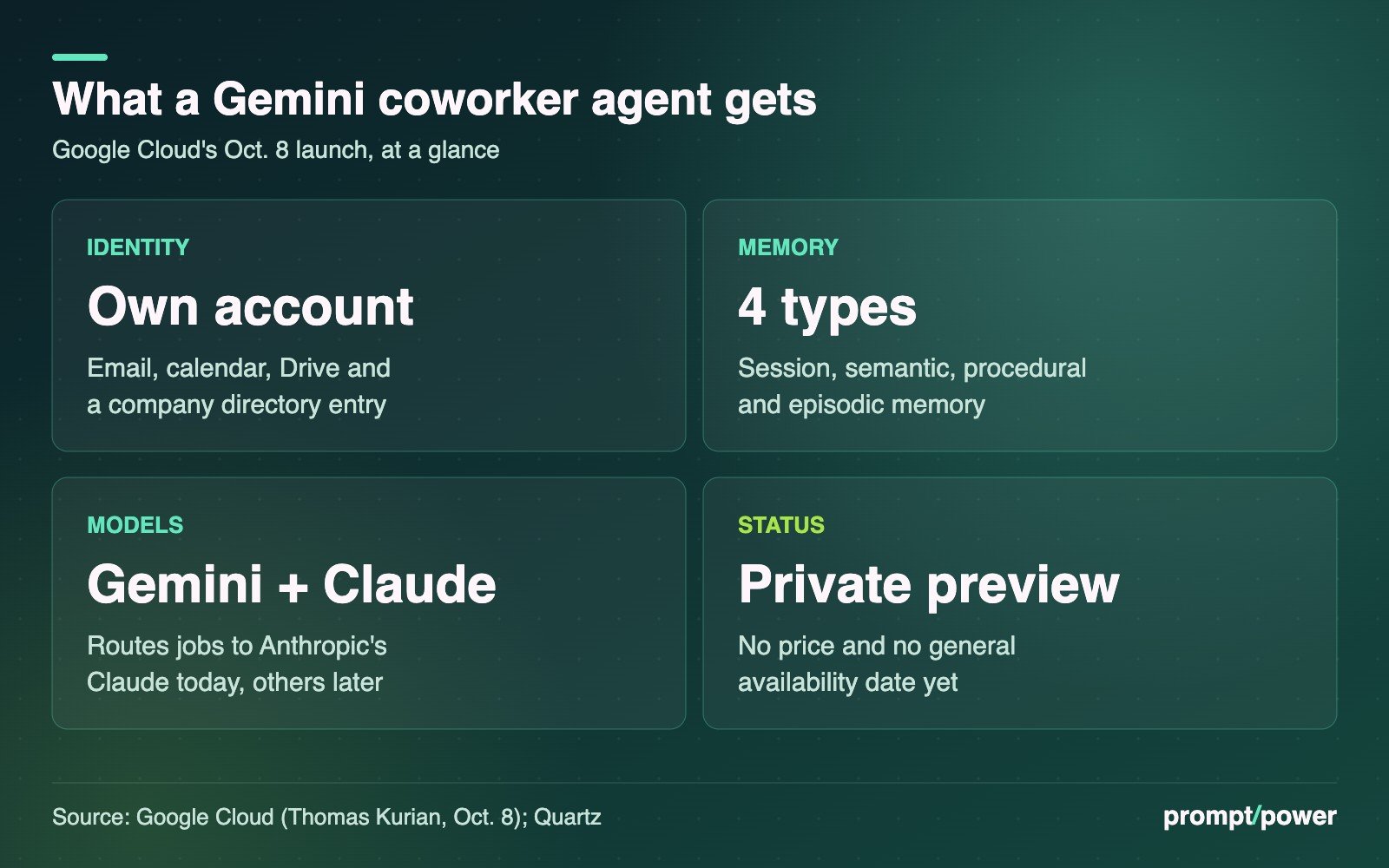
The part that matters for IT departments is the “coworker agent.” Google describes it as closer to a team member with “a persistent, defined role.” Per Kurian’s post, each one gets:
- Its own Workspace account, “including an email address, calendar, Drive, and presence in your company directory,” with addresses on an @agents.company.com domain.
- Four kinds of memory: session memory for the current task, “even when it runs for days,” a semantic knowledge base it builds as it works, procedural memory that includes “skills it writes for itself,” and episodic memory of everything it has done.
- Access only to what people share with it. “A coworker agent acts under its own identity rather than yours, and it sees only what you share with it,” Google says.
Because it runs in the cloud, work continues after you close the laptop. XenoSpectrum’s breakdown notes Google had earlier announced runs of up to seven days, though it is not clear that limit applies to the new agent.
Why Google’s agent routes work to Anthropic’s Claude
Here is the line that stands out. “Gemini is the agent, and the model underneath it is a separate choice,” Kurian wrote. It orchestrates “across our Gemini family of models and Claude models from Anthropic today, and other leading private and open models in the future.” A Smart Routing tool triages each workload to the model that delivers “maximum performance at the lowest possible cost.”
Google did not say how it decides when a job goes to Claude, XenoSpectrum points out, or how much switching improves quality or cost. AI Weekly raised the follow-up most compliance teams will ask: which data-processing agreement and audit trail apply when Google’s router hands a task to Anthropic.
Our read: Google is betting that the durable business is the layer that owns identity, memory and permissions, not the model. If an enterprise’s agents live in Workspace with Workspace logins, which model does the thinking matters less to Google than where the agent’s desk is. Anthropic is playing the same game from the other side. On Oct. 6 it shipped a Claude add-on that works inside Docs, Sheets and Slides.
The demand for routing is real. In the same post Google says PayPal “routes 10 million multi-model requests every week.”
“Every agent gets its own identity, cryptographically attested and governed like an employee, with least-privilege permissions.” Thomas Kurian, Google Cloud
An AI with a company login: who answers for it?
Google has thought about governance, at least on paper. Every action the agent takes “is written to an audit trail and attributed to the agent rather than to a person,” the post says. All traffic, including agent-to-agent traffic, passes through Agent Gateway, which Google calls “an AI network firewall.” Admins can set a hard cap on a project’s AI spending, after which the agent pauses until someone clicks resume.
That answers what happened. It does not answer who is responsible. When a human employee emails the wrong customer list, there is a manager, a policy and an HR file. When an agent with its own address does it, the audit log will say the agent did it, which is accurate and not much help. Courts are only starting to test how old agency law applies when software acts on a company’s behalf, as we reported on Oct. 5.
The practical questions are smaller and arrive first:
- Offboarding. XenoSpectrum notes Google has not explained how long memories are retained, how they are deleted, or how skills the agent writes for itself are reviewed.
- Licensing. VentureBeat reports Google has not said whether the agent is included in existing Gemini Enterprise subscriptions, or whether every coworker instance needs its own Workspace account.
- Sharing. An agent that sees “only what you share” sees whatever a busy team shares with it. Google hasn’t said whether agents can join groups or mailing lists; if they can, that scope could grow quietly.
Gemini agent availability and price
Most companies can’t turn this on yet. The agent is in private preview for enterprise customers, Quartz reported, with broader availability planned for some Business and Enterprise Workspace tiers. Android Authority says it is not available on personal Gemini accounts. Kurian’s post gives no general-availability date and no price; it says industry versions are “now in preview for Financial Services and Legal.”
If your company runs Workspace, the time to set rules is before the first agent shows up in the directory. Decide who can create one, which groups it may join, and who owns its mistakes. Google’s announcement on its main blog describes an agent that returns finished work “in the documents, inbox, and developer tools” people already use.
Google even supplied a sample rule for its policy engine, the kind admins write once and apply to every agent: “agents may not open documents classified Need to Know.” Somebody at your company will have to write the second one.

David Mensah covers software and platforms for prompt/power: apps, browsers, developer tools and the open web. He firmly believes every "simple" settings menu is hiding a second, worse settings menu.
Keep reading




Latest from prompt/power
- Cohere Opens an Ottawa Office as Its AI Agents Head to Navy ShipsOct 11
- Beijing Warns Officials Off ‘Blind Investment’ in AI and High TechOct 11
- TSMC Q3 Revenue Beat Its Forecast: What to Watch in ASML and TSMC EarningsOct 11
- China Gave AI Influencer Yuri an Official ID. What It Unlocks for CreatorsOct 11
- Double Counter Discord Breach: What to Do If Your IP Address LeakedOct 11
Leave a Reply