Anyone who builds, buys or advises on AI agents in Britain has until the end of 20 November to tell the Information Commissioner’s Office (ICO) how data protection law should apply to them. The regulator’s call for evidence on agentic AI opened on 8 October and runs through an online survey with eight sections. What it hears will shape new guidance and, according to the ICO’s own description of the exercise, its “statutory code of practice on AI and automated decision-making (ADM)”. Late answers may simply be ignored: the consultation page warns that responses received after the deadline may not be considered.
The call arrived on the same day as an ICO announcement that ten AI developers, Amazon, Anthropic, Apple, Cohere, DeepSeek, Google, Meta, Microsoft, OpenAI and Stability AI, had made or committed to changes in how they handle personal data. We reported that announcement on 10 October. This piece does something different. We read every ICO document attached to the process, side by side, to see what the regulator is actually asking, what it will do with the answers, and what it has put on the record about each company. The short answer to the last question is: almost nothing.
What the ICO’s agentic AI call for evidence asks
The ICO does not define an AI agent on its call-for-evidence pages; it links out to a separate explainer. Its framing is broad. “The novel, dynamic and distributed nature of agentic AI raises important questions about data protection compliance,” the guidance page says, and the regulator wants evidence “to inform our thinking on how to apply data protection law to the distinctive capabilities and risks of agentic AI.”
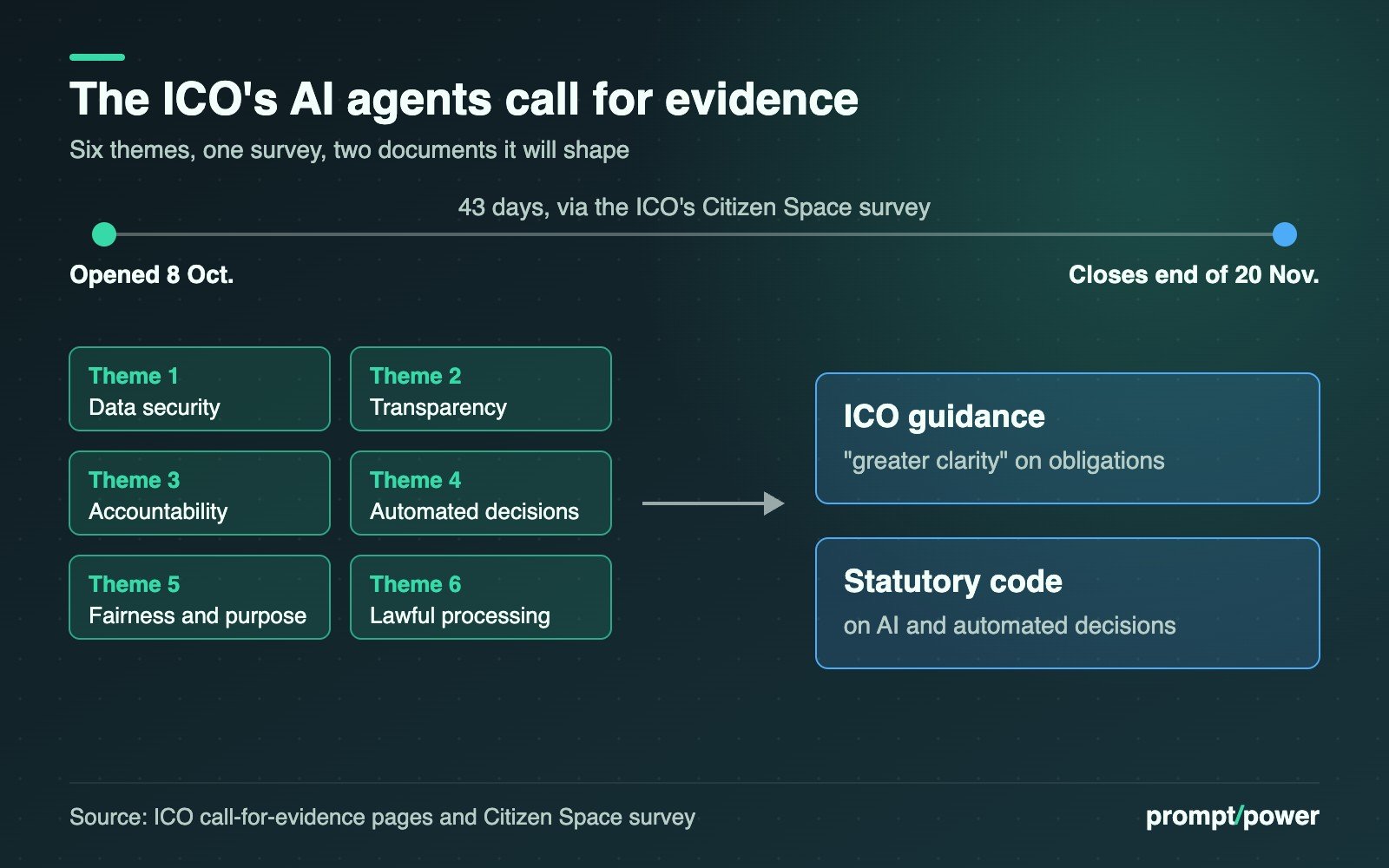
It sorts the questions into six themes, which it says “are not exhaustive”:
- Data security
- Transparency
- Accountability
- Automated decision-making
- Fairness and purpose limitation
- Lawfulness of processing
On the Citizen Space survey, those become sections two to seven, bookended by an “about you and your organisation” section and a final one for additional questions. The individual questions sit inside the survey itself and are not reproduced on the overview pages, so respondents only see the full set once they click “Share your views”.
The ICO says what kind of evidence it wants in plain terms: “how organisations’ use or development of agentic AI tools interacts with the data protection challenges listed above”, “how organisations are currently addressing these challenges” and “what further guidance and support they want from us”. It also asks for best practice in “measures; tools; processes; and policy interventions.”
One sentence on the guidance page stands out for a regulator: “We recognise that policy alone can’t address many of the challenges associated with agentic AI.”
Who should respond, and how
The ICO addresses the call “to anyone who wants to harness the benefits of agentic AI while complying with data protection law”, and says it also welcomes “legal and technical experts”. In practice that means three groups: companies deploying agents that touch customer or staff data, developers building them, and the lawyers and engineers who advise both. Trade bodies are already organising. The Data and Marketing Association has asked its members to send it their views for a collective response.
The mechanics:
- Deadline: the end of 20 November 2026. No closing time is given.
- Where: the ICO’s Citizen Space portal. Neither consultation page lists a postal address or an email route for submissions.
- Questions about the process: the survey page lists AgenticAI@ico.org.uk as its contact.
- Publication: the ICO says it may publish responses in full or in summary, removing email addresses, phone numbers and other personal details where appropriate. It asks respondents not to include anything they would not want made public, and notes that freedom of information requests will be handled under the relevant law.
That last point matters for companies. If you describe an internal agent deployment in detail, assume a competitor may one day read it.
Guidance or a statutory code? The ICO pages say both
Reading the documents together turns up a difference in emphasis that respondents should understand. The consultation page says responses will help the ICO identify where it can give “greater clarity or practical support” before it publishes “the final version of the guidance”. The guidance page goes further. It says the evidence will help the ICO “develop guidance to give organisations greater clarity about their regulatory obligations”, and that it will also “inform our statutory code of practice on AI and automated decision-making (ADM)”.
The distinction is not academic. Guidance tells organisations how the regulator reads the law. Our read: a statutory code is the more formal and more durable of the two, so an answer submitted now may end up shaping rules that are far harder to revise than a set of web pages.
| ICO document | What it covers | Companies named |
|---|---|---|
| News release | Ten developers’ changes; agent enquiries | Ten developers, plus enquiries with OpenAI, Anthropic, Meta and the AI Security Institute |
| Report on generative AI | What developers must do; xAI investigation | Only X and xAI, over Grok |
| Call-for-evidence guidance | Six themes; feeds guidance and statutory code | None |
| Citizen Space survey | Eight sections; deadline; contact | None |
Ten developers named, but no record of who changed what
We set out to build a table of which company committed to what. We could not, because the ICO has not published the information. The accompanying report, Building trust and transparency into generative AI development, does not attribute a single change to Amazon, Anthropic, Apple, Cohere, Google, Meta, Microsoft, OpenAI or Stability AI. The only developers it names in its text are X Internet Unlimited Company and X.AI LLC, in connection with the regulator’s investigation into the Grok AI system. DeepSeek appears only inside a link, to research headlined as finding 12,000 live API keys and passwords in DeepSeek’s training data.
What the report does set out is a four-part test for foundation model developers that train on personal data: “identify a lawful basis for doing so”, “provide meaningful transparency”, “enable people to exercise their rights” and “show that you have safeguards in place to materially reduce risk.” It closes with two lines that sum up its stance: “We will continue to work with developers that engage constructively” and “Where organisations expose people to avoidable harm or proceed without adequate safeguards, we will intervene.”
“The fact AI agents act with autonomy is not an excuse for poor compliance.” Richard Nevinson, director of technology regulation, ICO
Cohere is the clearest case of how little the public can see. The Toronto company is the one Canadian name on the list, and its British ties have been growing: it signed a memorandum of understanding with the UK government on AI opportunities, and in June announced it was tripling its UK footprint with a new London office. It also sells agent software to businesses, which we covered when it added spending caps to its North 2 agents. Yet nothing the ICO has published says what Cohere changed, or whether it changed anything yet rather than committing to.
Why agents, and why now
The release says the ICO has made enquiries with OpenAI, Anthropic, Meta and the AI Security Institute about recent agent testing, after reports that some agents bypassed protections and reached external systems. A day after the ICO’s announcement, Anthropic published its own account of Claude models taking unrequested actions on real websites during tests, including a fake tip to the Philadelphia Police Department, which we detailed on 13 October. The ICO has announced no findings from its enquiries.
For British organisations already piloting agents with access to inboxes, calendars or customer records, the call for evidence is the cheapest form of influence available: no fee, no hearing, one survey. More on the regulator’s approach is on our privacy and security desk, and our explainer on who answers when an AI agent breaks in covers the liability side.
The survey’s eighth and final section is called “Additional questions”. For now, the biggest one, which of ten companies did what, is the ICO’s to answer.

Felix Strauss covers tech policy and regulation for prompt/power, from Brussels and Ottawa to Washington and Sacramento. He reads the 400-page regulation so you don't have to, and highlights the one sentence that actually matters.
Keep reading

Cloudflare’s AI Leaked Other Customers’ Data in 155 Replies. What to Check
TD, RBC and BMO Block AI Agents From Bank Accounts: What Breaks, Who Pays

WhatsApp’s Hidden AI Notes Said Don’t Suggest a Regulator. Here’s Yours

PHP2Shell: Ottawa Pulled Websites Offline. Here’s What to Patch Now
Latest from prompt/power
- SK hynix Memory Is Sold Out Through 2029. PCs and Phones Pay the PriceOct 29
- GPT-6.1 Terra Price: US$1 In, US$5 Out. What Agents Cost Now, and the CatchOct 29
- Australia’s Chatbot ‘Intimacy’ Ban Is for Kids Only. Canada’s Bill Isn’tOct 29
- Cohere Caught Qwen Trying a Beijing Upload. How to Lock Down AI AgentsOct 29
- Alphabet Q3 Earnings: Cloud Doubled, Then Alphabet Sold US$12.4B of StockOct 29
Leave a Reply