
Google Cloud brought in US$30.71 billion in the July-to-September quarter, more than double the US$15.16 billion of a year earlier, according to Alphabet’s earnings release for the third quarter of 2026, issued after the market closed on Oct. 28. Total revenue rose 25% to US$127.58 billion. Profit went the other way. Diluted earnings fell to US$2.12 a share from US$2.87, well short of the US$3.02 analysts expected, Investing.com reported, and the shares fell about 10% in after-hours trading to US$288.35, from a US$322.22 close.
The cash-flow statement in the same release explains more than the earnings line does. Alphabet spent US$51.36 billion on property and equipment, more than all the cash its operations produced. It bought back none of its own stock. And it raised about US$41.4 billion in the quarter by selling new shares and bonds.
Alphabet Q3 2026 earnings: the numbers in the release
Operating income rose 30% to US$40.58 billion, for a 32% margin. Google Search and other revenue grew 12% to US$63.35 billion; YouTube ads grew 9% to US$11.21 billion. Cloud is where the money moved. Its operating income tripled to US$11.12 billion from US$3.59 billion, and its margin went from about 24% to about 36% by our math.
Chief executive Sundar Pichai led with scale: “We had a strong quarter and are now on a half-trillion dollar revenue run rate.” He added that “Google Cloud revenues grew 103%, powered by huge demand for our AI infrastructure and AI solutions,” and that “the Gemini app has reached one billion users.” Some of that demand comes from rivals: OpenAI now runs models on Google’s infrastructure, as our cloud-by-cloud explainer lays out.
Why Alphabet’s EPS missed: a SpaceX markdown
Most of the drop from last year sits below the operating line. Other income swung from a US$12.76 billion gain to an US$8.22 billion loss, driven by an US$8.66 billion loss on equity securities. A year earlier the same line was a US$10.73 billion gain. A footnote in the release says the loss cut net income by US$6.7 billion and diluted EPS by 55 cents.
Chief financial officer Anat Ashkenazi named the holding on the earnings call: other income was negative “due primarily to unrealized loss from our investment in SpaceX,” which she tied to a fall in SpaceX’s stock price during the quarter.
Add the 55 cents back and EPS is about US$2.67 by our math. That still trails the US$3.02 estimate by 35 cents, so the SpaceX mark does not explain the whole miss. Two financing costs also weigh on the per-share figure. Interest expense rose to US$967 million from US$143 million, and US$298 million went to dividends on preferred stock that did not exist a year ago.
Alphabet free cash flow went negative again
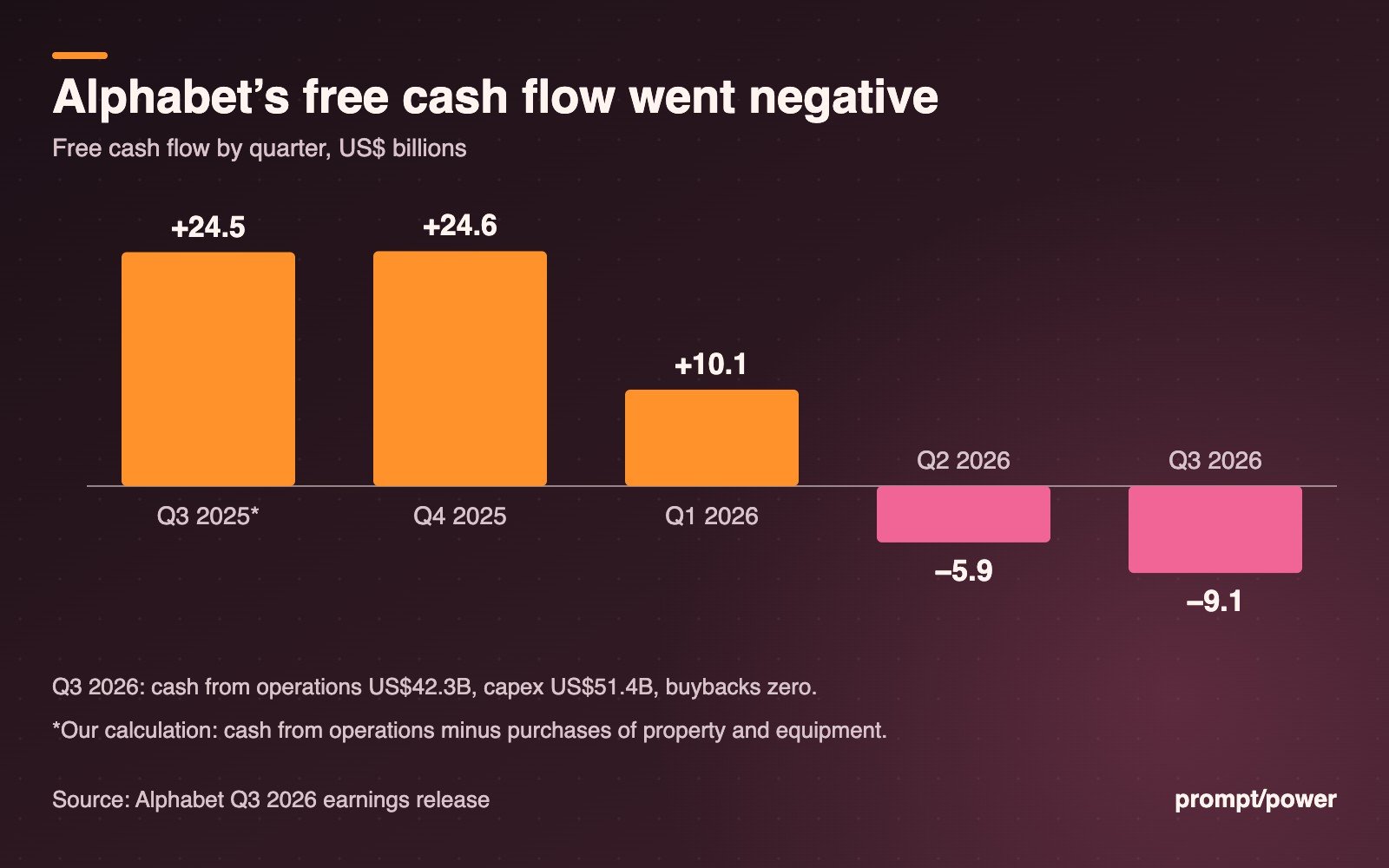
Operating cash flow fell 13% to US$42.29 billion while capital spending more than doubled from US$23.95 billion. The release puts free cash flow at minus US$9.07 billion, the second negative quarter in a row after minus US$5.86 billion in the second quarter. A year earlier it was about US$24.5 billion by our calculation. “We had negative free cash flow of $9.1 billion in the third quarter, driven by our investments in CapEx,” Ashkenazi said.
She said about 65% of the quarter’s technical-infrastructure spending went to servers and networking equipment and kept the 2026 capex range of US$195 billion to US$205 billion. Alphabet has spent US$131.95 billion through September, which leaves roughly US$63 billion to US$73 billion for the fourth quarter, by our math. For 2027, she said, “We continue to expect our CapEx to increase significantly.”
No buybacks, new shares and US$28.7 billion in bonds
A year ago Alphabet spent US$11.50 billion repurchasing stock in the third quarter. This year that line is zero, for the quarter and for 2026 so far. The release lists what came in instead:
- New stock: 12 million Class A shares for US$4.3 billion and 24 million Class C shares for US$8.1 billion, sold through an at-the-market program that still had US$27.6 billion of room on Sept. 30.
- Debt: senior unsecured notes for net proceeds of US$28.7 billion, “to be used for general corporate purposes.”
- Preferred stock: 6.25% mandatory convertible preferred shares, sold earlier in 2026 for about US$19.06 billion, carrying a quarterly dividend of US$15.63 a share payable Nov. 15.
Alphabet is not short of money. It ended September with US$265.1 billion in cash and marketable securities against US$125.1 billion of long-term debt. Our read: it is choosing to fund the build-out with outside capital rather than run down that pile, and selling shares is the reverse of the buybacks that used to soak up its spare cash. In the call transcript we read, no analyst asked about it. The common dividend stays at 22 cents a share, payable Dec. 14.
What it means for you
For shareholders, the old Alphabet deal (steady buybacks shrinking the share count) is on hold, and new shares now dilute existing holders. Alphabet is not alone in turning cash-negative: Meta’s third-quarter free cash flow fell to minus US$2.12 billion on Oct. 21. Microsoft’s results, also out Oct. 28, stayed positive at roughly US$18.6 billion by our math. Alphabet’s hole is the deepest of the three. More earnings coverage is on our business and startups page.
One pair of numbers sums up the turn. In the third quarter of 2025, Alphabet spent US$11.50 billion buying its own shares. In the third quarter of 2026, it sold US$12.4 billion of them.

James Whitfield covers hardware for prompt/power: chips, semiconductors, laptops, components and the benchmarks behind the launch-day claims. He thinks the most important number on any spec sheet is usually the one in the footnote.
Keep reading

Anthropic S-1 Explained: US$16.3B Revenue, US$80.7B Loss, Who Controls ANT

Amazon Promises 30,000 UK Entry-Level Jobs by 2030. What AI Means for Them

Netflix Cuts Its 2026 Ad Forecast to US$2.7B as Price Hikes Hold

Tesla Q3 Earnings: SpaceX Out-Earned It Nearly 4 to 1 as Merger Talks Begin
Latest from prompt/power
- SK hynix Memory Is Sold Out Through 2029. PCs and Phones Pay the PriceOct 29
- GPT-6.1 Terra Price: US$1 In, US$5 Out. What Agents Cost Now, and the CatchOct 29
- Australia’s Chatbot ‘Intimacy’ Ban Is for Kids Only. Canada’s Bill Isn’tOct 29
- Cohere Caught Qwen Trying a Beijing Upload. How to Lock Down AI AgentsOct 29
- Cloudflare’s AI Leaked Other Customers’ Data in 155 Replies. What to CheckOct 29
Leave a Reply