
PQ Wins Quebec: Montreal AI’s Bigger Risk Is Immigration, Not a Referendum
Look at the immigration section of the Parti Québécois platform before you look at the referendum section. Montreal’s AI cluster was built on graduate students and foreign researchers. The PQ, which won 59 of the National Assembly’s 127 seats on Oct. 5, has promised to cap international students at 50,000 and cut temporary immigration in half.

The sovereignty vote is the headline nationally. For founders, researchers and the investors who back them, it is the slower-moving problem.
Quebec election results: 59 seats, five short of a majority
Paul St-Pierre Plamondon’s party came back from three seats in 2022 to form a minority government, five short of the 64 needed for a majority, according to The Canadian Press. Charles Milliard’s Liberals took 40 seats and remain the Official Opposition. Éric Duhaime’s Conservatives won 19, Québec solidaire nine. The Coalition Avenir Québec, in power for eight years, was shut out entirely, and outgoing premier Christine Fréchette lost her own seat in Trois-Rivières.
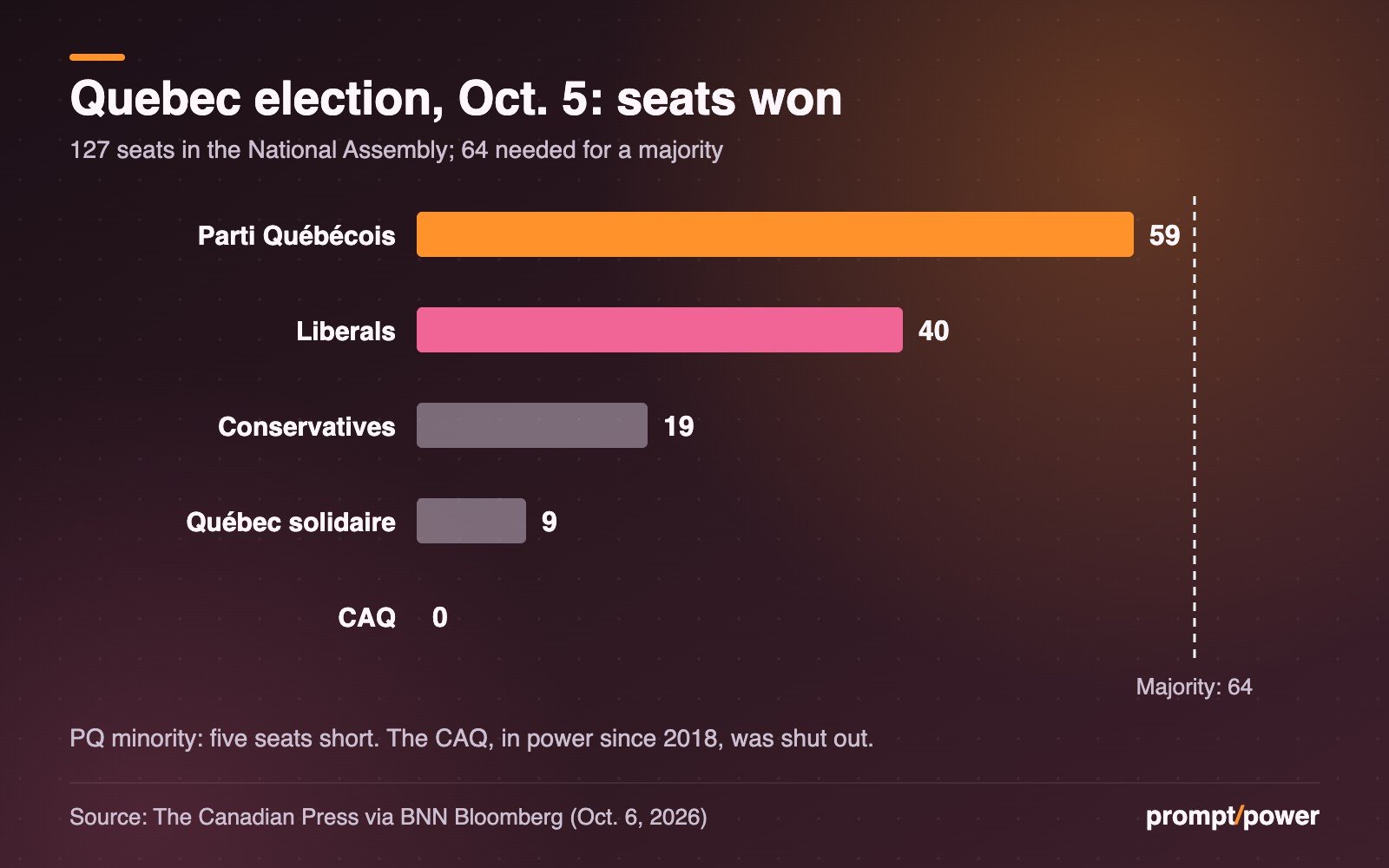
The PQ did it on about 28% of the vote, with the Liberals near 24% and the Conservatives near 21%, by CP’s count. The legislature grew from 125 to 127 seats for this election, which is why the majority line sits at 64.
On the referendum, St-Pierre Plamondon has promised one in his first term, but not while Donald Trump is in the White House. CTV’s platform tracker notes the party set aside CA$130 million for a vote after Trump’s term ends in January 2029. The premier-designate signalled no rush. “We’ve got time and we’ve got plenty of urgencies and problems to solve,” he said, Global News reported on Oct. 7. Québec solidaire’s Ruba Ghazal, whose nine seats the PQ may need, added a condition of her own: “If there is a single condition for independence, it is that the population wants it.”
What the bond market is pricing
Money is usually the fastest critic of a sovereigntist win. This time it shrugged. Quebec’s 30-year bonds traded a little more than 9 basis points above comparable Ontario debt as results came in on election night, up from about 7 two weeks earlier, money.ca reported, citing Bloomberg. During the 2014 campaign, which the PQ lost, that gap reached about 17.
“Clearly spreads would widen and perhaps rather sharply in a true referendum campaign.” Derek Holt, Scotiabank, in a report cited by Bloomberg, according to money.ca
Holt’s point is that the calm is conditional. Our read: a minority government that cannot hold a vote before 2029 gives investors a two-to-three-year window in which sovereignty is a scenario, not a deal term. BetaKit’s Madison McLauchlan reached a similar conclusion, writing that a referendum is very likely at least two years out.
PQ immigration caps and Montreal AI talent
Here is where the platform bites. According to CTV’s tracker, the PQ would:
- lower permanent immigration to 35,000 a year, from 45,000;
- cut non-permanent residents roughly in half, to 200,000 to 250,000 by the end of a four-year term;
- cap international students at 50,000 and the Temporary Foreign Worker Program at about 40,000;
- pause economic immigration in favour of selecting temporary residents already in Quebec.
None of those lines mentions AI. All of them touch it. Our read: Montreal’s university labs depend on international graduate students, and a startup that wants to hire a machine-learning engineer from Paris or Bangalore runs through exactly these programs. The PQ’s own 100-day plan, published Oct. 3, commits to tabling a new immigration plan with lower thresholds early in the mandate. A minority needs partners to pass it, and the details are where the sector will lobby hardest. Jean-François Harvey, who runs the Council of Canadian Innovators in Quebec, told BetaKit the sector wants “stability and predictability” and that the “devil is in the details.” The council is pushing immigration fast-tracks for skilled workers, a VC investment tax credit and procurement reform. Richard Chénier, CEO of Québec Tech, told BetaKit he wants clearer policies built for startups.
Mila, federal AI money and the PQ’s AI committee
The research money is less exposed than the talent pipeline, at least for now. Mila has two paymasters. Quebec’s outgoing CAQ government granted the institute CA$36 million on Feb. 27. Ottawa funds it as one of three national institutes under the Pan-Canadian AI Strategy, and in September federal AI minister Evan Solomon said Mila’s new mandate to lead the open-source part of the national strategy would come with funding “in the tens of millions,” BetaKit reported on Sept. 17. A sovereigntist premier and a federalist minister now both claim the same Montreal institute as a strategic asset. That is leverage for Mila, and a possible tug of war.
The PQ’s AI policy is mostly a process. On Sept. 24 the party promised an expert committee on AI drawing on Mila, IVADO and the Obvia observatory, with a first task, in St-Pierre Plamondon’s words, “de mesurer les conséquences de cette technologie” (to measure the consequences of this technology) in schools, workplaces, business and government. Pivot reported that the party also wants AI in the public service for efficiency, and that its blue book on independence argues Canada cannot speak for Quebec on AI internationally. That is the sovereignty question restated as tech policy, and it will come back in any referendum campaign.
Taxes, the Fonds and Quebec-headquartered companies
For companies already headquartered in Quebec, the near-term changes are fiscal. The PQ would cut the small and medium-sized business tax rate from 11.5% to 9.5%, which the party says saves a company with CA$5 million in taxable income about CA$90,000 a year, per CTV. It pays for that by scrapping the Fonds du développement économique, through which Investissement Québec administers aid to many SMEs, and by capping subsidies for foreign companies. A tax cut helps profitable firms. Most early-stage AI startups are not profitable, which is why losing the Fonds may matter more to them than the rate.
The premier-designate also plans a new secretariat for government efficiency and regulatory streamlining that will audit every government IT project in its first weeks, and he has said he will scrap failed CAQ projects including the SAAQclic licensing platform, CBC reported. For Quebec’s software and consulting firms, that audit is a procurement event worth watching.
What it means for you
- If you’re hiring in Montreal: lock in work permits and permanent-residency files you can move now. Thresholds are the first lever this government says it will pull.
- If you’re raising: expect investors to ask about 2029 in diligence, but the bond market is not yet pricing a near-term vote.
- If you depend on Investissement Québec aid: ask your account manager what replaces the Fonds du développement économique before the first budget.
Our pre-election coverage found that chatbots answering Quebec voters leaned on an AI-built voter guide. The next question for those same tools will be harder. The new legislature is due to open in November, and the immigration plan is the document Montreal’s AI labs will read line by line, looking for one number: 50,000.

Jeff Cameron writes about the business and policy side of AI for prompt/power. A chief operating officer by trade, he also writes for Not An Atlas.
Keep reading

Canada’s Instant-Payment Rail Is Coming. Big Six Banks Might Not Be on It

Uber and Pony.ai Robotaxis Head for London Tests. Here’s What’s Approved

Manus Raises More Than US$500 Million After China Blocked Meta’s Deal

Microsoft’s H-1B Green Card Freeze Puts Canada’s Promise to the Test
Latest from prompt/power
- Cohere Opens an Ottawa Office as Its AI Agents Head to Navy ShipsOct 11
- Beijing Warns Officials Off ‘Blind Investment’ in AI and High TechOct 11
- TSMC Q3 Revenue Beat Its Forecast: What to Watch in ASML and TSMC EarningsOct 11
- China Gave AI Influencer Yuri an Official ID. What It Unlocks for CreatorsOct 11
- Double Counter Discord Breach: What to Do If Your IP Address LeakedOct 11
Leave a Reply