
AI Victim Impact Video: Arizona Court Orders New Sentencing in Pelkey Case
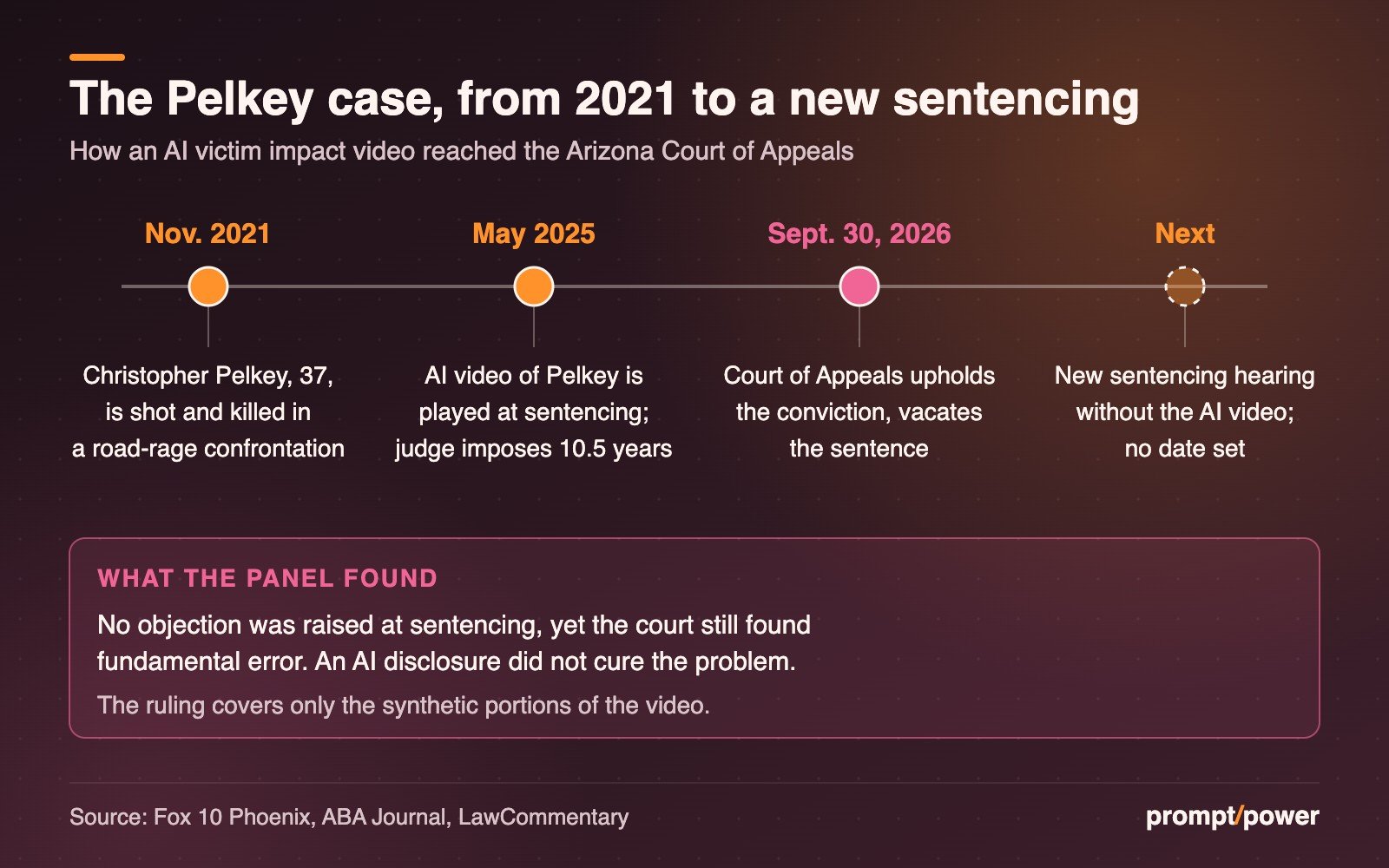
Christopher Pelkey was 37, an Army veteran, when he was shot and killed in a road-rage confrontation in November 2021. At the sentencing of the man convicted of his death, in May 2025, his family played a video in which an AI-generated likeness of Pelkey spoke about forgiveness and addressed the defendant directly, the ABA Journal reported. The judge, Maricopa County Superior Court Judge Todd Lang, said from the bench: “I love that AI. Thank you for that,” according to Fox 10 Phoenix. He imposed 10.5 years.
On Sept. 30, the Arizona Court of Appeals threw that sentence out.
What the Arizona Court of Appeals decided
The unanimous three-judge panel of Division One upheld Gabriel Paul Horcasitas’s manslaughter conviction and ordered a new sentencing hearing, LawCommentary reported. The court also rejected a separate challenge over text messages from Pelkey’s phone that had been excluded at trial, according to IBTimes UK.
The defence had argued that Horcasitas was denied due process because the judge “heard and expressly relied on an AI-generated video that recreated the victim’s appearance and voice,” Fox 10 reported. Prosecutors countered that the video was reliable because it “reflects what the victim’s sister believed the victim would have said.”
The panel was not persuaded. It noted that “no Arizona case has addressed the admissibility of an AI-generated depiction of a victim,” and found that “there is no question it played a role” in the sentence. The judge’s consideration of the video, the court wrote, “so prejudiced Horcasitas as to render the sentencing procedure fundamentally unfair,” as quoted by the ABA Journal.
Two technical points make the ruling sharper than it first looks. Nobody objected to the video at the hearing, so the panel reviewed it under the demanding “fundamental error” standard and still found the hearing unfair. And the AI disclosure that accompanied the video, LawCommentary reported, did not cure the reliability problem. The ruling reaches only the synthetic portions; genuine footage of Pelkey was treated differently.
Why an AI victim impact video is different from a photo
The core of the opinion is a distinction between grief and simulation. In the panel’s words, as reported by Forbes, the video presented “a depiction of the victim and his thoughts created from the imaginings of the victim’s sister,” and it “erases the interpretive distance between the family’s belief about what the victim would have said” and anything Pelkey himself said. A photograph shows who someone was. A synthetic voice speaking in the first person asserts what he thinks.
“Sentencing statements are subjective expressions, not objective proof.” Stacey Wales, Pelkey’s sister, as quoted by Forbes
Wales has defended the video. She told Forbes that, “when judged by what it purported to be,” it was “authentic and reliable,” that the court “drew an arbitrary line between media formats,” and that the video “was not evidence in the trial.” Speaking to Fox 10, she said, “We were disappointed of course,” and noted that Arizona’s Victims’ Bill of Rights “allows us the opportunity to speak in any manner.”
Gary Marchant, an Arizona State University law professor who sits on a committee drafting best practices for AI in courts, called the decision “prudent,” Forbes reported. Forbes also quoted him describing the statement as “borderline prejudicial because it is guessing what the victim would say.”
Our read: this is the first appellate court we know of to put a limit on AI recreations of victims at sentencing, and it did so without questioning the family’s right to speak. The line it drew is about authorship. Civil courts face a cousin of the problem, as in Japan’s voice-clone cases.
Victim impact statements in Canada: written, in your own words
Canada’s Criminal Code already answers much of this question in its structure. Under section 722(4), a victim impact statement “must be prepared in writing, using Form 34.2.” The court must let the victim present it by reading it, reading it with a support person nearby, reading it behind a screen, or “any other manner the court considers appropriate,” under section 722(5). Section 722(6) allows the victim, or someone presenting on their behalf, to bring “a photograph of themselves taken before the commission of the offence,” as long as it would not disrupt the proceedings.
Judges also strip out content that goes beyond harm and loss. Provincial guidance, such as Nova Scotia’s victim services guidelines, says statements should not include facts about the case, criticism of the offender’s character or expressions of vengeance, and should offer an opinion on sentence only with the court’s approval. Multimedia is not banned outright: in R v Denny, a 2016 Nova Scotia Supreme Court decision, the judge found that “a commemorative youtube video can be an acceptable form of community impact statement,” as summarized by Criminal Notebook, provided impermissible commentary is disregarded.
We found no Canadian ruling on an AI-generated victim speaking in the first person. The Code’s emphasis on a written statement and a pre-offence photograph suggests a Canadian judge would face the same authorship problem the Arizona panel identified.
What happens next in the Pelkey case
The case goes back to Maricopa County Superior Court for a new sentencing hearing, without the AI video. The appeals court did not decide what sentence Horcasitas should receive, and as of Oct. 5 it was not clear whether either side would seek review from the Arizona Supreme Court, IBTimes UK reported. No date has been set.
Pelkey’s family will be in that courtroom again. This time, the words spoken for him will have to be their own.

Felix Strauss covers tech policy and regulation for prompt/power, from Brussels and Ottawa to Washington and Sacramento. He reads the 400-page regulation so you don't have to, and highlights the one sentence that actually matters.
Keep reading




Latest from prompt/power
- Cohere Opens an Ottawa Office as Its AI Agents Head to Navy ShipsOct 11
- Beijing Warns Officials Off ‘Blind Investment’ in AI and High TechOct 11
- TSMC Q3 Revenue Beat Its Forecast: What to Watch in ASML and TSMC EarningsOct 11
- China Gave AI Influencer Yuri an Official ID. What It Unlocks for CreatorsOct 11
- Double Counter Discord Breach: What to Do If Your IP Address LeakedOct 11
Leave a Reply