Twenty companies, from Foxconn and Quanta to Infineon and Toronto’s Celestica, now face a U.S. trade investigation over the power hardware that sits beneath AI chips. The U.S. International Trade Commission voted on Oct. 9 to open Investigation No. 337-TA-1526 on a complaint from Vicor Corporation of Andover, Massachusetts, and published the notice in the Federal Register on Oct. 14. Vicor is asking for a limited exclusion order and cease-and-desist orders, which could keep infringing power modules, and the servers built around them, out of the U.S. The respondents get 20 days from service to answer.
We read the notice line by line. The detail that matters most is not the count of companies. It is that five of the 20 are U.S. and Taiwanese units that already lost an ITC case to Vicor last year.
Who Vicor named in the ITC complaint
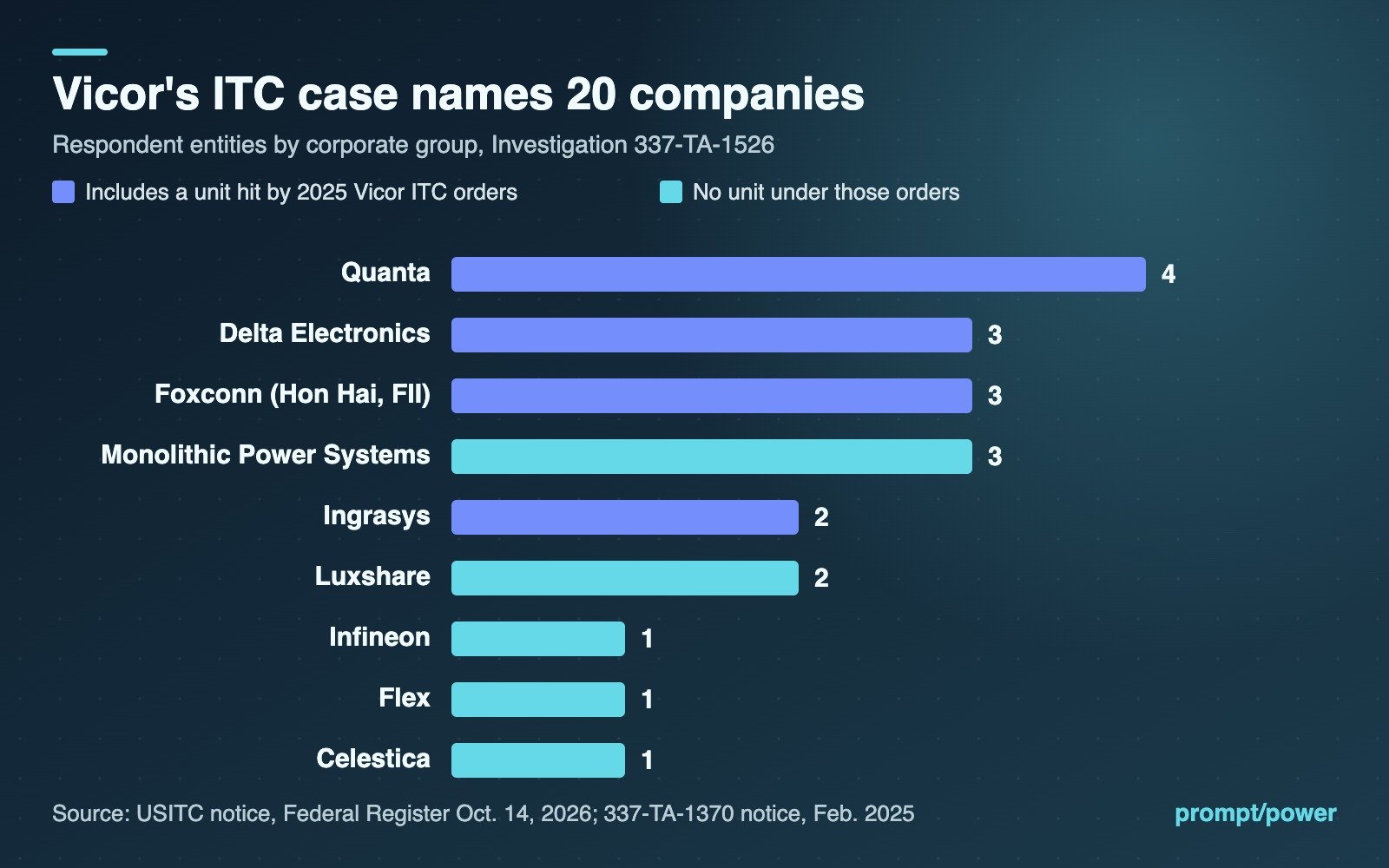
Vicor filed its complaint on Sept. 9 and supplemented it on Sept. 10. The notice lists every respondent with an address. Grouped by corporate family, it reads like a directory of who builds AI servers and their power stages:
- Quanta (four entities): Quanta Computer Inc., Quanta Cloud Technology Inc., Quanta Cloud Technology USA LLC and Quanta Computer USA Inc.
- Delta Electronics (three): Delta Electronics, Inc. of Taipei, Delta Electronics (Americas) Ltd. and DET Logistics (USA) Corporation, both in Fremont, California.
- Monolithic Power Systems (three): the Kirkland, Washington parent plus subsidiaries in Chengdu and Shanghai.
- Foxconn (three): Hon Hai Precision Industry, Foxconn Industrial Internet and FII USA Inc. of Milwaukee.
- Ingrasys (two), Luxshare (two), and one entity each for Infineon Technologies AG, Flex Ltd. and Celestica Inc.
By address, eight sit in the U.S., five in Taiwan, five in mainland China, one in Germany and one in Canada. That mix is the point. Chipmakers that design power stages (Infineon, Monolithic Power) sit on the same list as the contract manufacturers that bolt those parts onto AI server boards (Foxconn, Quanta, Celestica, Flex). Vicor is aiming at the component and the finished machine at once.
Celestica is the only Canadian company named. Its listed address is 5140 Yonge Street in Toronto.
What the ‘734 patent covers
The asserted patent is U.S. Patent No. 10,903,734, “Delivering power to semiconductor loads,” granted Jan. 26, 2021. Its sole listed inventor is Patrizio Vinciarelli, Vicor’s founder. It claims priority to April 5, 2016, and Google Patents estimates it expires June 2, 2036, so this is not an old patent near the end of its life.
The notice says Vicor asserts claims 1-8, 11-14, 18-26, 40-56, 65-71, 80, 81, 83, 84, 90-93 and 95. That is 54 claims, a wide net that makes it harder for a respondent to design around one narrow claim and walk away.
Here is the engineering in plain terms. A big AI accelerator runs on very low voltage and enormous current. The patent’s own background notes that a typical CPU can need more than 200 amps and a typical GPU more than 500, figures written years before today’s rack-scale AI parts. Pushing that much current sideways across a circuit board wastes power as heat. Vertical power delivery puts the final conversion stage directly underneath the processor, so current travels a short path straight up into the chip package.
The patent describes a converter built from many cells at a coarse spacing, paired with an “interconnection module” that translates it onto the finer grid of power contacts on the chip. Google Patents’ summary calls the result “vertical power delivery,” the same phrase in the investigation’s title.
The notice spells out the target: power systems “to power artificial intelligence (‘AI’) accelerators, tensor processing units (‘TPU’), graphical processing units (‘GPU’) and central processing units (‘CPU’).”
What an exclusion order could block
The scope paragraph covers “vertical power delivery systems and components thereof, used in data center server, artificial intelligence and cloud computing systems,” plus “computing systems containing the same.” The second phrase is the one buyers should read twice. A limited exclusion order applies only to products made by or for the named respondents, but it can reach the servers those parts go into, not just the parts.
No AI chip designer or cloud company is a respondent. But “TPU” in the scope language is Google’s name for its in-house AI chips (we covered them in orbit, of all places), and Vicor is plain about whom it wants at the table. In its Oct. 12 announcement, the company said OEMs and hyperscalers whose systems use the respondents’ vertical power components would need a Vicor license to import them, and that its royalty rates go up as the case moves toward an exclusion order. That is a licensing pitch delivered through a trade court.
The Commission also decided the government’s own litigators will sit this one out. “The Office of Unfair Import Investigations will not participate as a party in this investigation,” the notice says. The Chief Administrative Law Judge will assign the presiding judge; none is named yet.
Vicor already won this fight once
This is Vicor’s second swing at the AI server supply chain. In Investigation 337-TA-1370, the Commission voted on Feb. 13, 2025 to find a violation on two Vicor patents (Nos. 9,166,481 and 9,516,761) and no violation on a third. It issued a limited exclusion order covering “the unlicensed entry of infringing power converter modules and computing systems containing the same,” and cease-and-desist orders against Delta Electronics (Americas), FII USA, Ingrasys Technology USA, Quanta Computer and Quanta Computer USA.
All five of those entities are named again in the new case. The 2025 orders used the same “computing systems containing the same” language that now reappears, which tells you Vicor’s playbook: win on a module patent, then make the server assemblers carry the risk.
The respondents have mostly been quiet in public. Luxshare told investors it expects little negative impact, Reuters reported on Oct. 10, and BigGo Finance reported that the company said the products in question are not yet in mass production. We found no published statement from Foxconn, Quanta, Delta, Infineon, Monolithic Power, Flex or Celestica as of Oct. 16.
What it means for AI server buyers
Nothing is blocked today. An ITC case moves through discovery and a hearing before an administrative law judge, then Commission review and a 60-day presidential review window before any order bites. The 2025 case shows that path can end in real orders, though.
For anyone pricing AI capacity, the useful question is narrower than “will GPUs get banned.” It is which board in a given rack carries a vertical power module from one of these 20 companies, and whether its maker has signed a Vicor license. Every watt saved under the chip matters at data-centre scale, which is why AI’s electricity bill keeps pushing power stages closer to the silicon. More hardware coverage here.
The patent Vicor is suing on was filed on Dec. 12, 2018. The document’s own example of a hungry GPU drew 500 amps.

James Whitfield covers hardware for prompt/power: chips, semiconductors, laptops, components and the benchmarks behind the launch-day claims. He thinks the most important number on any spec sheet is usually the one in the footnote.
Keep reading


Latest from prompt/power
- Meta Q3 Earnings Oct. 21: The Capex, Ads and Cash Numbers to WatchOct 21
- Anthropic’s 5% Pledge Is Worth About US$48B. Here’s the Fine PrintOct 21
- Commons AI Study Meets Parliament’s Interpreter Math: 44 Passes in 5 YearsOct 21
- CNN All Access Canada Price Is CA$7.99. Americans Pay About 23% MoreOct 20
- DeepSeek Federal Ban: DHS Order Also Covers Apps Built on Its ModelsOct 20
Leave a Reply