The House of Commons has opened a study of artificial intelligence in Canada’s democratic institutions, and its first witnesses were the people who run the House itself. On Oct. 20 the Standing Committee on Procedure and House Affairs (PROC) heard from Clerk of the House Eric Janse and the two co-chairs of the House of Commons AI Working Group, then from the Canadian region of the International Association of Conference Interpreters (AIIC), according to the meeting notice. On Thursday, Oct. 22, MPs will question officials from the UK House of Commons and the Scottish Parliament by video. The interpreters were on the list for a reason: a federal briefing from March shows Parliament’s interpretation service running on 99 accredited people and an accreditation exam that passes fewer than one candidate in seven.
That briefing, prepared by Public Services and Procurement Canada (PSPC) for Minister Joël Lightbound’s March 12, 2026 appearance before the Board of Internal Economy, is the document to read alongside the witness list. We could find no published transcript of the Oct. 20 meeting, so this piece sticks to what the committee scheduled and what the government’s own numbers say.
Who PROC called for its AI study
The first hour belonged to the administration. Janse appeared with Natalie Foster, Clerk Assistant, and Christopher Henry, Director General of Digital Enablement and Innovation. Both are listed as co-chairs of the House of Commons AI Working Group. The second hour paired AIIC Canada president Alionka Skup and conference interpreter Marina Mistral, a member of the association’s Science Hub, with Franklin De Vrieze of the Westminster Foundation for Democracy, who joined by video.
The Oct. 22 notice for meeting 43 is the comparative half. It lists University of Waterloo assistant professor Anamaria Crisan, lawyer Kevin Deveaux and Sarah Lister of the United Nations Development Programme, followed by Sarah Davies, Clerk Assistant and Managing Director of the UK House of Commons’ Chamber and Participation Team; Luke Hussey, Director of Digital Value at the UK Parliamentary Digital Service; and Alistair Stoddart, Senior Participation Specialist at the Scottish Parliament. Every one of those Westminster and Holyrood witnesses is appearing by videoconference.
The study’s political backdrop arrived in September. The Economist reported that up to 20 per cent of what was said on the House floor had been flagged as AI-generated by the detection tool Pangram, The Canadian Press reported on Sept. 25, with MPs from both main parties split on whether that is a problem.
The interpreter shortage, in the government’s numbers
Here is what PSPC’s Translation Bureau told the board in March. It has 99 accredited interpreters for Parliament: 58 employees and 41 freelancers supplied by 39 firms under a standing offer. Before a new procurement tool took effect in January 2026, the briefing says, there were 75 resources under an open contract. Read plainly, the freelance bench went from 75 to 41.
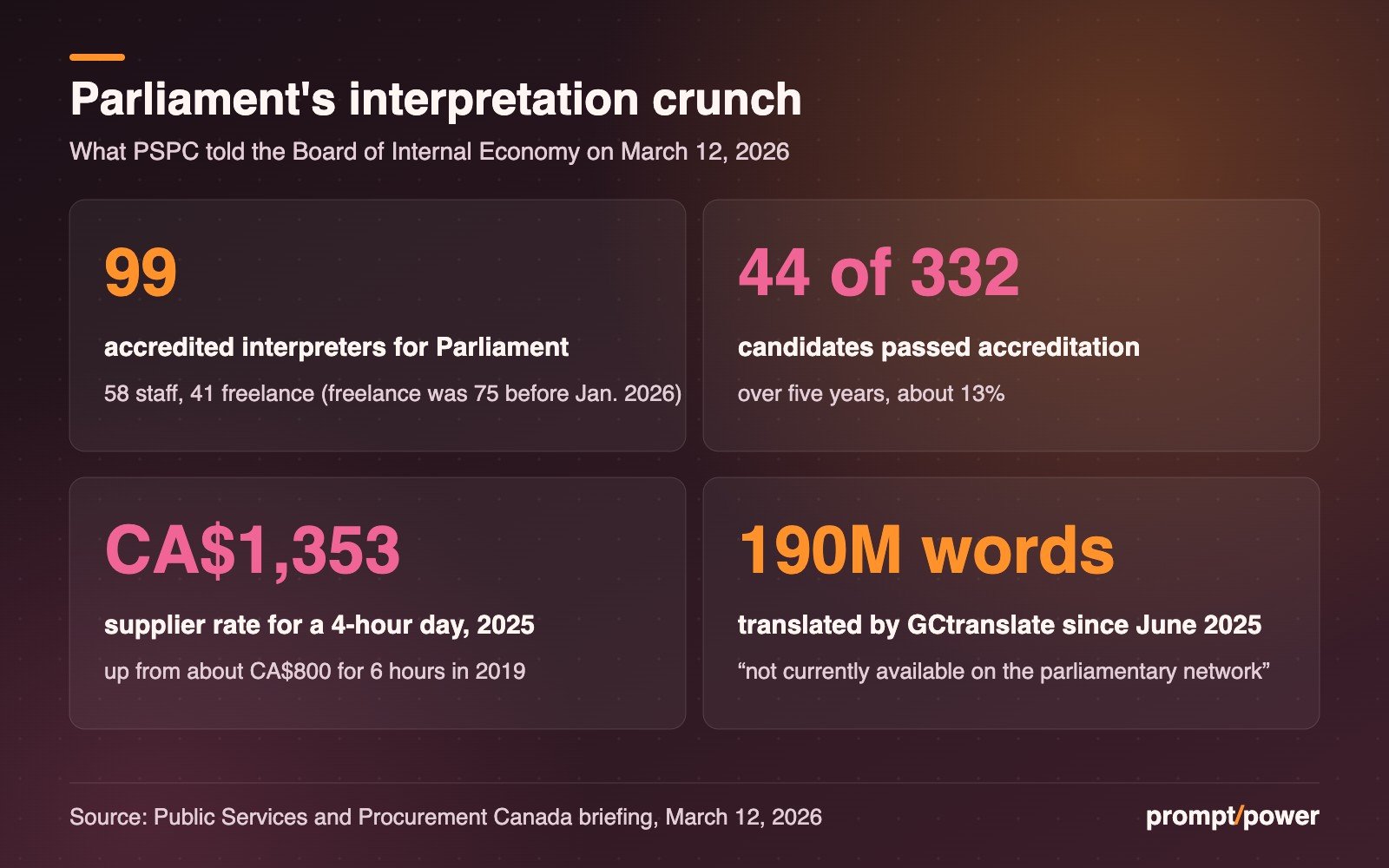
Supply into that pool is thin. Over five years, 332 candidates sat the accreditation exam and 44 passed, about 13%. The Nov. 7, 2025 sitting did slightly better: 10 of 60. The Bureau says it added two independent experts to the marking but that “the marking criteria, test format, and pass thresholds have not changed.”
Over five years, 332 candidates sat Parliament’s interpretation exam. Forty-four passed.
The money has moved the other way. Supplier rates rose from about CA$800 for a six-hour day in 2019 to about CA$1,353 for a four-hour day in 2025, plus a 25% bonus when a meeting is broadcast. PSPC calls that an increase of nearly 70%. Per booked hour, our calculation, it is steeper: about CA$133 then, about CA$338 now, roughly two and a half times as much. The shorter day sits in the briefing’s health and safety section, not its pay section. Interpreters’ working time in virtual and hybrid meetings is capped at four hours, and the briefing notes that sound-related risks such as feedback “persist,” even after acoustic incidents fell about 75% between 2020 and 2024.
The Bureau received nearly CA$49 million in 2025–26 for parliamentary interpretation and translation and delivered 20,000 hours of official-languages interpretation in 2024–25.
GCtranslate is not on Parliament’s network
This is where AI enters the government’s own paperwork. GCtranslate, which the briefing calls the Government of Canada’s first AI-assisted translation tool, had translated more than 190 million words (roughly 547,000 pages) since June 2025 and was being tested in seven federal organizations. Wider deployment was planned for April 2026, with full rollout by March 31, 2027.
Parliament was not part of it. GCtranslate is “not currently available on the parliamentary network,” the briefing says. Instead, the Translation Bureau has worked with the National Research Council of Canada on AI tools for its own translators doing parliamentary work. On interpretation, the live spoken kind, the Bureau says it is evaluating AI for preparation, audio quality and real-time assistance, while acknowledging “the limits of automation.” Among options to avoid future deficits, it lists reviewing its agreements with the House and Senate and “using AI to increase productivity.”
Our read: that last line is why AIIC was at the table. When the agency that pays for interpretation names AI as a cost lever, the people doing the interpreting have every reason to want it on the record, before anyone treats machine output as good enough for a bilingual chamber. We have not seen what Skup or Mistral told MPs, and we won’t guess.
What to watch at Thursday’s UK and Scotland session
- House rules for AI. How the UK and Scottish parliaments govern AI use by staff and members, set against whatever the Commons working group told MPs on Oct. 20.
- The network question. A government AI translation tool that the parliamentary network couldn’t use in March is a concrete gap MPs can ask the UK Parliamentary Digital Service how it handles.
- Interpretation versus translation. Text tools like GCtranslate and live interpretation are different problems. Watch whether witnesses keep them apart.
- The evidence. The committee’s official transcript of the Oct. 20 meeting, once posted, is the record to quote.
For Westminster’s own direction on AI oversight, see our report on the UK’s AI security plan. Parliament’s last tech fight over what software can be compelled to do was Bill C-22 and Signal. More in our policy coverage.
One number from the March briefing sits underneath all of it. In 2024–25, freelance interpreters working for Parliament averaged 3.27 hours a day, inside a four-hour ceiling for virtual and hybrid meetings. The briefing’s AI plans for that booth stop at preparation, audio quality and real-time assistance.

Felix Strauss covers tech policy and regulation for prompt/power, from Brussels and Ottawa to Washington and Sacramento. He reads the 400-page regulation so you don't have to, and highlights the one sentence that actually matters.
Keep reading


Latest from prompt/power
- Meta Q3 Earnings Oct. 21: The Capex, Ads and Cash Numbers to WatchOct 21
- Anthropic’s 5% Pledge Is Worth About US$48B. Here’s the Fine PrintOct 21
- CNN All Access Canada Price Is CA$7.99. Americans Pay About 23% MoreOct 20
- DeepSeek Federal Ban: DHS Order Also Covers Apps Built on Its ModelsOct 20
- Google Magic State Cultivation Explained: What Willow Fixed, What It Didn’tOct 20
Leave a Reply