Meta Q3 Earnings: A US$64.6B Beat, US$34.9B of Capex and Negative Cash Flow

Meta reported third-quarter 2026 revenue of US$64.60 billion on Oct. 21, up 26% from a year earlier and above the top of the US$61 billion to US$64 billion range it had promised in July. But it spent US$34.91 billion on capital expenditures in the quarter, more than it generated in operating cash, and free cash flow turned negative at minus US$2.12 billion. Those figures come from Meta’s earnings release, issued at 4:01 p.m. ET that day. Meta also narrowed its 2026 capex range upward again, to US$135 billion to US$145 billion, and guided to fourth-quarter revenue of US$73 billion to US$76 billion.
Profit fell, and not only because of the spending. Operating income dropped 37% to US$12.99 billion after a US$9.89 billion charge tied to Meta’s August agreement with 52 state attorneys general over teen mental health litigation. Diluted earnings were US$3.83 a share. Excluding the charge, Meta says, they would have been US$7.40.
Ahead of the results, our Meta Q3 preview laid out each benchmark Meta set for itself in its July 29 second-quarter release. Here is how it scored against every one.
Meta Q3 2026 earnings vs its own guidance
| What Meta promised in July | What it reported Oct. 21 | Verdict |
|---|---|---|
| Q3 revenue of US$61B to US$64B | US$64.60B, up 26% | Beat the top end by about US$600M |
| About a 1% foreign-exchange headwind | Growth was 26% with or without currency effects | Smaller headwind than planned |
| 2026 total expenses of US$165B to US$169B | Now US$175B to US$179B | Raised by the US$9.9B legal charge; otherwise unchanged |
| 2026 capex of US$130B to US$145B | Now US$135B to US$145B | Floor raised for the third time this year |
| Tax rate of 15% to 17% for the rest of 2026 | 24% in Q3, 17% excluding the charge | At the top of the range on Meta’s adjusted basis |
| 2026 operating income above 2025 | Still expected, but now “excluding” the Q3 legal charge | Promise kept with an asterisk |
The last row is the one to read twice. In July, Meta said flatly that it expected 2026 operating income above 2025’s. The October release keeps that expectation only after setting aside the US$9.89 billion charge. Reasonable for a one-time item, but a quiet change to a promise investors were holding Meta to.
Meta capex: US$34.9B in a quarter, and a US$49B-plus Q4
Capex in the release counts purchases of property and equipment, US$33.94 billion, plus principal payments on finance leases, US$964 million. That is US$34.91 billion for the quarter and about US$85.8 billion for the first nine months.
Our math: to land at US$135 billion to US$145 billion, Meta needs to spend roughly US$49 billion to US$59 billion between October and December. Its largest quarter so far was the third, at US$34.91 billion.
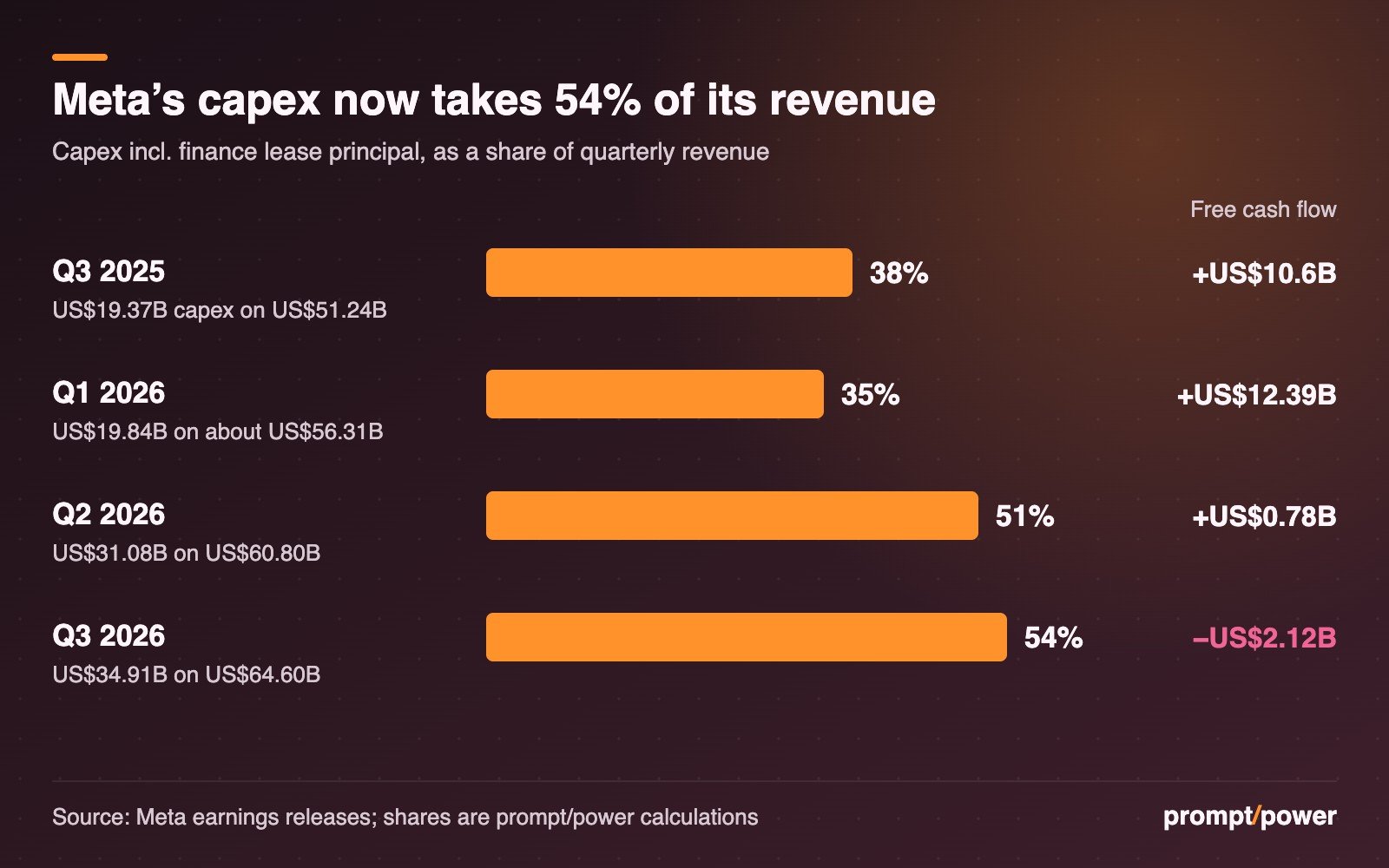
Capex is also eating a larger share of every dollar Meta earns. These are our calculations from Meta’s releases:
- Q3 2025: US$19.37 billion of capex on US$51.24 billion of revenue, about 38%.
- Q1 2026: US$19.84 billion on about US$56.31 billion (derived from Meta’s nine-month total), about 35%.
- Q2 2026: US$31.08 billion on US$60.80 billion, about 51%.
- Q3 2026: US$34.91 billion on US$64.60 billion, about 54%.
In Canadian dollars, at the Bank of Canada’s Oct. 19 rate of CA$1.4097, the new range is about CA$190 billion to CA$204 billion.
Meta spent about 54 cents of every revenue dollar on capex in the third quarter. A year ago it was 38 cents.
Free cash flow turned negative
Our preview flagged free cash flow as the number to read first, after it fell to US$784 million in the second quarter. It has now gone below zero. Operating cash flow was US$32.79 billion, up from US$30.00 billion a year earlier, but capex outran it, leaving free cash flow at minus US$2.12 billion against plus US$10.6 billion in the third quarter of 2025.
Meta bought back no stock for a second straight quarter, against US$3.33 billion a year earlier, and paid US$1.36 billion in dividends and dividend equivalents. Cash, cash equivalents and marketable securities fell to US$82.45 billion at Sept. 30, from US$90.26 billion at the end of June. Long-term debt rose to US$80.92 billion, from US$58.74 billion at the end of 2025.
Meta is paying for the AI buildout partly with borrowed money and partly from its cash pile, while its headcount fell 15% from a year earlier to 66,775. On the call, CFO Susan Li said the total was down 12% from the second quarter “following the May 2026 headcount reduction.”
The ad business is still carrying it
Demand is not the problem. Advertising revenue rose 26% to US$63.06 billion. Ad impressions grew 10% and the average price per ad rose 14%: fewer new ad slots, each worth more. Family daily active people averaged 3.64 billion in September, up 3%.
Family of Apps operating income was US$17.12 billion, down from US$24.97 billion. Reality Labs lost US$4.13 billion, slightly less than a year ago. Meta expects Reality Labs to lose US$18 billion to US$19 billion in 2026 and about US$15 billion in 2027.
Mark Zuckerberg framed the quarter around the AI push: “We hit major milestones this quarter toward delivering personal superintelligence for everyone,” he said in the release. Meta has started charging for that work, as our look at Muse Wonder’s API pricing showed, but the release does not break out AI revenue separately from advertising.
What Meta said on the call: no 2027 capex number
The release gave no capex figure for 2027, and Li would not supply one on the evening call. “We are still developing our budget and capacity plans for next year,” she said, according to a transcript of the call, adding that Meta did “not have anything more specific or quantitative to share until we get to the Q4 call.” The release itself says only that Meta expects “to continue investing aggressively” and is “not providing a full-year 2027 revenue outlook.”
That is a break from last year, when Meta used its third-quarter release to warn that capex dollar growth would be “notably larger” the following year. Anyone wanting a ceiling on 2027 spending has to wait for the fourth-quarter call.
Zuckerberg did give one product number. “More than 10 million people in the US and Canada have set up Muse personal agents,” he said on the call, and about 25% of them use it on a given day. Muse has not launched elsewhere; he cited the compute it needs.
What else was in the release
- A new share class. Meta’s board approved a publicly listed, non-voting Class C stock, to be issued as a dividend of one Class C share for each Class A and Class B share, with an effective date of Jan. 19, 2027. Meta says it expects the Class A price to reflect the equivalent of a two-for-one split and that “the stock dividend will not change the voting power of any shareholder.” The release also says Meta “entered into a Founder Alignment Agreement” with Zuckerberg covering his sales of the Class C shares he receives; it does not give the terms, and we have not yet read the related SEC filing. Li said on the call there are no “specific financing plans to announce at this time.”
- Legal exposure. The attorneys-general agreement provides for payments of up to about US$18.59 billion, of which US$9.89 billion was charged in the third quarter. Meta still has several US youth-related trials scheduled in the coming months, the release says.
We have also reported on how Meta classifies AI data centres as research for tax credits. More earnings coverage is on our business and startups page.
A year ago, Meta’s third quarter turned US$19.37 billion of capex into about US$10.6 billion of free cash flow. This year it spent US$34.91 billion and finished US$2.12 billion short.

Marcia Okonkwo covers the business of technology for prompt/power: venture capital, startups, IPOs and earnings. She treats a valuation as a mood rather than a number until the S-1 says otherwise.
Keep reading

Meta Q3 Earnings Oct. 21: The Capex, Ads and Cash Numbers to Watch

Anthropic’s 5% Pledge Is Worth About US$48B. Here’s the Fine Print

Bumble Buyout: Ithaca Holdings Pays US$6.05 a Share, a 138% Premium

Amazon Eyes Decart for US$7B as Nvidia Weighs Buying Reflection AI
Latest from prompt/power
- OpenAI Is on Google Cloud Now. Where GPT-6 Actually Runs, Cloud by CloudOct 22
- Apple ‘Pro and Tell’ Oct. 28: What’s Confirmed and What’s Only RumouredOct 22
- Tesla Q3 Earnings: SpaceX Out-Earned It Nearly 4 to 1 as Merger Talks BeginOct 22
- PHP2Shell: Ottawa Pulled Websites Offline. Here’s What to Patch NowOct 22
- Ofcom Fines Tismi £437,500 for Leaving 366,000 Numbers Open to ScammersOct 22
Leave a Reply