The AI uses Europe has banned, and why they matter if you live in Canada or the U.S.
Since Feb. 2, 2025, the EU has banned eight AI practices, from social scoring to emotion inference at work and school. What's on the list and what it means outside Europe.


Most debates about AI rules are about the future. In the European Union, a short list of uses has been illegal since Feb. 2, 2025. They’re worth knowing even if you live in Toronto or Texas, because the companies that build workplace software, cameras and chatbots sell into Europe, and the EU’s list has become a reference point for what many people think AI shouldn’t do.
The eight banned practices
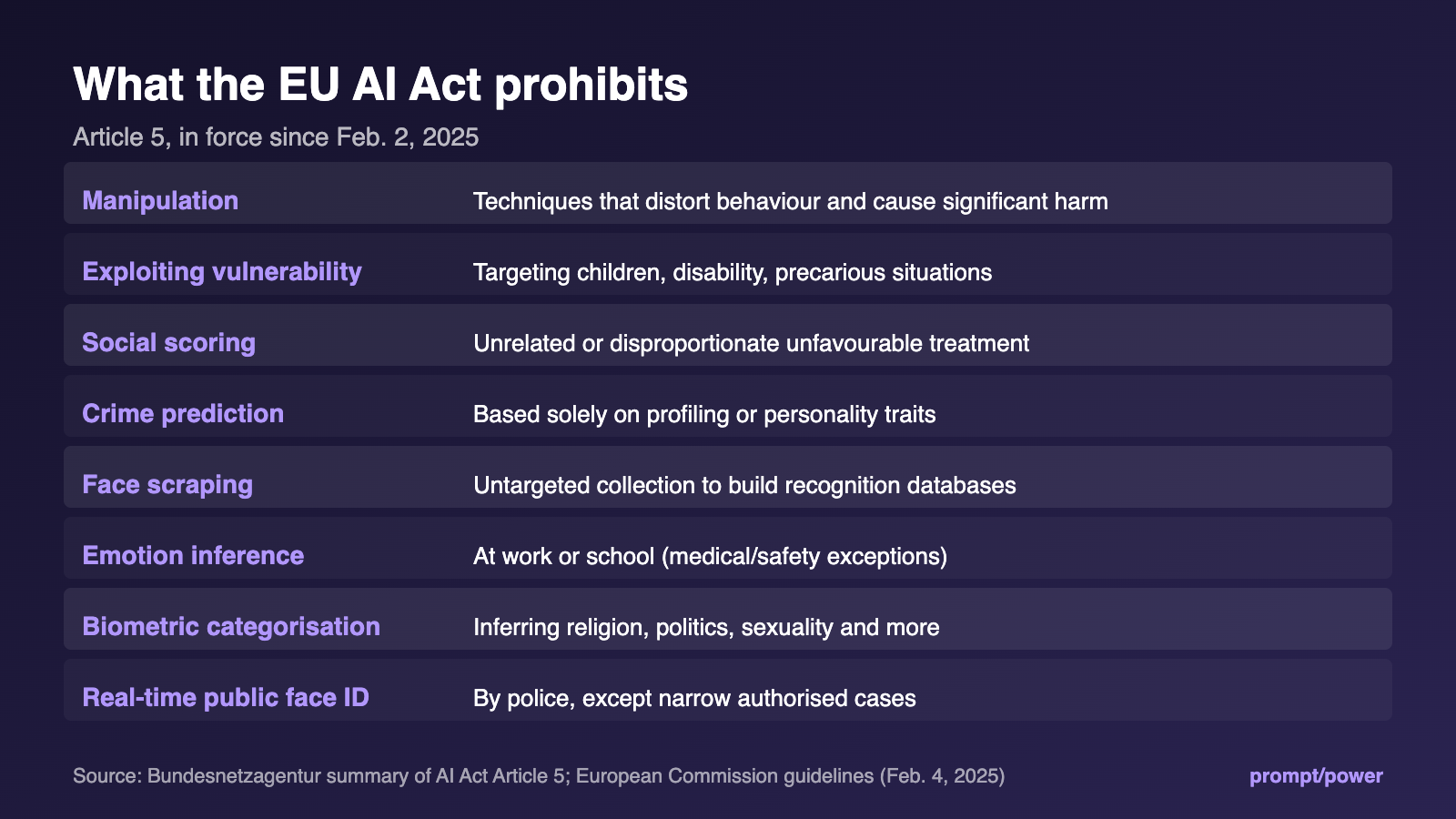
Article 5 of the EU AI Act prohibits the following, as summarised by Germany’s Federal Network Agency (Bundesnetzagentur), which oversees AI rules there:
- Harmful manipulation and deception: subliminal or deceptive techniques that materially distort behaviour and cause or are likely to cause significant harm.
- Exploiting vulnerabilities: targeting people because of age, disability or a precarious social or economic situation.
- Social scoring: rating people on social behaviour or personal traits in a way that leads to unrelated or disproportionate unfavourable treatment.
- Predicting crime from profiling alone: assessing someone’s likelihood of offending based solely on profiling or personality traits.
- Untargeted face scraping: building facial recognition databases by harvesting images from the internet or CCTV.
- Emotion inference at work and in education.
- Biometric categorisation to infer sensitive traits such as ethnicity, political opinions, union membership, religion, sex life or sexual orientation.
- Real-time remote face identification in public by police, except in narrow, authorised cases such as searching for abduction victims or preventing an imminent terrorist threat, and only where national law provides for it.
The emotion ban, up close
The ban on inferring emotions at work and in schools is the one most likely to touch ordinary software. Tools that score how engaged employees look on video calls, or how attentive students seem, appear to fall within its scope. There’s an exception for medical or safety reasons, such as therapeutic uses. The ban applies in workplaces and education, so emotion analysis in other settings is treated differently under the Act.
What it doesn’t settle
The European Commission published non-binding guidelines on the prohibited practices on Feb. 4, 2025, available in all EU languages since July 29, 2025. Only the EU’s Court of Justice can give a binding interpretation, and many of the lines, such as what counts as “significant harm,” will be drawn case by case. Breaches of the prohibitions carry the Act’s highest fines.
Why it matters in North America
Canada and the U.S. have no equivalent federal list. But a vendor selling emotion-scoring to a multinational has to switch it off for European staff, and some vendors may find it simpler to change the product everywhere. If your employer or your child’s school uses software that claims to read emotions, it’s fair to ask whether the same product is sold in Europe, and what it does differently there.
More from prompt/power: AI therapy chatbots: the rules · Australia’s chatbot rules for children · Bill C-22, explained
Researched and drafted with AI tools, fact-checked against primary sources and approved by a human editor before publishing. Prices and dates are as of publication. Our standards →

Keep reading




Latest from prompt/power
- Anthropic’s charity math: a US$82-billion benefit fund, an 80% founder pledge that isn’t binding, and a shrinking employee matchNov 22
- Britain’s AI Growth Zones: where they are, what they get, and how the money is stackedNov 22
- Is that Black Friday ‘regular price’ real? The rules in Canada, the U.S. and the U.K., and how to checkNov 21
- How to read an IPO prospectus in 10 minutes, using Anthropic’s as the exampleNov 20
- ChatGPT Pro, Claude Max or Google AI Ultra? What CA$140 a month buysNov 20