Do clocks go back in November 2026 in B.C., Alberta and Manitoba? No. When Ontario, Quebec and most of Atlantic Canada fall back one hour at 2 a.m. on Sunday, Nov. 1, most of British Columbia and all of Alberta and Manitoba keep their clocks where they are, permanently. From that morning, Winnipeg shows the same time as Toronto, Calgary sits one hour behind it and Vancouver two. Updated phones and Macs should handle it on their own, Windows PCs need Microsoft’s Oct. 13 Patch Tuesday update, and the gadgets that quietly apply old daylight-time rules are the ones to watch.
Three provinces made the call in seven months. That compressed timeline is why software is still catching up, and why this guide exists.
Do clocks go back in November 2026? Province by province
British Columbia went first. Premier David Eby announced on March 2 that the March 8 spring-forward would be the province’s last time change, bringing into force a 2019 law that had sat on the shelf waiting for U.S. states to move. The province’s official daylight-time page says clocks will not change on Nov. 1 and the new zone, called Pacific time (PCT), is UTC-7 year-round. There are exceptions. The Peace River region (Dawson Creek, Fort St. John, Fort Nelson) was already on UTC-7 all year, so nothing changes there. The East Kootenay (Cranbrook, Fernie, Invermere, Kimberley) stays on UTC-6 to match Alberta. Golden makes one last change on Nov. 1, then sits at UTC-7.
Alberta followed. The government’s page on Alberta’s new time system renames what used to be Mountain Daylight Time as Alberta Time (ABT), fixed at UTC-6, and says that “beginning in November 2026, clocks will no longer reset to Mountain Standard Time.”
Manitoba was last, and latest. The province announced on Sept. 17 that it will stay on daylight time permanently, leaving roughly six weeks of lead time.
“We heard from Manitobans loud and clear – no more changing the clocks in Manitoba.” Premier Wab Kinew, Sept. 17
The rest of the country splits the usual way. Saskatchewan and Yukon already skip the twice-yearly change, while Ontario, Quebec (except the Lower North Shore), the four Atlantic provinces and most of Nunavut fall back on Nov. 1, according to Moving2Canada’s provincial rundown. So does the U.S., which means Vancouver ends up one hour ahead of Seattle all winter.
New time zones after Nov. 1: Toronto, Winnipeg, Calgary, Vancouver
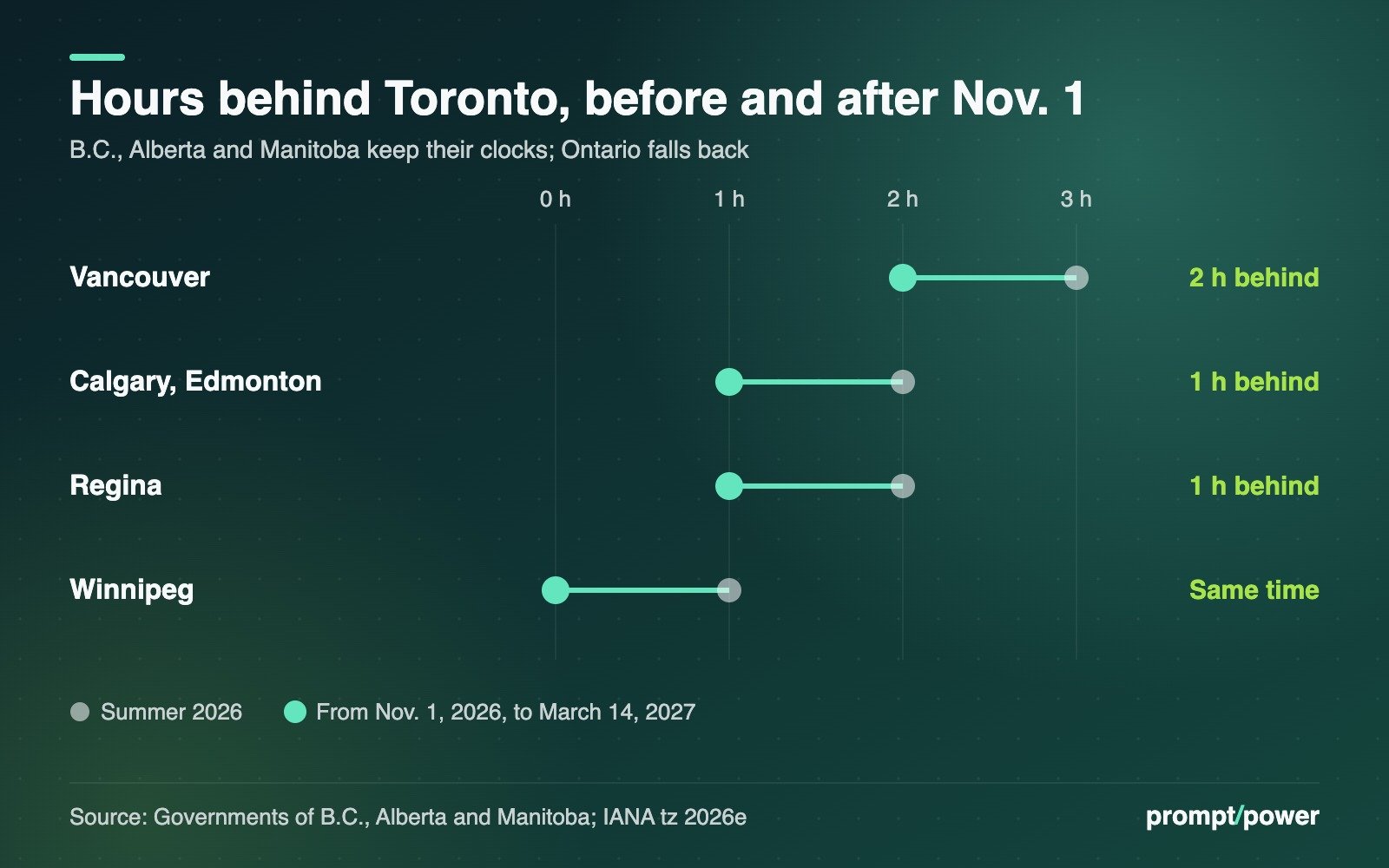
The clocks in the West stand still, but the gaps move, because the East falls back to meet them. Here is the country at noon in Toronto on Nov. 2.
| City | UTC offset from Nov. 1 | When it’s noon in Toronto |
|---|---|---|
| Seattle | UTC-8 | 9 a.m. |
| Vancouver, Whitehorse | UTC-7 | 10 a.m. |
| Calgary, Edmonton, Regina, Cranbrook | UTC-6 | 11 a.m. |
| Winnipeg | UTC-5 | Noon |
| Toronto, Montreal | UTC-5 | Noon |
| Halifax | UTC-4 | 1 p.m. |
| St. John’s | UTC-3:30 | 1:30 p.m. |
Calgary and Regina now share a clock all year. Winnipeg and Toronto match from Nov. 1 until Ontario springs forward on March 14, 2027, when Winnipeg drops back to one hour behind, Calgary to two and Vancouver to three. The twice-a-year shuffle hasn’t disappeared. It has moved east.
One open question: northwestern Ontario communities that have long followed Winnipeg time. The Internet Assigned Numbers Authority’s time zone database, the file nearly every phone and computer relies on, says in its Sept. 29 release 2026e that it is not yet known whether they will follow Manitoba. That same release moves Manitoba to permanent UTC-5 and labels it with the traditional abbreviation EST, so don’t be alarmed if your phone in Winnipeg suddenly says “Eastern.”
Windows PCs: install the October update, or use this workaround
Microsoft shipped the fix with its Oct. 13 Patch Tuesday release. Windows Report’s rundown of the release notes says KB5127648, for Windows 11 versions 24H2, 25H2 and 26H2, “introduces the new UTC-05:00 Manitoba time zone,” and that KB5126653 for Windows 11 23H2 adds the same zone and enables permanent daylight time for British Columbia and Alberta. Microsoft has also posted interim guidance for Manitoba and British Columbia on its time zone blog.
To check: Settings > Windows Update > Check for updates, install, restart. Then in Settings > Time & language > Date & time, Manitobans should pick “(UTC-05:00) Manitoba.”
If you can’t patch yet (a locked-down work laptop, say), WindowsForum’s workaround for Manitoba is to turn off “Set time zone automatically,” choose “Eastern Time (US & Canada)” and switch off “Adjust for daylight saving time automatically.” That pins the PC at UTC-5. Swap it back to the Manitoba zone once the update lands. By the same logic, an unpatched machine in Calgary could sit on “(UTC-06:00) Saskatchewan” and one in Vancouver on “(UTC-07:00) Arizona,” since neither zone observes daylight time. That last part is our suggestion, not Microsoft’s.
iPhone, Mac and Android: mostly automatic, with caveats
Apple delivers time zone rules as a background download. In May, iPhone in Canada reported that Canadian iPhones received an “Updated Time Zone Information Available” notice tied to the B.C. and Alberta changes, which applies after a restart. If you see it, restart. Then confirm Settings > General > Date & Time > Set Automatically is on.
It hasn’t been flawless. Some B.C. iPhone owners spent the spring watching their phones flip to Edmonton time, the same site reported; the stopgap was to turn Set Automatically off and pick Vancouver by hand. If you do that, remember to turn it back on, or your phone won’t change zones when you travel.
On Android, Google’s help page puts the switches in the Clock app: More > Settings > Change date and time, then turn on “Automatic date and time” and “Automatic time zone.” Some devices use your location to pick the zone; Wi-Fi-only tablets rely on it entirely. Keep system updates current, since that is how new zone rules arrive.
Calendars, Outlook and the gadgets that won’t update
Classic Outlook for Windows takes its time zone definitions from Windows itself, so reinstalling Outlook won’t fix a wrong label; patching Windows will. That advice comes from an independent advisor on Microsoft’s Q&A forum, not from Microsoft. Recurring meetings set up across provinces deserve a look in the first week of November: a standing 9 a.m. Winnipeg-to-Toronto call that used to be an hour apart is now simultaneous.
The real risk sits in hardware that applies daylight-time rules by itself but never gets updates. A B.C. IT firm, Asher Tech, warns that most embedded and smart-home devices don’t receive time zone data updates, and that point-of-sale and building systems may need vendor firmware. Our read: older car head units, thermostats, security cameras and cable boxes are the likeliest to jump back an hour on Nov. 1 anyway.
What to do before Nov. 1
- Update everything with a screen. Windows Update, iOS and macOS updates, Android system updates. Restart when asked.
- Check automatic time is on on phones, tablets and computers.
- On Windows in Manitoba, select “(UTC-05:00) Manitoba” after patching, or use the Eastern-time workaround until you can.
- Audit recurring cross-country meetings for the week of Nov. 2.
- On Nov. 1, check the gadgets that set their own time: car, thermostat, cameras, smart displays. If one fell back, set it by hand or turn off its automatic daylight-time option.
And leave the stove alone. In Vancouver, Calgary and Winnipeg, the microwave clock you set by hand in March is, for once, the one clock in the house guaranteed to be right on Nov. 1.
More practical guides live in our software section, including what breaks when Reddit kills RSS on Nov. 13 and our explainer on setting up passkeys on every device.

David Mensah covers software and platforms for prompt/power: apps, browsers, developer tools and the open web. He firmly believes every "simple" settings menu is hiding a second, worse settings menu.
Keep reading




Latest from prompt/power
- Meta Q3 Earnings Oct. 21: The Capex, Ads and Cash Numbers to WatchOct 21
- Anthropic’s 5% Pledge Is Worth About US$48B. Here’s the Fine PrintOct 21
- Commons AI Study Meets Parliament’s Interpreter Math: 44 Passes in 5 YearsOct 21
- CNN All Access Canada Price Is CA$7.99. Americans Pay About 23% MoreOct 20
- DeepSeek Federal Ban: DHS Order Also Covers Apps Built on Its ModelsOct 20
Leave a Reply