
Isomorphic Labs has not yet put one of its drugs into a human being. Investors may value it at US$40bn (about £30bn) anyway.
The London company, spun out of Google DeepMind in 2021 to turn AlphaFold’s protein-structure predictions into medicines, is in early talks to raise new money at a valuation of at least US$40bn, Bloomberg reported on Oct. 8, citing people familiar with the matter. One person said the figure could reach US$50bn (about £37bn). The financing hasn’t closed, the terms could change, and the report did not say how much Isomorphic is trying to raise or name the investors in the talks, according to Runtime Wire’s summary of the Bloomberg story. None of the coverage we reviewed carried a comment from the company.
Isomorphic Labs valuation talks come five months after its last round
The timing is what makes the number jump off the page. On May 12, Isomorphic announced a US$2.1bn (about £1.6bn) Series B led by Thrive Capital. Alphabet and its venture arm GV returned, and MGX, Temasek, CapitalG and the UK’s Sovereign AI Fund came in as new backers. The company never published the valuation. City AM puts it at about US$17.5bn, which would mean the price more than doubled in five months if the new talks land at the floor Bloomberg reported.
Before May, the only disclosed outside money was a US$600m round in March 2025, also led by Thrive. Add the two and Isomorphic has raised about US$2.7bn from outside investors, not counting years of support from Alphabet, which remains its majority owner.
What a US$40bn price tag is actually buying
There is no revenue figure in any of the reporting. What investors can see is a lineage and a set of contracts.
The lineage is the Nobel kind. Chief executive Sir Demis Hassabis shared the 2024 chemistry prize for AlphaFold, part of the year neural networks swept two Nobels, and Isomorphic was set up to push that work from predicting protein shapes to designing molecules that bind to them. In January 2024 it signed deals with Eli Lilly and Novartis: US$45m upfront from Lilly with up to US$1.7bn in milestones, and US$37.5m upfront from Novartis with up to US$1.2bn more. Together that is close to US$3bn (about £2.2bn) if every target is hit, plus royalties. Novartis later expanded its deal, and on Jan. 20, 2026, Isomorphic announced a “cross-modality, multi-target research collaboration with Johnson & Johnson” with no financial terms disclosed.
Milestone money is the industry’s most optimistic arithmetic. It pays out only as candidates clear stages that most drug candidates never clear.
The other asset is reach. On Oct. 7, Isomorphic joined Google DeepMind and Meta in putting a combined US$300m into Biohub’s US$1.8bn Virtual Biology Initiative, which also counts the U.S. Department of Energy and the NIH among its backers. That is a seat at the table where the next generation of biological training data gets made.
The clinical-trial clock has already slipped once
In July 2025, Colin Murdoch, then Isomorphic’s president, told Fortune the next milestone was human testing. “We’re staffing up now. We’re getting very close,” he said. Hassabis had said the company would have AI-designed drugs in trials by the end of 2025. At Davos in January he moved that to the end of 2026, which Reuters reported as a delay.
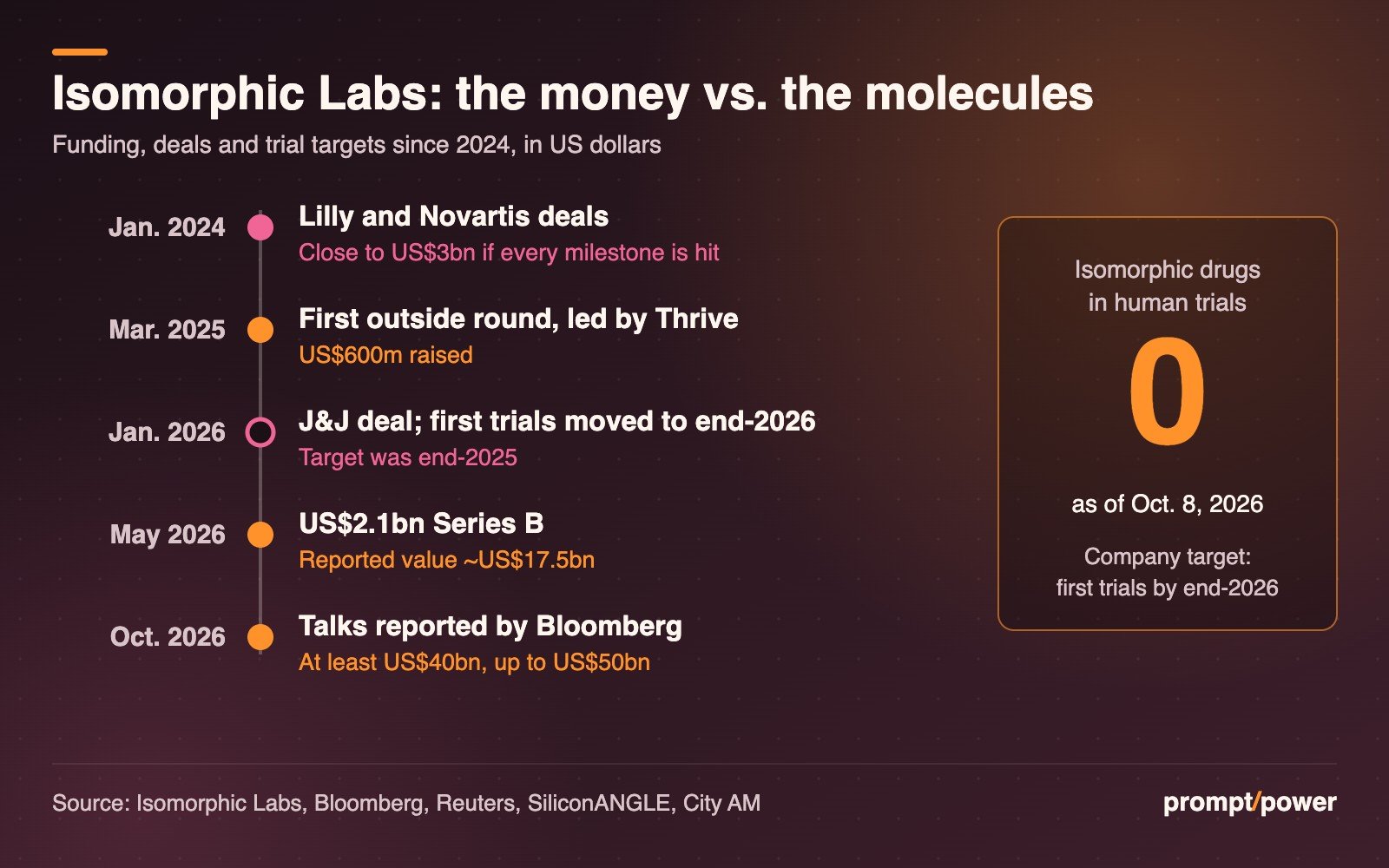
Isomorphic’s own target for its first human trials is the end of 2026. The money is moving faster than the molecules.
That leaves under three months. No AI-discovered medicine from any company has yet been approved for sale, as City AM noted. Our read: a US$40bn-plus round before a first dosing is a bet on the platform, priced the way investors price frontier AI labs, rather than on any one drug.
Britain’s government is on the cap table
The UK angle is new this year. The Sovereign AI Fund, a government-funded venture vehicle, confirmed its stake in the May round without disclosing the amount. Science and Technology Secretary Liz Kendall said at the time that “What Isomorphic Labs is doing has the potential to completely reshape how medicines are discovered.” The fund’s head of ventures, Joséphine Kant, called Isomorphic “one of the most consequential companies being built anywhere in the world today,” Computer Weekly reported.
A bigger round would mark that stake up on paper, and dilute it unless the fund writes another cheque. Washington is having a louder version of the same argument about taking stakes in AI labs. London’s version arrived quietly, through a venture fund.
What to watch before year-end
- A first patient dosed. The end-2026 target is public. Missing it twice would test the valuation story harder than any rival.
- Who leads the round. Bloomberg named no investors. A return by Thrive or Alphabet would signal insiders paying up; a new sovereign fund would echo May.
- Partner milestones. Lilly, Novartis and J&J payments are the closest thing Isomorphic has to revenue, and none has been itemised publicly.
Murdoch once described the end goal to Fortune: “here’s a disease, and then click a button.” At US$40bn, investors are paying for the button before the first click.

Marcia Okonkwo covers the business of technology for prompt/power: venture capital, startups, IPOs and earnings. She treats a valuation as a mood rather than a number until the S-1 says otherwise.
Keep reading

Bumble Buyout: Ithaca Holdings Pays US$6.05 a Share, a 138% Premium

Amazon Eyes Decart for US$7B as Nvidia Weighs Buying Reflection AI

Cohere Opens an Ottawa Office as Its AI Agents Head to Navy Ships

Arena, the Leaderboard That Ranks AI Models, Is Now Worth US$3.1 Billion
Latest from prompt/power
- Meta Q3 Earnings Oct. 21: The Capex, Ads and Cash Numbers to WatchOct 21
- Anthropic’s 5% Pledge Is Worth About US$48B. Here’s the Fine PrintOct 21
- Commons AI Study Meets Parliament’s Interpreter Math: 44 Passes in 5 YearsOct 21
- CNN All Access Canada Price Is CA$7.99. Americans Pay About 23% MoreOct 20
- DeepSeek Federal Ban: DHS Order Also Covers Apps Built on Its ModelsOct 20
Leave a Reply