
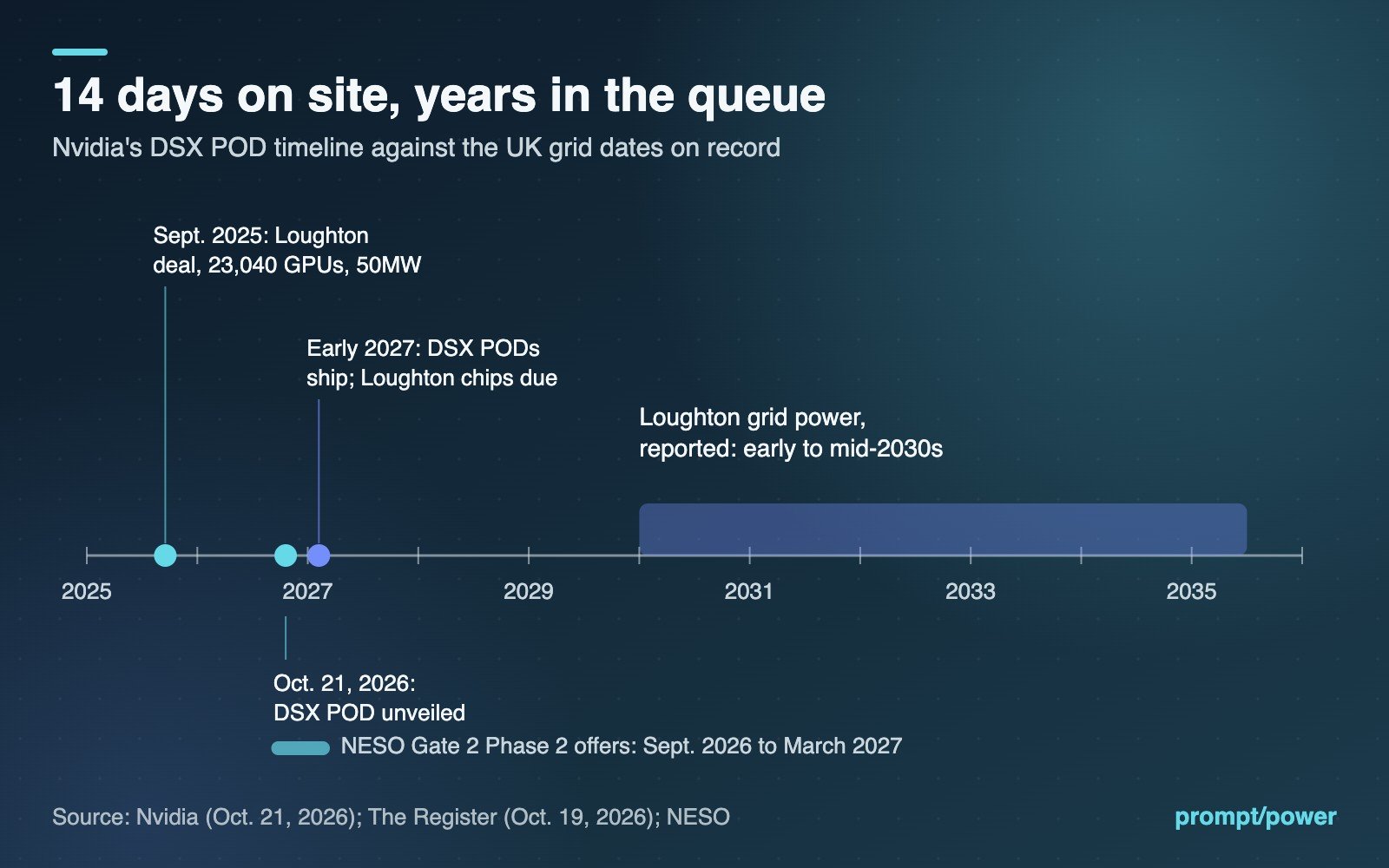
Nvidia on Oct. 21 unveiled DSX POD, a reference design for complete Vera Rubin AI factories that partners build and test inside modular containers before shipping them. At GTC Berlin, the company said the design cuts deployment at a prepared site “from six months to as little as 14 days,” with partners delivering units worldwide from early 2027. For British operators, the trouble is the phrase “prepared site.” The UK’s most prominent AI campus, Nscale’s Loughton site in Essex, was due to switch on in 2027 and may not get enough grid power until the early to mid-2030s.
Nvidia’s own announcement is precise about where its 14 days begin. The containers arrive “ready to connect out of the box to a prepared site’s power, cooling, networking and other supporting infrastructure.” The release never says how long preparing that site takes, or who does it. In Britain, that is the slow part.
What Nvidia DSX POD actually is
DSX POD is not a new chip or a single product. It is a blueprint that hardware partners follow to build a whole AI factory, Vera Rubin systems included, inside shipping-style modules. According to the release, partners finish rack-to-rack cabling, wiring, piping and functional validation in their own facilities before shipment, separately from site preparation. Seventeen partners are named, from server makers Dell Technologies, HPE, Lenovo, Foxconn’s Ingrasys, GIGABYTE, Pegatron, Quanta Cloud Technology and Wistron to power and cooling suppliers Schneider Electric, Vertiv, Eaton and Delta, plus Bull, Crusoe, DayOne, Armada and the defence firm Anduril.
Jensen Huang, Nvidia’s founder and chief executive, framed it as a construction problem. “An AI factory creates value when it starts producing tokens — not when construction is complete,” he said in the release.
What the release leaves out is as telling. It gives no megawatt rating per pod, no GPU count, no rack count and no power draw. The headline promises to accelerate Europe’s infrastructure deployment, yet no European or UK customer or site is named. Without a megawatt figure, a British developer cannot yet tell how many pods a given grid connection would feed.
The 14 days start after the hard part
Our read: DSX POD compresses the stage of a data centre build that a factory can control. Cabling thousands of connections, pressure-testing liquid-cooling loops and validating systems are slow, skilled jobs, and moving them indoors to a production line is a real gain. Nvidia’s newsroom account repeated the same qualifier when it posted the news on X: the 14 days apply at a prepared site.
None of that touches the queue for electricity. A prepared site in the release’s sense already has power, cooling and fibre waiting at the boundary fence. In much of southern England, getting a high-voltage connection to that fence is measured in years, and it is decided by network operators, not by Nvidia’s partners.
Britain’s grid queue, by the numbers
Loughton shows the gap at full scale. Under the September 2025 deal, Nscale planned 23,040 Nvidia GB300 GPUs in a 50MW facility, expandable to 90MW, for Microsoft’s Azure, with first chips in early 2027, The Register reported on Oct. 19. The Telegraph first reported that Microsoft had ended the agreement, and The Guardian reported in September that UK Power Networks had warned the capacity might not be available until the 2030s, according to The Register. Microsoft did not respond to The Register. We set out what that does to the wider pledge in our UK AI pledge tracker.
UK Power Networks told The Register it could not discuss individual connections, citing Section 105 of the Utilities Act, but said that “many datacenters… are awaiting works on the national transmission network which we do not own.” Nscale said it was “exploring alternative power sources for the site.”
The queue behind Loughton is long. Demand for new connections rose from 41GW to 125GW in under a year, with data centres accounting for at least 80GW, The Register reported. The National Energy System Operator (NESO) is part-way through reissuing connection offers under its reform programme. Its published timetable has Gate 2 Phase 2 offers for transmission and large embedded projects going out “between early September 2026 and mid-January 2027,” and distribution offers “between mid-October 2026 and mid-March 2027.” Offers are released area by area, so some places hear before others.
Put those dates next to Nvidia’s and the problem is obvious. A British developer waiting on a Gate 2 offer may not learn its connection date until early 2027. That is the same window in which Nvidia says the first DSX PODs ship.
“Many datacenters… are awaiting works on the national transmission network which we do not own.” UK Power Networks, to The Register
Where factory-built AI could still help in the UK
There is a British case for DSX POD, and it is narrower than the headline. Containers suit sites that already have power: existing data centre halls with spare capacity, industrial sites with large connections, or campuses running their own generation. The Register notes that some developers are already turning to gas-powered generation rather than wait years for the grid, and that Ofgem has proposed charging data centre developers for connection requests. Nscale’s “alternative power sources” line points the same way. For any of those, cutting six months of on-site fit-out to two weeks is worth real money.
It does nothing for the sites where the connection itself is in dispute. In Charlton, the fight over a 180MW data centre on the Thames is really a fight over who gets a scarce grid connection in London. Our explainer on AI’s electricity use sets out why the load forecasts vary so widely. More on the hardware side lives on our hardware page.
What to watch before DSX PODs ship in 2027
- A megawatt figure. Until Nvidia or a partner publishes the power draw of a single pod, nobody can size one against a grid offer.
- A named European site. The release is pitched at Europe but names none. The first UK customer will show whether the design is going to powered brownfield sites or new campuses.
- NESO’s Gate 2 offers. The dates in those letters, not the shipping dates of containers, will decide how much Vera Rubin capacity can run in Britain in 2027.
One detail from The Register’s Loughton coverage is worth keeping in mind whenever the 14-day claim comes up. In March, it reported, the site meant to host the country’s largest AI supercomputer was being used as a scaffolding yard.

James Whitfield covers hardware for prompt/power: chips, semiconductors, laptops, components and the benchmarks behind the launch-day claims. He thinks the most important number on any spec sheet is usually the one in the footnote.
Keep reading



Latest from prompt/power
- SK hynix Memory Is Sold Out Through 2029. PCs and Phones Pay the PriceOct 29
- GPT-6.1 Terra Price: US$1 In, US$5 Out. What Agents Cost Now, and the CatchOct 29
- Australia’s Chatbot ‘Intimacy’ Ban Is for Kids Only. Canada’s Bill Isn’tOct 29
- Cohere Caught Qwen Trying a Beijing Upload. How to Lock Down AI AgentsOct 29
- Cloudflare’s AI Leaked Other Customers’ Data in 155 Replies. What to CheckOct 29
Leave a Reply