
The first Mac you can touch starts at US$2,899 (CA$3,999). Apple announced the MacBook Pro with PROLED XDR Display on Oct. 28: 14- and 16-inch models with a tandem OLED screen, a touch sensor built into the panel, a Dynamic Island in place of the notch, and the existing M5 Pro and M5 Max chips. Pre-orders opened Oct. 28 in 30 countries and regions, including the US and Canada, and the laptops reach customers and stores on Friday, Nov. 6. The top 16-inch M5 Max model starts at US$4,799 (CA$6,599).

We read Apple’s US release, its technical specifications page and the Apple Canada release side by side. The headline figures are Apple’s. The more useful ones are in the footnotes, the spec sheet and the Canadian price list. We have not used the machine; nothing below is hands-on.
MacBook Pro PROLED XDR price and release date
There are four starting configurations. Each keeps the storage floor of the MacBook Pro it sits above: 1TB on M5 Pro, 2TB on M5 Max, with 24GB and 36GB of memory respectively, per the spec sheet.
| Model | US price (education) | Canada price (education) |
|---|---|---|
| 14-inch, M5 Pro | US$2,899 (US$2,749) | CA$3,999 (CA$3,789) |
| 16-inch, M5 Pro | US$3,399 (US$3,199) | CA$4,799 (CA$4,519) |
| 14-inch, M5 Max | US$4,499 (US$4,199) | CA$6,299 (CA$5,869) |
| 16-inch, M5 Max | US$4,799 (US$4,499) | CA$6,599 (CA$6,189) |
That is a big step up from the non-touch machines Apple introduced in March. Those started at US$2,199 (CA$2,999) for the 14-inch M5 Pro and US$2,699 (CA$3,599) for the 16-inch, as we listed in our Oct. 6 preview. Same chips, same base storage, US$700 more. In Canada the gap is CA$1,000 on the 14-inch M5 Pro and CA$1,200 on the 16-inch. Apple’s release does not say whether the March models stay on sale.
One thing you don’t have to buy: a charger. The release lists a 70W adapter at US$59 (CA$79), 96W at US$79 (CA$95) and 140W at US$99 (CA$129), which reads like a sold-separately change. It isn’t. The spec sheet’s “In the Box” section puts a 70W adapter with the 15-core M5 Pro 14-inch, a 96W adapter with the 18-core M5 Pro and M5 Max 14-inch, and a 140W adapter with every 16-inch, plus a 2-meter USB-C to MagSafe 3 cable. The listed bricks are spares.
MacBook Pro price in Canada vs the US
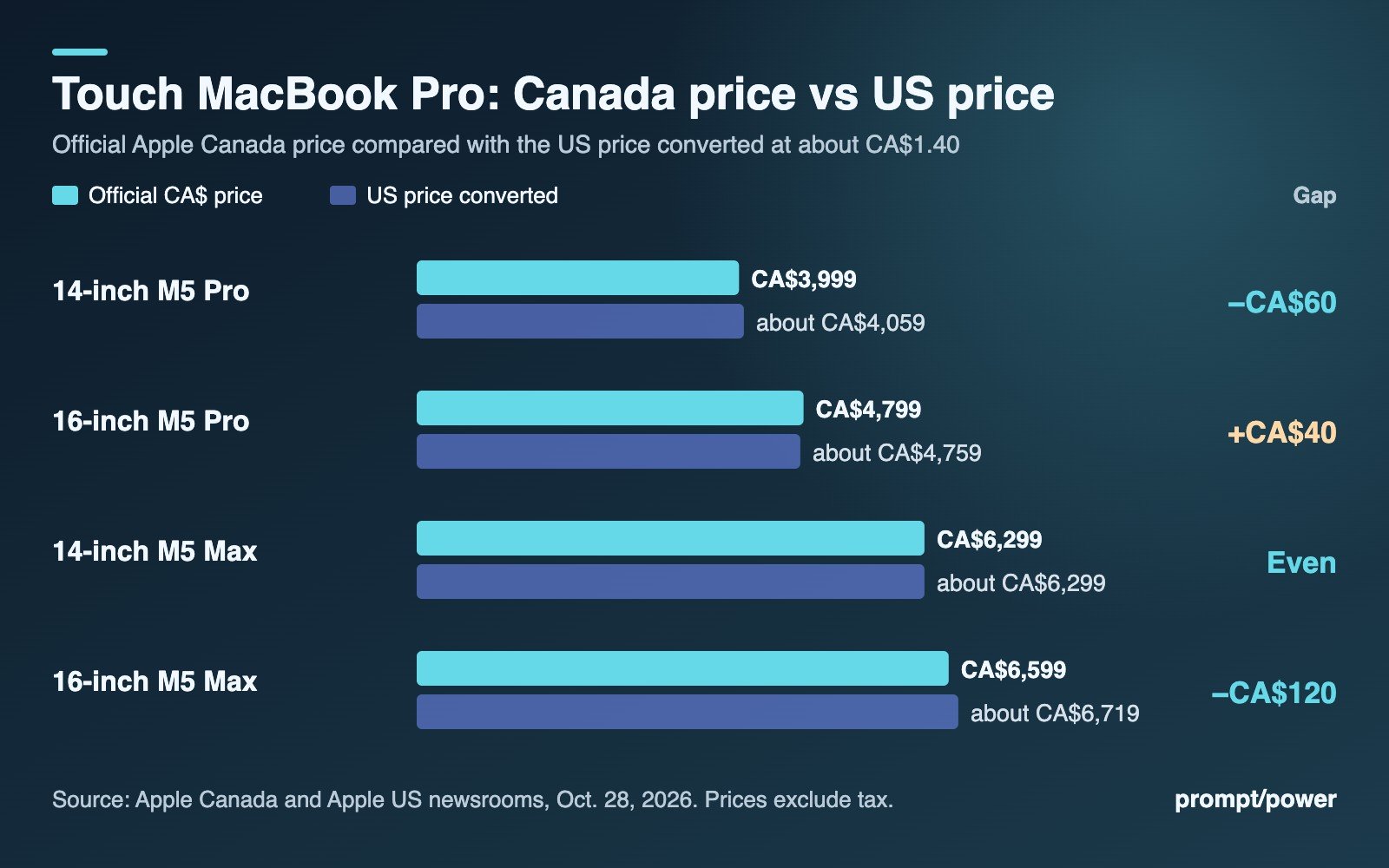
Canadian Apple prices are usually set, not converted, and this launch shows it. At about CA$1.40 to the US dollar, here is how each official Canadian price compares with a straight conversion of the US price (both exclude sales tax):
- 14-inch M5 Pro: CA$3,999 vs about CA$4,059 converted. Canadians pay about CA$60 less.
- 16-inch M5 Pro: CA$4,799 vs about CA$4,759. About CA$40 more, the only model priced above conversion.
- 14-inch M5 Max: CA$6,299 vs about CA$6,299. Dead even.
- 16-inch M5 Max: CA$6,599 vs about CA$6,719. About CA$120 less.
So the most expensive model is, relatively, the best deal north of the border, and the one most people will weigh against a 14-inch is the worst. The gaps are small enough that a currency swing could erase them by spring. Education pricing follows the same pattern: the 16-inch M5 Pro is CA$4,519 for students, against about CA$4,479 for a converted US$3,199.
What PROLED XDR and Touch actually do
PROLED XDR is Apple’s name for a tandem OLED panel, two stacked layers of light-emitting material. Apple claims up to 2,000 nits of peak brightness for both HDR and SDR content, a 10,000,000:1 contrast ratio, a ProMotion refresh rate that runs from 120Hz down to 10Hz, and both P3 and Adobe RGB color gamuts with more than 80 percent of Rec. 2020. The 14-inch screen is 14.2 inches diagonally at 3024 by 1986 pixels; the 16-inch is 16.3 inches at 3472 by 2266, both at 254 pixels per inch.
“PROLED XDR is the world’s best laptop display.” (Johny Srouji, Apple’s chief hardware officer, in Apple’s release)
That is Apple’s claim, and independent display measurements will tell us more once review units circulate. Srouji also called the machine “a monumental step forward for the Mac.”
The touch part is more modest than “touchscreen Mac” suggests. Apple’s release never uses the word. It says the sensor is “built directly into the display panel,” that touch works “in tandem with the keyboard shortcuts and trackpad gestures pros know and love,” and that “macOS automatically translates touches into clicks.” In other words, apps that were never designed for fingers still respond to them, as if you’d clicked. The keyboard and trackpad stay.
Apple named apps it says are being tuned for touch: Notion, Canva, Zoom, Microsoft Word, Excel, PowerPoint and Outlook, Adobe Lightroom, DaVinci Resolve, Blender, Maxon Cinema 4D and ZBrush, Shapr3D and Algoriddim djay Pro. Footnote 4 is the catch: “Apps listed will be available later this year.” None of those optimised versions is promised for Nov. 6.
Dynamic Island on Mac, and the Siri AI fine print

The notch is gone, replaced by a Dynamic Island that Apple describes as a home for Spotlight, Live Activities and Siri AI. Footnote 1 narrows that: “Spotlight only moves to the Dynamic Island if Siri AI is available and enabled.”
And Siri AI comes with conditions of its own. Per the footnotes in the Canadian release, it is “available in beta in macOS 27.2,” in English, French, Japanese, Korean, Portuguese and Spanish, and not for users under 13. Server-backed Apple Intelligence features face daily usage limits, and Apple says “expanded access to such features will be available for a fee in the future.” The release also notes that Siri AI “is currently unavailable in the EU in iOS, iPadOS, and watchOS,” a line about Apple’s other platforms that says nothing either way about the Mac in Europe. If you’re unsure whether your account qualifies, our guide to turning on Siri AI walks through the settings, and this explainer covers where those requests go.
The machines ship with macOS 27 Golden Gate.
M5 Pro vs M5 Max: weight, battery and ports
Apple gave no performance numbers against older Macs, only that a “completely redesigned thermal architecture” maintains sustained performance in the thinner body, and that M5 Max “is built for users who want to push the limits even further.” Configurations go up to 128GB of unified memory and 16TB of storage.
The weight drop is real on paper. The 14-inch M5 Pro is 3.0 pounds (1.38 kg), half a pound lighter than before, by Apple’s count; the 16-inch M5 Pro is 4.0 pounds (1.82 kg), 0.7 pounds lighter. M5 Max adds about 0.1 pound to each. The 14-inch is 0.59 inch thick.
The “up to 24 hours” battery figure needs reading closely. On the spec sheet, 24 hours of video streaming belongs only to the 16-inch M5 Pro, with its 100-watt-hour battery. The 14-inch M5 Pro is rated for up to 22 hours of video and 14 hours of wireless web; the 14-inch M5 Max, 20 and 13. Apple’s battery testing was done in September 2026.
Ports hold steady: three Thunderbolt 5, HDMI, an SDXC slot, MagSafe and a headphone jack. M5 Pro drives up to three external displays and M5 Max four. Wi-Fi 7, Bluetooth 6, Touch ID and a 12MP Center Stage camera round it out, and Apple says fast charging reaches 50 percent in about 30 minutes.
What the rumours got right, and wrong
Our Oct. 6 preview and our Oct. 22 “Pro and Tell” rundown leaned mostly on Bloomberg’s Mark Gurman, as most rumour reporting in our hardware coverage does. Scored against Apple’s documents:
- Right: tandem OLED, touch alongside the trackpad, a Dynamic Island, 14- and 16-inch sizes, and M5 Pro and M5 Max rather than M6. Outlets that wrote “M6 MacBook Pro” mixed it up with the cheaper 14-inch M6 model Apple announced separately on Oct. 27.
- Right: “significantly lighter,” and a Nov. 6 shelf date with same-day pre-orders, matching Apple’s press-release launches of 2024 and 2025.
- Open, now settled: the name. Gurman had said it was unclear Apple would keep “MacBook Pro.” It did, with “PROLED XDR Display” bolted on.
- Underestimated: the price. Reports said only that it would cost more than today’s Pro. A US$700 premium over the same chip and storage is more than most buyers would have budgeted.
What it means for you
If you want the screen, the lighter body or touch, pre-order knowing two of the headline features (optimised touch apps and Spotlight in the Dynamic Island) depend on software that isn’t finished. If you mainly want M5 Pro performance, the same chip was US$2,199 (CA$2,999) in March, and Apple isn’t claiming the new one is any faster. And Canadians eyeing a 16-inch: the M5 Max model is priced about CA$120 under conversion, the M5 Pro model about CA$40 over.
The charger is still in the box. For CA$3,999, it ought to be.

Andrew Lovesey is the editor-in-chief of prompt/power and the founder of Loveseyland, a Toronto studio that builds worlds and the companies inside them. Before that he spent 12 years at Canadian Geographic and the Royal Canadian Geographical Society, finishing as Director of Digital and Video, and later led the digital practice at Navigator. He is a Fellow of the RCGS and received its Quest Medal for his part in the expedition that located the wreck of Shackleton's Endurance. At prompt/power he covers Apple and writes the big-picture analysis. He has helped find a ship lost for more than a century, and still can't reliably find a phone charger that works.
Keep reading


Latest from prompt/power
- SK hynix Memory Is Sold Out Through 2029. PCs and Phones Pay the PriceOct 29
- GPT-6.1 Terra Price: US$1 In, US$5 Out. What Agents Cost Now, and the CatchOct 29
- Australia’s Chatbot ‘Intimacy’ Ban Is for Kids Only. Canada’s Bill Isn’tOct 29
- Cohere Caught Qwen Trying a Beijing Upload. How to Lock Down AI AgentsOct 29
- Cloudflare’s AI Leaked Other Customers’ Data in 155 Replies. What to CheckOct 29
[…] We haven’t tested either laptop, so every performance figure here is Apple’s own claim. Our launch story on the PROLED XDR MacBook Pro covers touch and the Dynamic Island in more […]