
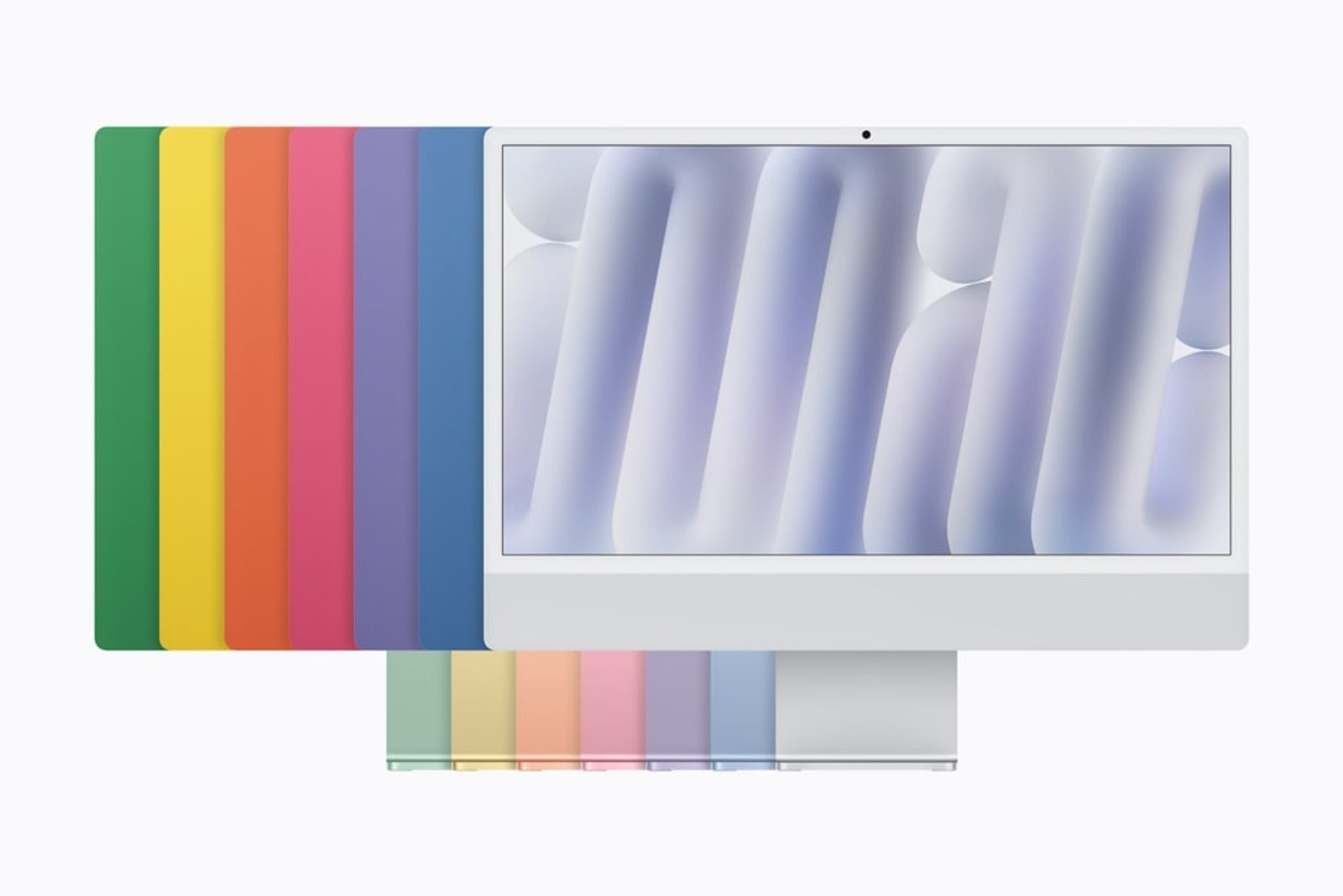
Apple’s new iMac with M6, announced Oct. 27, costs US$1,499 (CA$2,099) with a 10-core CPU and 10-core GPU, or US$1,699 (CA$2,299) with 12 cores of each. Pre-orders opened Oct. 28, and the first units arrive Friday, Nov. 6. It keeps the 24-inch 4.5K screen, the 12MP Center Stage camera and the same seven colours as the M4 model, and adds Wi-Fi 7, faster storage and Apple’s new chip. If you own an Intel or M1 iMac, this is the upgrade Apple built for you. If you bought an M4 iMac in the past two years, you can almost certainly skip it.
We read Apple’s release against its Oct. 28, 2024 announcement of the M4 iMac, footnote by footnote, and took Canadian prices from Apple Canada’s release. We haven’t tested the new iMac; every performance figure below is Apple’s claim, and we say what Apple compared it with.
iMac M6 price in the US and Canada
| iMac with M6 | US price | Canada price | Education (US / Canada) |
|---|---|---|---|
| 10-core CPU, 10-core GPU | US$1,499 | CA$2,099 | US$1,449 / CA$2,029 |
| 12-core CPU, 12-core GPU | US$1,699 | CA$2,299 | US$1,599 / CA$2,159 |
Canadians pay close to the straight conversion. At about CA$1.40 to the US dollar, US$1,499 is about CA$2,099, exactly Apple Canada’s price. The 12-core model’s US$1,699 converts to about CA$2,380, so the CA$2,299 sticker is about CA$80 under. The same CA$80 shows up on the 12-core education price. Apple Upgrade leasing in the US starts at US$28.99 a month over 36 months.
The bigger story is the floor. The M4 iMac launched at US$1,299 with an 8-core CPU and 8-core GPU. That tier is gone: the M6 line starts at US$1,499, the M4’s old 10-core price. MacRumors reports the M4 iMac’s price had already risen to US$1,499 earlier in 2026, which fits the memory squeeze our buyer’s guide covered on Oct. 6. Apple’s education price for the entry model is also up, from US$1,399 for the 10-core M4 to US$1,449.
What changed from the M4 iMac, and what didn’t
Here is what Apple’s release adds:
- Chip. M6 with up to a 12-core CPU and 12-core GPU, Neural Accelerators in each GPU core, a Dual 16-core Neural Engine and up to 170GB/s of memory bandwidth.
- Wireless. Wi-Fi 7 and Bluetooth 6, up from Wi-Fi 6E and Bluetooth 5.3 on the M4.
- Storage. SSD reads and writes “up to 2x faster” than the M4 model, Apple says.
- Ethernet. A 2.5 Gigabit option, which Apple says is “available on models with 12-core CPU and 12-core GPU.”
- Displays. Support for up to two 6K external monitors.
And what stays the same: the 24-inch 4.5K Retina panel at 500 nits, the 12MP Center Stage camera with Desk View, and the colours. The M4 release listed green, yellow, orange, pink, purple, blue and silver. The M6 release lists the same seven.
The part buyers should notice is where the extras moved. On the M4, the US$1,499 10-core model was the top tier: it got four Thunderbolt 4 ports, Touch ID as standard and the nano-texture option. On the M6, those sit with the US$1,699 12-core model. Apple’s footnotes say nano-texture “is an option on models with 12-core CPU and 12-core GPU,” that the 10-core model “can configure to Magic Keyboard with Touch ID,” and that “all four USB-C ports support Thunderbolt 4” on 12-core models. MacRumors’ comparison calls the 10-core the two-port model. So US$1,499 buys a newer chip than it did in 2024, but fewer of the trimmings.
One gap: Apple’s release doesn’t state base memory or storage for either model. The M4 started at 16GB and 256GB. Check the configurator before you order, especially if you want local AI, where memory decides what runs.
Apple’s “up to” claims, and what they were measured against
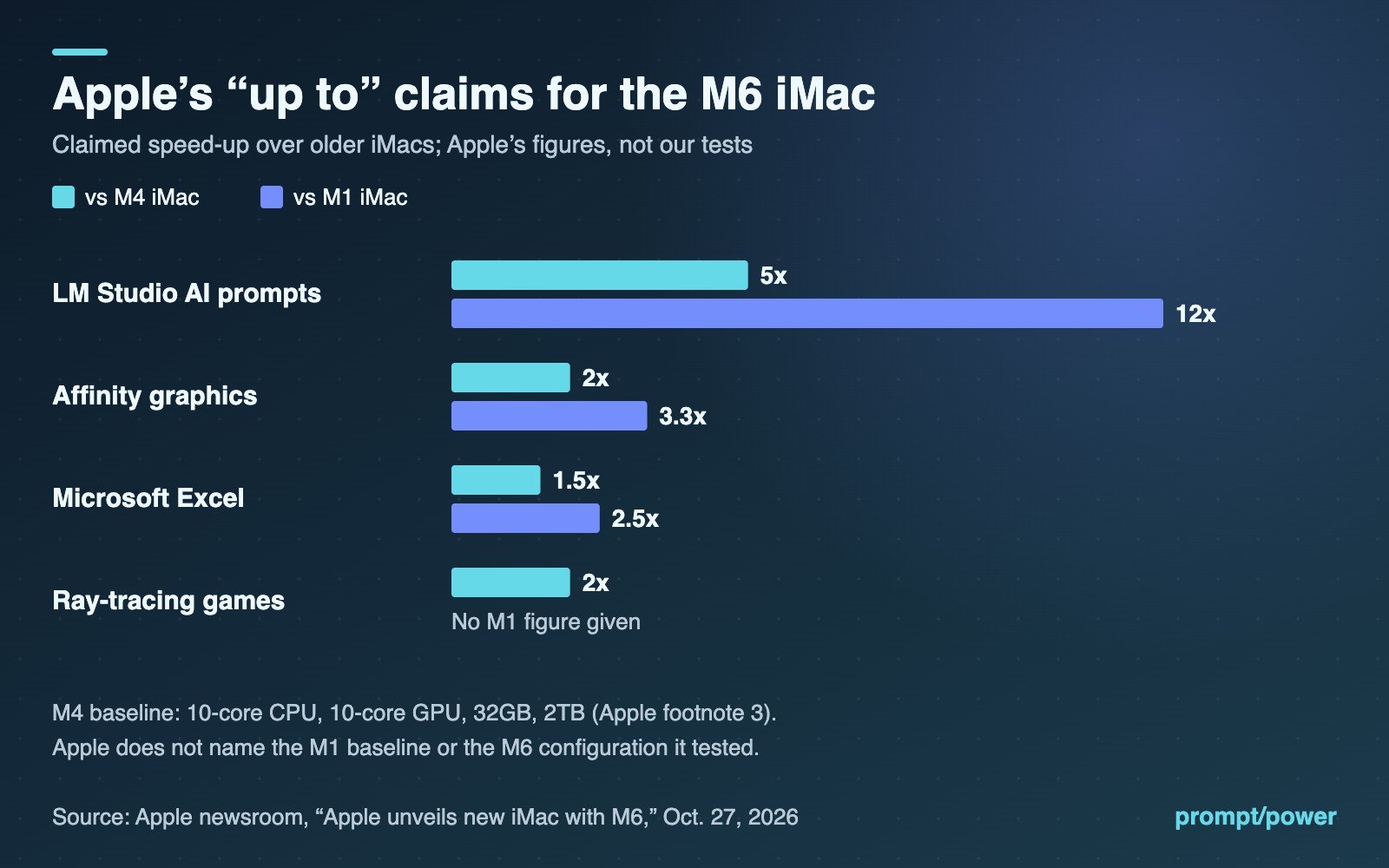
Apple’s headline numbers are all “up to” figures, and its footnotes are uneven about the baseline. The M4 comparisons are the best documented. Footnote 3 says they use “previous-generation iMac systems with Apple M4, 10-core CPU, 10-core GPU,” with “32GB of unified memory, and 2TB SSD.” That is a well-specified M4, not a stripped one.
| Apple’s claim for iMac with M6 | vs M4 iMac | vs M1 iMac |
|---|---|---|
| AI prompt processing in LM Studio | Up to 5x | Up to 12x |
| Graphics in Affinity photo editing | Up to 2x | Up to 3.3x |
| Microsoft Excel | Up to 1.5x | Up to 2.5x |
| Ray-tracing gaming | Up to 2x | Not given |
| Baseline system Apple names | 10-core CPU, 10-core GPU, 32GB, 2TB (footnote 3) | Not specified (footnote 1) |
What none of the footnotes says is which M6 Apple tested. If the numbers come from the 12-core M6, part of each gain is simply two more CPU and GPU cores, and the US$1,499 model will land lower. The M1 comparisons are vaguer still: footnote 1 says only that “testing was conducted by Apple in September 2026,” without naming the M1 configuration. The same footnote covers Apple’s “up to 18x faster” claim against “the most popular Intel-based iMac,” which Apple doesn’t identify.
Apple also claims the “world’s fastest single-threaded CPU performance,” tested in October 2026 against shipping competitive systems, per footnote 4. That claim is Apple’s, and independent benchmarks after Nov. 6 will test it.
The AI pitch: LM Studio, Claude and Siri AI
The largest number in the release is the 5x gain over M4 in AI prompt processing in LM Studio, the app many people use to run open-weight models at home. Our read on what that means: prompt processing is the step where the model reads your input, and it leans on raw compute, which the Neural Accelerators in M6’s GPU cores add. Generating the reply, token by token, depends far more on memory bandwidth and on how much memory you have. Apple gives a 170GB/s bandwidth figure but no bandwidth comparison with M4, so don’t expect replies to stream five times faster. Our guide to running open-weight models explains how much memory each model size needs.
Apple’s release also names third-party AI apps by name. One of its images shows “the Claude app is displayed alongside Pixelmator Pro on iMac with M6 in orange,” and the text cites “LM Studio Bionic and Topaz Studio.” Apple doesn’t say any of them need M6 to run.
Then the fine print on Apple’s own AI. Siri AI is a beta in macOS 27.2 (here’s how to turn it on), and footnote 2 warns that “certain Apple Intelligence features that rely on server-side models are subject to daily usage limits,” adding that “expanded access to such features will be available for a fee in the future.” Server-side features run in Apple’s cloud, not on your new chip; our explainer on where Siri and Apple Intelligence requests go maps which is which.
“iMac is the world’s best all-in-one, and today it raises the bar yet again.” Shelly Goldberg, Apple’s vice president of Hardware Engineering
Should you upgrade? Advice for M4, M1 and Intel owners
Intel iMac owners: yes. Apple claims up to 18x the performance of its unnamed Intel reference, and you also get Wi-Fi 7, the 4.5K screen and Apple Intelligence features your Intel machine can’t run.
M1 iMac owners: probably, if the machine is your daily workhorse. Apple’s own figures put the M6 at 2.5x to 12x faster depending on the task, and the M1 iMac is five years old. If it mostly runs a browser and email, it can wait.
M3 and M4 iMac owners: no, unless you run local AI models daily or need 2.5 Gigabit Ethernet. The screen, camera, speakers and design are the same, and Apple’s best documented M4 claims are 1.5x to 2x outside AI.
Buying your first iMac: the 12-core model is the better value if you want Touch ID, four Thunderbolt ports or nano-texture, since the US$200 step makes Touch ID and four Thunderbolt ports standard and unlocks the nano-texture option. If you see an M4 iMac on clearance well below US$1,499, it’s the same screen and camera for less.
More hardware coverage is here. In 2024, US$1,499 bought the top iMac with four Thunderbolt ports and Touch ID. On Nov. 6, it buys the entry model.

Andrew Lovesey is the editor-in-chief of prompt/power and the founder of Loveseyland, a Toronto studio that builds worlds and the companies inside them. Before that he spent 12 years at Canadian Geographic and the Royal Canadian Geographical Society, finishing as Director of Digital and Video, and later led the digital practice at Navigator. He is a Fellow of the RCGS and received its Quest Medal for his part in the expedition that located the wreck of Shackleton's Endurance. At prompt/power he covers Apple and writes the big-picture analysis. He has helped find a ship lost for more than a century, and still can't reliably find a phone charger that works.
Keep reading


Latest from prompt/power
- SK hynix Memory Is Sold Out Through 2029. PCs and Phones Pay the PriceOct 29
- GPT-6.1 Terra Price: US$1 In, US$5 Out. What Agents Cost Now, and the CatchOct 29
- Australia’s Chatbot ‘Intimacy’ Ban Is for Kids Only. Canada’s Bill Isn’tOct 29
- Cohere Caught Qwen Trying a Beijing Upload. How to Lock Down AI AgentsOct 29
- Cloudflare’s AI Leaked Other Customers’ Data in 155 Replies. What to CheckOct 29
Leave a Reply