
China Gave AI Influencer Yuri an Official ID. What It Unlocks for Creators
Yuri’s identity card lists a name, a birthday, an address and facial features, the same basic fields a person would carry. Yuri is not a person. She is an AI-generated virtual idol who has sung in Mandarin and English on a 100-metre-wide screen on Shanghai’s Bund, and, according to ABC News in Australia, she was the first Chinese digital human to receive “a government-based official identification card.”
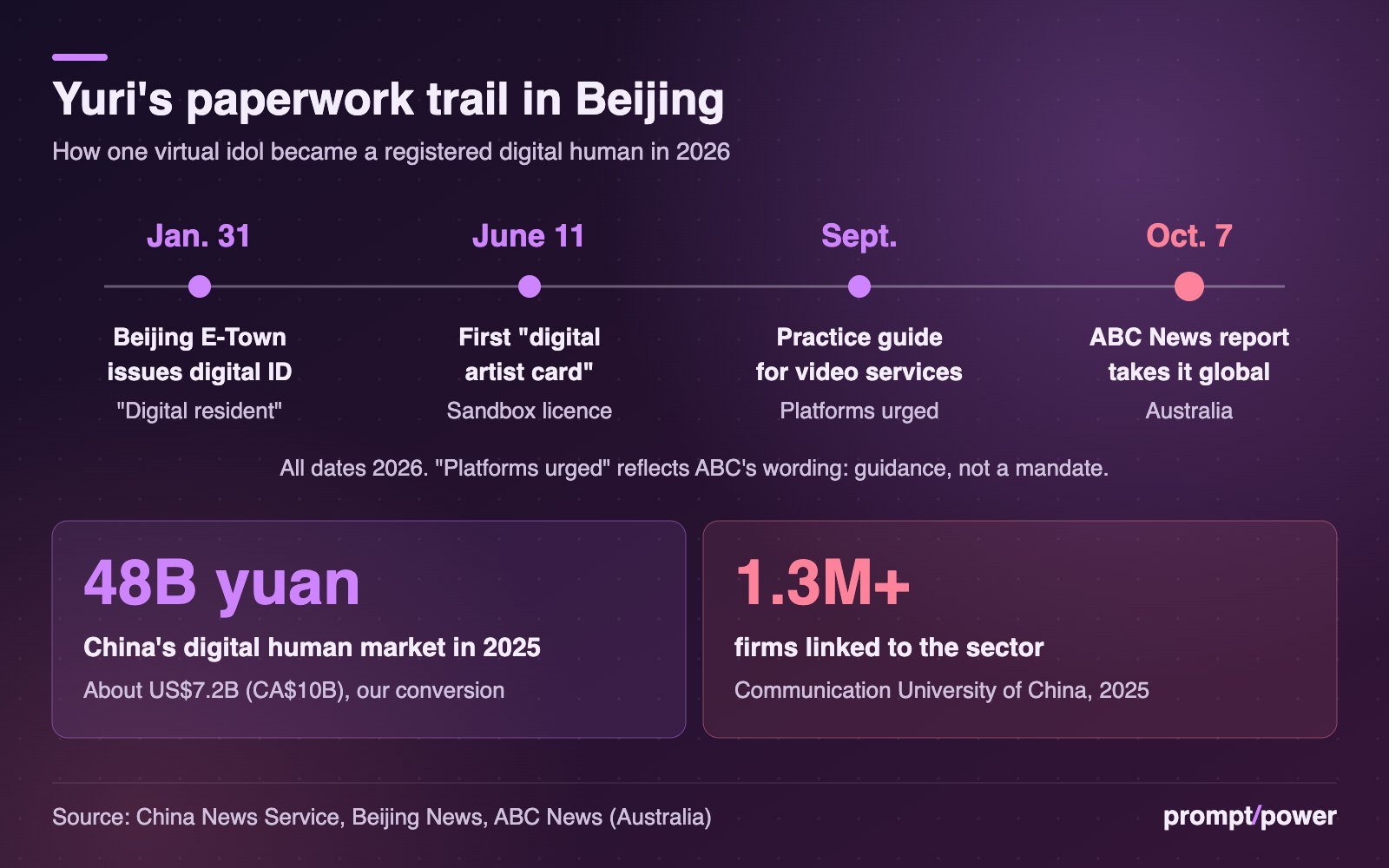
The card arrived months before most of the world heard about it. Chinese state-run outlet China News Service reported on Jan. 31 that the Beijing Economic-Technological Development Area, the district better known as Yizhuang or Beijing E-Town, had issued Yuri a digital identity and named her a “digital resident.” ABC’s Oct. 7 report put the story in front of an international audience, and it has since been picked up by Cybernews and others.
The ID itself is a novelty. What it is attached to is more interesting for anyone who makes money as, or with, a virtual creator.
What Yuri’s digital human ID says and what it unlocks
ABC reports that the identity “allows her operators to open a digital currency wallet for her business and secure commercial partnerships in industries including fashion, gaming and automotive.” The wallet detail links to a Beijing E-Town government page dated Sept. 16.
Read that sentence carefully. The ID does not let Yuri do anything. It lets her operators do things in her name, with an official record of who is behind her. A human team builds and maintains Yuri’s system and manages her fan interactions, ABC notes.
That team has a name. Yuri is the work of Hanqing Studio, founded by Zhao Hanqing, according to China News Service, and her intellectual property is owned by Beijing Gu Yu Qiu Shi Commercial Technology Co., per a June report in the Beijing News. The same outlet says Yuri has more than a million followers across platforms.
From ‘digital resident’ to licensed performer
The identity card was step one. On June 11, Yizhuang handed Yuri what the Beijing News called China’s first “digital artist card,” a compliance credential issued through a “sandbox approval” pilot for virtual performers. The process runs from application through compliance review and a trial period inside the sandbox to an exit approval, and includes intellectual property checks, safety reviews of the underlying large model’s output, and real-time monitoring with human response to risk alerts.
Zhao was candid about why a creator would want this. “For us, the biggest significance of ‘sandbox approval’ comes down to three characters: certainty,” Zhao said, according to the Beijing News (our translation from Chinese). “What companies fear most isn’t having rules, but not knowing where the rules are.”
Then, in September, Beijing issued a practice guide for broadcasting and online video services “urging them to register their digital humans,” ABC reported. Note the verb. As ABC describes it, this is guidance to platforms rather than a hard registration mandate, and ABC also notes that China “has not introduced a unified national system” for the sector. Shanghai has its own approach, a blockchain framework from 2024 that gives digital humans a permanent serial number.
China’s digital human market: 48 billion yuan
The money explains the paperwork. ABC puts China’s digital human market at 48 billion yuan in 2025, “rapidly expanding.” At recent exchange rates of roughly 6.7 yuan to the U.S. dollar, that is about US$7.2 billion (about CA$10 billion), by our conversion.
The industry is also crowded. A 2025 report from the Communication University of China counts at least 1.3 million firms linked to the sector, according to ABC. Not all of them are benign. Cybernews points to digital personas posing as doctors to push misleading medical advice, the kind of problem an ID system is designed to trace back to a company.
“Digital identification is a way of tracing that wrongdoing to the company that’s made it available.”
That is Jeannie Paterson of the University of Melbourne’s Centre for Artificial Intelligence and Digital Ethics, speaking to ABC. A digital human cannot be sued or jailed, she argued, so accountability has to land on whoever deployed it.
Lennon Chang, a cybersecurity expert at Deakin University, told ABC the same registration could unmask anonymous users and push businesses toward self-censorship. “They would definitely come with a chilling effect,” he said.
Canada and the U.S. ask for disclosure, not an ID
North American rules start from the opposite end. They do not care what a virtual influencer is called or where it “lives.” They care whether the audience is misled.
In Canada, the self-regulatory body Ad Standards updated its influencer disclosure guidelines in fall 2025 to cover AI-generated influencers directly. “If you are using an AI-generated influencer, disclosure is still necessary,” the guidelines say, and best practice is “to disclose that the spokesperson is virtual,” with tags such as #VirtualInfluencer or #AIinfluencer. The document also says a virtual influencer should not give a testimonial about a product “it cannot experience,” and reminds brands that breaching the Competition Act can bring civil or criminal action from the Competition Bureau.
In the U.S., the Federal Trade Commission’s June 2023 update to its Endorsement Guides changed the definition of endorsements to clarify how far it covers “fake reviews, virtual influencers” and other formats, according to the FTC’s announcement.
Neither system gives a virtual creator a legal identity, a wallet or a performance licence. They put the burden on the post.
What it means for creators and brands
Our analysis: China’s model offers virtual-creator studios something Western rules do not, a state-recognized way to sign contracts and get paid in a character’s name, in exchange for putting the operator on file. Zhao’s word, certainty, is the selling point. The cost is that a registry built for consumer protection is also a registry of who is speaking behind every avatar, which is Chang’s worry.
For Canadian creators building AI personas, the practical rules are simpler and stricter on the audience side. Label the account as virtual. Do not let it review a moisturizer it has never touched. And if the persona borrows a real voice or face, the licensing questions in our guide to selling AI music and cloned voices apply, as do the personality-rights questions we covered in Giorgia Meloni’s voice trademark filing.
Brands signing a Chinese virtual idol should ask for the operator’s registration and, for live shows, the digital artist card. Yuri has both. Her birthday is on file in Yizhuang. The people who wrote it there are on file too.

Casie Stewart covers the creator economy, social platforms and wellness tech for prompt/power: who gets paid, who gets seen, and what the algorithm is really asking of the people who feed it. She has been publishing online since 2005, long before "creator" was a job title, and has spent most of that time on the other side of the platforms she now writes about. Based in Toronto. Her rule for any new app: if it promises to save you time, check how much of it you just spent reading the onboarding.
Keep reading




Latest from prompt/power
- Cohere Opens an Ottawa Office as Its AI Agents Head to Navy ShipsOct 11
- Beijing Warns Officials Off ‘Blind Investment’ in AI and High TechOct 11
- TSMC Q3 Revenue Beat Its Forecast: What to Watch in ASML and TSMC EarningsOct 11
- Double Counter Discord Breach: What to Do If Your IP Address LeakedOct 11
- Fired OpenAI Safety Researchers Deny Leaking, Warn of a ‘Chilling’ CultureOct 11
Leave a Reply