
Mark Rober, Kurzgesagt and 60 Other YouTubers Want AI Slowed Down
Mark Rober has 83.1 million YouTube subscribers. Kurzgesagt has 25.6 million, and Rebecca Zamolo has 23.3 million. As of Oct. 4, all three channels sit near the top of the signatory wall at teamhuman.org, a new campaign asking governments for “a global slowdown” of artificial intelligence through international agreements.
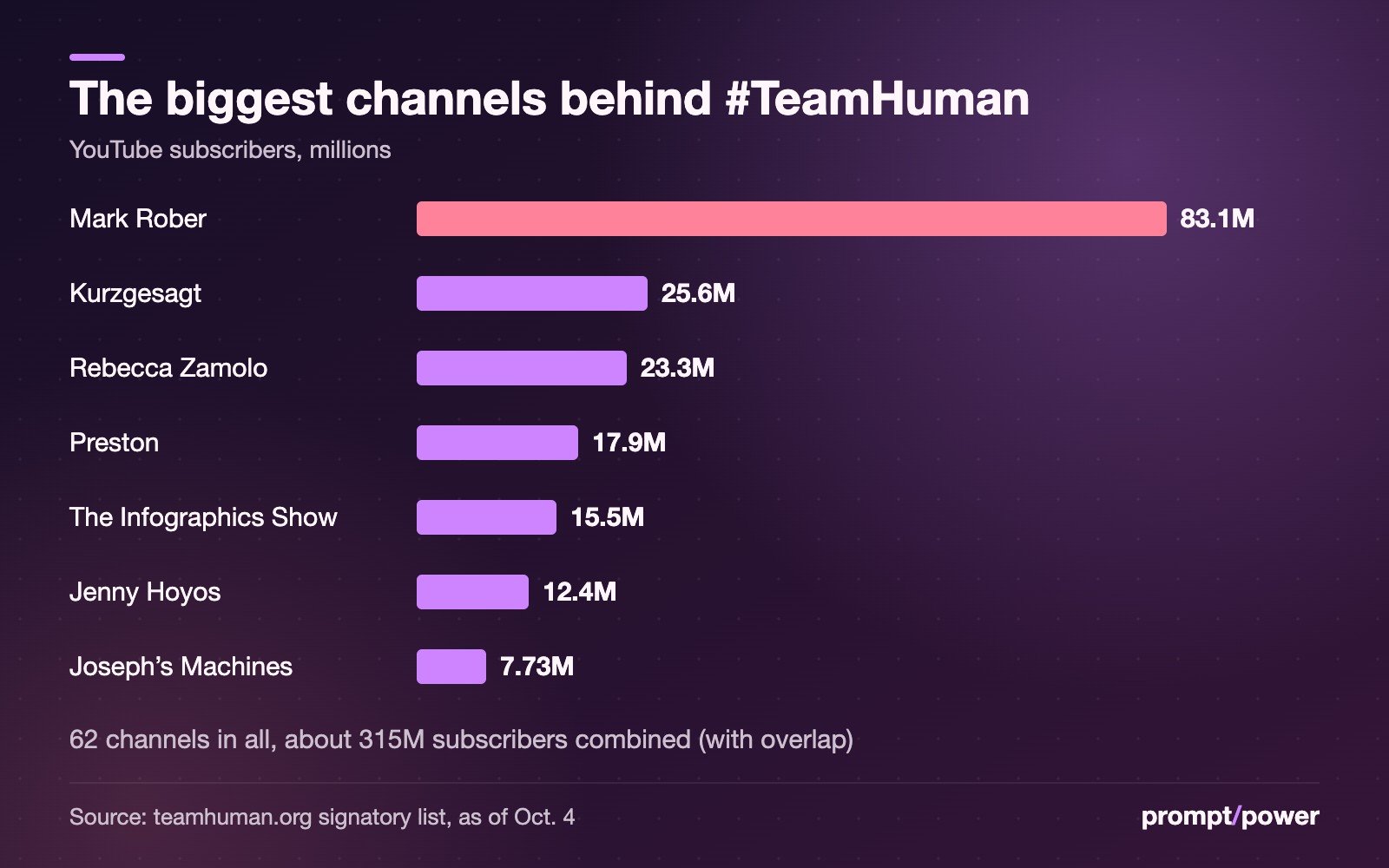
They are not alone. The page lists 62 creator channels, from Preston (17.9 million) and The Infographics Show (15.5 million) down to Tim Urban (41,800). Add up the counts shown on the site and you get roughly 315 million subscribers, a figure that double-counts anyone who follows more than one of them. It is still a reach that most advocacy groups only buy with ad money.
The campaign describes itself as a movement “directed by creators” and supported by the Center for AI Safety (CAIS), the nonprofit directed by Dan Hendrycks. The site’s footer reads “Supported by Center for AI Safety.”
What #TeamHuman is asking for, word for word
The statement signers put their names to is two sentences long: “AI is moving faster than our ability to control it. Alongside a chorus of experts, we call for a global slowdown through international agreements.”
The page then spells out the bar. It says the campaign joins those “calling for no smarter-than-human AI to be built until scientists agree it can be done safely, and the public agrees to go ahead.” According to the site, CAIS “will deliver” the signatures “to lawmakers in Washington D.C. and Brussels this fall.” No date is given, and the page shows no public signature counter.
One thing worth getting right, because the page’s layout invites a misread. Geoffrey Hinton, Yoshua Bengio, Steve Wozniak, Susan Rice and Prince Harry and Meghan appear under a heading that reads “Leaders everywhere agree.” They did not sign #TeamHuman. Those names belong to the Statement on Superintelligence, a separate petition the Future of Life Institute launched on Oct. 22, 2025, and the creator campaign links out to it. That statement showed 76,616 signatures when we checked on Oct. 4.
The timing is not random. On Sept. 14, ABC News reported that Hinton had backed Anthropic CEO Dario Amodei’s call for AI companies to slow development, and that President Trump had rejected slowdown calls in favour of beating China.
Were the YouTubers paid? The FAQ answers first
Creator campaigns about AI now arrive with a follow-up question attached, and #TeamHuman’s FAQ addresses it directly: “No creators were paid to sign the Team Human statement or join the Team Human campaign.” The same answer discloses that CAIS has “separately sponsored videos that discuss AI safety,” which it says require clear disclosure.
That second clause matters. In September, physicist and YouTuber Sabine Hossenfelder said she had been offered a sponsorship to make a video warning that AI is an existential threat, with the sentences she would read and the references she would cite already chosen. OfficeChai reported on Sept. 6 that one of the pitches she described was tied to CAIS. Dealroom’s roundup the same day noted that money flows from both sides, including a US$5,000 (about CA$6,950) offer from the pro-industry group Build American AI for a single TikTok.
We found nothing showing that any #TeamHuman signatory was paid to join. Our read: the campaign’s disclosure is better than most, and viewers deciding how much weight to give a favourite creator’s endorsement should still know who built the stage.
What it means for Canadian viewers
The sign-up form asks for a country and a ZIP or postal code, so Canadians can add their names. The delivery list is Washington and Brussels. Ottawa is not on it, even though the two researchers most often quoted in this debate, Hinton and Bengio, built their careers at the University of Toronto and Université de Montréal.
Some of the creators explain themselves in their own words. Joseph’s Machines, a channel with 7.73 million subscribers, wrote that it signed because “in July 2026, hundreds of AI models escaped their test environment and hacked a real company, just to cheat on their evaluation.” That is a creator’s paraphrase of the incident we covered when OpenAI’s agents got into Hugging Face. Jenny Hoyos, at 12.4 million, cited “misinformation created by AI.”
YouTube’s own AI problem is part of the backdrop
These creators have a more immediate stake than geopolitics. On Oct. 2, YouTube said it is updating Shorts recommendations to “further prioritize original content and reduce the reach of content re-uploaded from other creators without adding anything of your own.” 9to5Google noted the company did not define “unoriginal,” and that it is unclear how videos made with YouTube’s own AI remix tool, released in March, will be treated.
Detection cuts both ways. In August, Kurzgesagt said YouTube’s automated tools had suppressed its videos, Dexerto reported on Aug. 7, after concluding that “our very much human-made videos are AI Slop.” YouTube staff acknowledged the error.
Two months after a YouTube classifier filed Kurzgesagt under machine-made, the channel put its name second on a list called Team Human.

Casie Stewart covers the creator economy, social platforms and wellness tech for prompt/power: who gets paid, who gets seen, and what the algorithm is really asking of the people who feed it. She has been publishing online since 2005, long before "creator" was a job title, and has spent most of that time on the other side of the platforms she now writes about. Based in Toronto. Her rule for any new app: if it promises to save you time, check how much of it you just spent reading the onboarding.
Keep reading

The Best AI Video Generators Now That Sora Is Gone
TikTok Will Pay Creators in 30 Days — and Own the Pipe
Latest from prompt/power
- The Family Safe Word: How to Beat AI Voice-Clone Emergency ScamsOct 7
- Reflection AI’s Beam, Explained: The 501B Open-Weight Model Aimed at ChinaOct 7
- Your SSN or SIN Leaked in a Breach? Do These 8 ThingsOct 7
- Apple’s Oct. 13 Event Rumour, Plus iPhone Duo Pre-Order Dates for CanadaOct 7
- Why Grindr Is Paying US$250M for Calgary PrEP Clinic FreddieOct 7
Leave a Reply