
Joshua Kutryk’s First Press Conference From Space Is Oct. 13: How to Watch
For 20 minutes on Tuesday, Oct. 13, a room at the Canadian Space Agency’s headquarters in Longueuil, Que., will be talking to someone in orbit. Col. Joshua Kutryk, 12 days into his first spaceflight, takes questions from Canadian reporters in what the CSA’s Oct. 8 media advisory calls the mission’s first live space-to-Earth connection.
The CSA will stream it. The questions belong to accredited journalists, but anyone can watch, and the timing is friendly for classrooms in every province. Here is everything you need, plus what Kutryk has been doing since he left Florida on Oct. 1 and what else is about to arrive at the station.
Kutryk press conference: time, date and livestream
The program begins at 11 a.m. ET. The video link to the International Space Station opens at 11:25 a.m. ET and runs for 20 minutes. Mathieu Caron, director of the CSA’s Astronauts’ Office, hosts from the John H. Chapman Space Centre, according to the advisory.
| What | Details |
|---|---|
| Date | Tuesday, Oct. 13, 2026 |
| Program starts | 11 a.m. ET |
| Live link to the ISS | 11:25 to about 11:45 a.m. ET |
| Link start, other cities | Vancouver 8:25 a.m., Edmonton and Regina 9:25 a.m., Winnipeg 10:25 a.m., Halifax 12:25 p.m., St. John’s 12:55 p.m. |
| Where to watch | CSA media YouTube channel, @mediasASC-CSAmedia |
| Host | Mathieu Caron, CSA Astronauts’ Office |
The advisory names the CSA’s @mediasASC-CSAmedia YouTube channel as the stream. For the Crew-13 launch, the agency described that channel as the original feed without interpretation and ran its main presentation on the Canadian Space Agency channel, per its September launch advisory. Check both on the morning.
Want to ask something yourself? You can’t, unless you are press. Journalists attend in person with a press card or register by email with the CSA’s media relations office, which sends a Teams link and accepts written questions. Teachers planning a lesson around it can start the stream at 11 a.m. ET to catch the introduction, or join at 11:25 for the link itself.
How Kutryk got there in a record 7 hours, 55 minutes
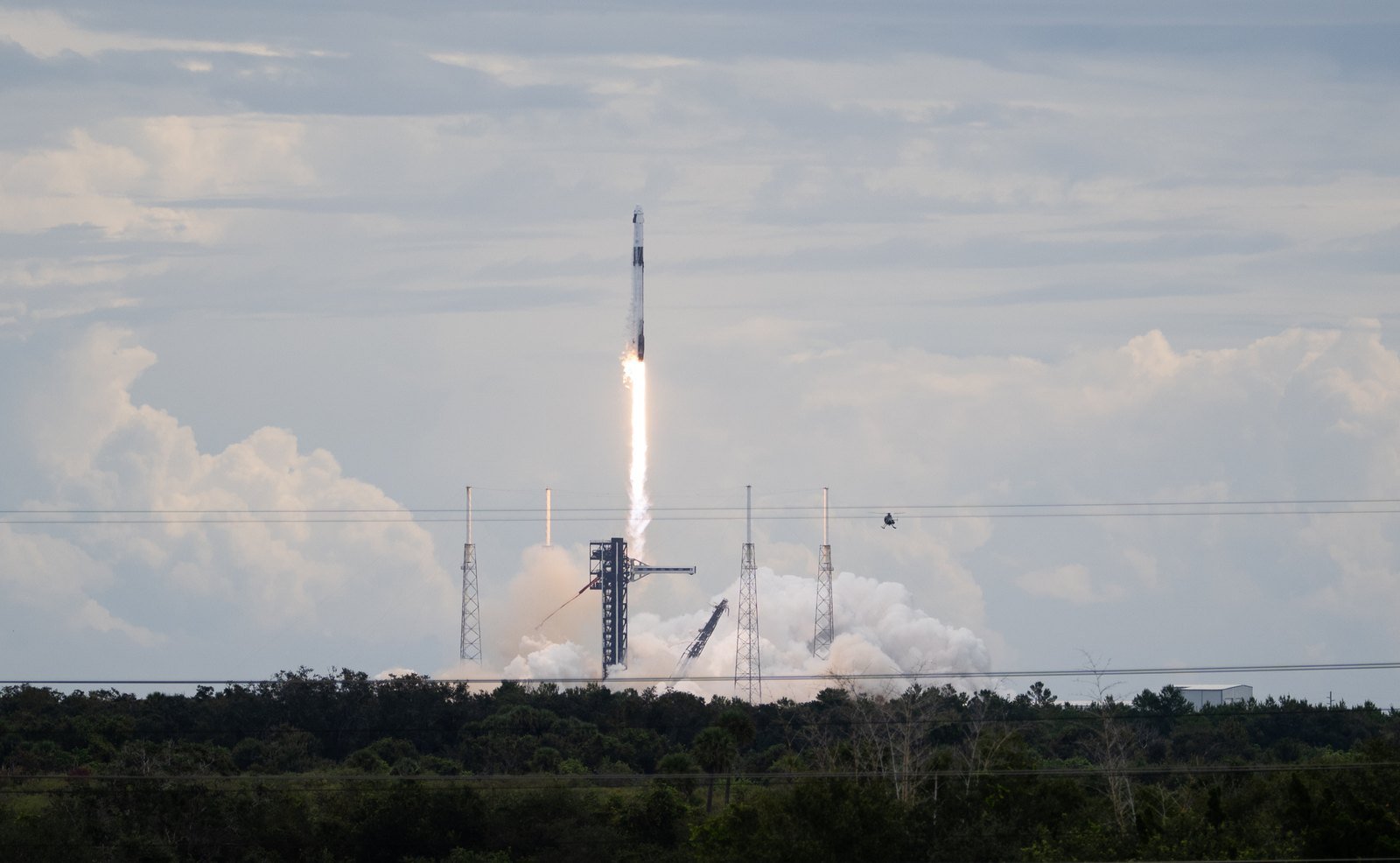
Crew-13 lifted off at 11:10 a.m. ET on Oct. 1 from Space Launch Complex 40 at Cape Canaveral Space Force Station, Space.com reported. The Dragon, named Grace, had flown before: it carried Axiom Mission 4 in 2025. Grace docked to the forward port of the station’s Harmony module at 7:05 p.m., and the hatch opened at 9:19 p.m., according to SpaceQ.
That trip took 7 hours and 55 minutes. NASA called it the fastest launch-to-docking of any U.S. spacecraft in station history, KeepTrack noted, beating an uncrewed cargo Dragon’s mark of just over 12 hours from November 2024. Typical crewed Dragon flights take 15 to 24 hours, per Space.com. KeepTrack credits favourable orbital timing rather than new hardware. Julianna Scheiman, SpaceX’s director of NASA science and Dragon programs, put it more plainly at the post-launch briefing: “We got lucky this time.”
Kutryk flies with NASA’s Jessica Watkins, the mission commander, NASA pilot Luke Delaney and Roscosmos cosmonaut Sergey Teteryatnikov. He is an engineer and former Royal Canadian Air Force test pilot with more than 4,000 hours in over 40 aircraft types who grew up on the Prairies, according to the CSA’s mission page.
The mission is a milestone for the agency too. The CSA says it is Canada’s fourth long-duration station mission and the first CSA astronaut flight under NASA’s Commercial Crew Program, the arrangement that buys seats on commercial spacecraft. It runs about six months.
“It is an honour to represent Canada in space and to share my journey with everyone back home.” Joshua Kutryk, in the CSA’s Oct. 1 launch release
What Kutryk is testing on the space station
Most of Kutryk’s Canadian science uses his own body as the lab. The CSA’s launch release lists studies of mental health, bone density, cardiorespiratory health, orientation perception, anemia and ocular rigidity, plus a new exercise protocol. The agency’s list of his science activities puts names to them:
- AstroFit tests a new exercise routine meant to reduce what microgravity does to the body.
- C-STARS studies mental health, including how stress and coping relate to emotions like gratitude and awe.
- Home-Base looks at how astronauts keep track of where they are when there is no up.
- SANSORI-2 investigates the factors behind vision changes some astronauts experience.
- SPARK examines why and how anemia occurs in space.
- CARDIOBREATH tracks how the heart and lungs control blood pressure.
- TBone and TBone2 use 3D imaging to measure how spaceflight affects bone.
- Bio-Monitor records vital signs through a smart shirt.
He also takes part in European and NASA studies, from an exercise device called E4D to a comparison of astronaut data with submariners that tries to separate the effects of spaceflight from plain confinement. Away from the experiments, the CSA says he will handle maintenance and repairs and support robotics work and spacewalks.
What else happens on the ISS in October
The station got quieter on Oct. 8. Crew-12’s Dragon splashed down off Los Angeles at 11:34 a.m. EDT, bringing Jessica Meir, Jack Hathaway, the European Space Agency’s Sophie Adenot and Roscosmos’s Andrey Fedyaev home after 237 days. Before they left, Meir was scheduled to hand station command to cosmonaut Pyotr Dubrov on Oct. 4, SpaceQ reported.
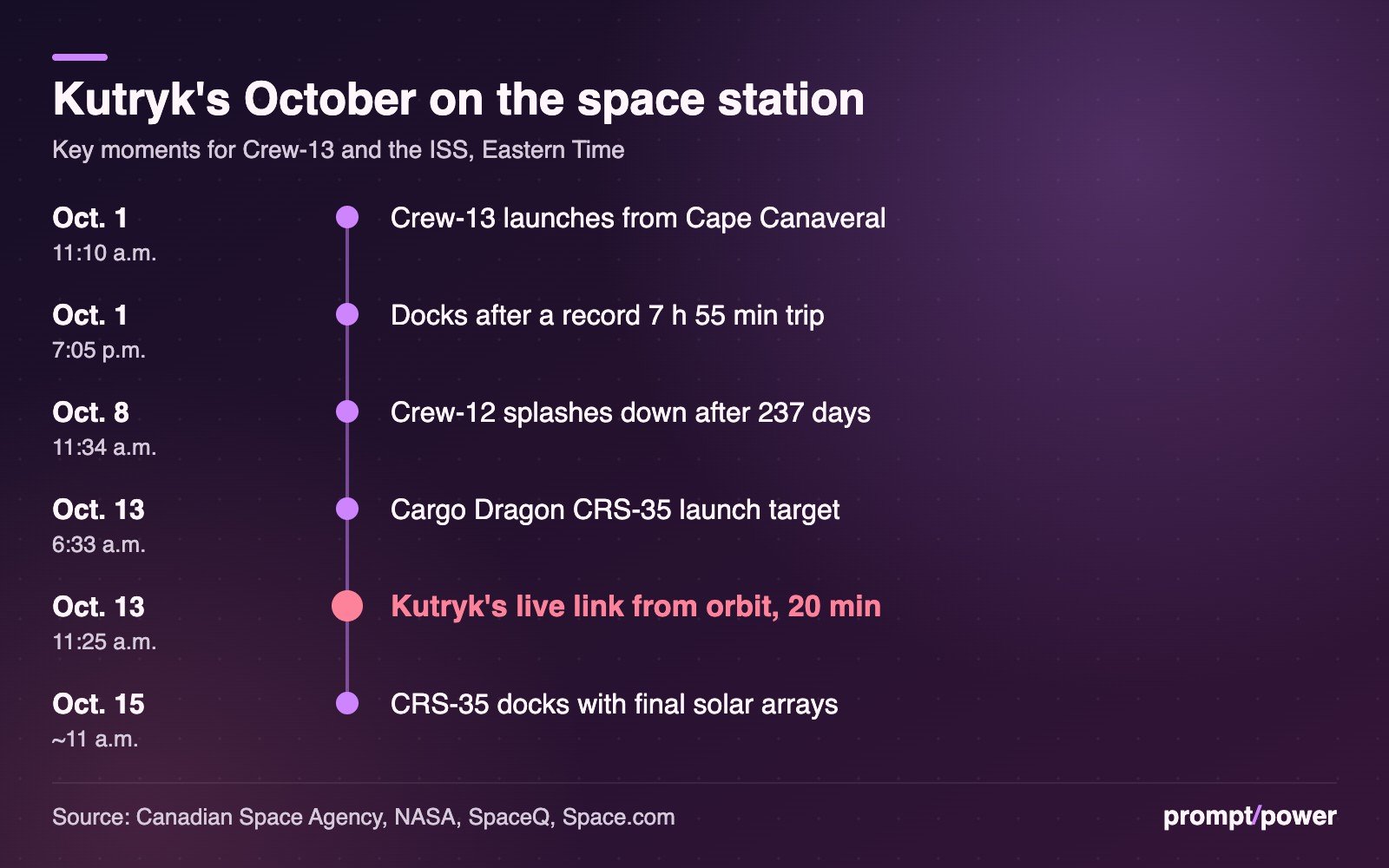
Next comes cargo. NASA and SpaceX are targeting 6:33 a.m. EDT on Oct. 13, the same morning as Kutryk’s press conference, for the 35th commercial resupply flight. The cargo Dragon carries more than 6,300 pounds (about 2,860 kilograms) of supplies and science, including hardware to make artificial retinas, 3D heart tissue for drug testing and brain organoids for studying Alzheimer’s, Parkinson’s and multiple sclerosis. It is due to dock on Oct. 15 at about 11 a.m. ET.
The headline item is the final set of Roll-Out Solar Arrays, which add power alongside the station’s original solar wings. Astronauts will install them on future spacewalks, according to SpaceQ. Nobody has said who will make those spacewalks.
October is busy in orbit generally. The day Kutryk launched, Google’s first Project Suncatcher satellite went up carrying four of its AI chips. And SpaceX, which flies both Dragons, is reportedly lining up US$40 billion in debt to buy Nvidia hardware.
What to do on Oct. 13
Bookmark the CSA media channel now, since YouTube often lists scheduled streams ahead of time. Launch dates slip, so if the cargo flight moves, check the CSA’s news page to confirm the press conference has not moved with it. If you have kids, the 20-minute window fits inside one class period in most of the country.
And keep an eye on the clock. If the cargo Dragon leaves the pad on time, it will have been in orbit for just over five hours when Kutryk’s link closes at about 11:45 a.m. ET. Crew-13 took 7 hours and 55 minutes to cover the same distance. The cargo ship is scheduled to take about two days.

Priya Natarajan covers science and society for prompt/power: climate and energy tech, data centres, and the physical cost of the digital world. Every query has a water bill, and she would like to see the receipt.
Keep reading


Latest from prompt/power
- Cohere Opens an Ottawa Office as Its AI Agents Head to Navy ShipsOct 11
- China Gave AI Influencer Yuri an Official ID. What It Unlocks for CreatorsOct 11
- Double Counter Discord Breach: What to Do If Your IP Address LeakedOct 11
- Fired OpenAI Safety Researchers Deny Leaking, Warn of a ‘Chilling’ CultureOct 11
- Arena, the Leaderboard That Ranks AI Models, Is Now Worth US$3.1 BillionOct 11
Leave a Reply