
Microsoft spent US$39.37 billion on property and equipment in the three months to Sept. 30, a little more than double the US$19.39 billion it spent in the same quarter a year earlier. That line sits on the cash-flow statement of the fiscal 2027 first-quarter results Microsoft posted on Oct. 28, under headline numbers that beat last year on every count: revenue of US$92.28 billion, up 19%; operating income of US$45.92 billion, up 21%; and Azure revenue of US$33.17 billion, up 48%. Two days before the report, Microsoft had confirmed it was offering voluntary buyouts to about 60,000 employees.
Put those facts side by side. Microsoft is spending more on data centres than ever while inviting roughly a quarter of its staff to leave.
Microsoft Q1 FY27 earnings: the numbers in the release
GAAP net income rose 32% to US$36.63 billion, or US$4.92 a diluted share, against US$27.75 billion and US$3.72 a year earlier. Strip out the swing from Microsoft’s OpenAI stake, as the company does in its non-GAAP figures, and growth is a calmer 18%: net income of US$36.4 billion and US$4.89 a share. The release says the OpenAI investment added US$207 million to net income this quarter and subtracted US$3.1 billion a year ago. Most of the gap between 32% and 18% is last year’s loss going away, not this year’s business getting better.
Microsoft Cloud revenue was US$63.9 billion, up 30%. The release puts Azure at US$33.17 billion against US$22.38 billion, which works out to 48.2% by our math and a little over a third of all revenue.
Chief executive Satya Nadella talked about the stack, not the spend: “We are delivering greater capability, choice, control, and cost efficiency for customers across our entire stack.” Chief financial officer Amy Hood called it “a strong start to the fiscal year.”
Why year-on-year comparisons got harder
This is the first quarter under the two-segment structure Microsoft announced in September. The old three-way split is gone. In its place are Agents and Infra, which carries Azure, Microsoft 365 commercial cloud and industry solutions cloud, and Devices and Consumer, which carries Windows OEM and devices, Xbox content and services, and search and advertising. Microsoft says it has “recast certain prior period amounts to conform to the way we internally manage and monitor our business.”
The recast numbers are the only fair comparison, and they tell a lopsided story:
- Agents and Infra: revenue US$76.80 billion, up 25% from a recast US$61.67 billion; operating income US$40.56 billion, up 24%.
- Devices and Consumer: revenue US$15.48 billion, down 3% from US$16.00 billion; operating income US$5.36 billion, up 2%.
Inside Devices and Consumer, Windows OEM and devices revenue fell 22% and Xbox content and services slipped 2%, while search and advertising excluding traffic acquisition costs grew 12%. Anyone comparing these segments with figures published before September is comparing different baskets.
Microsoft capex vs free cash flow
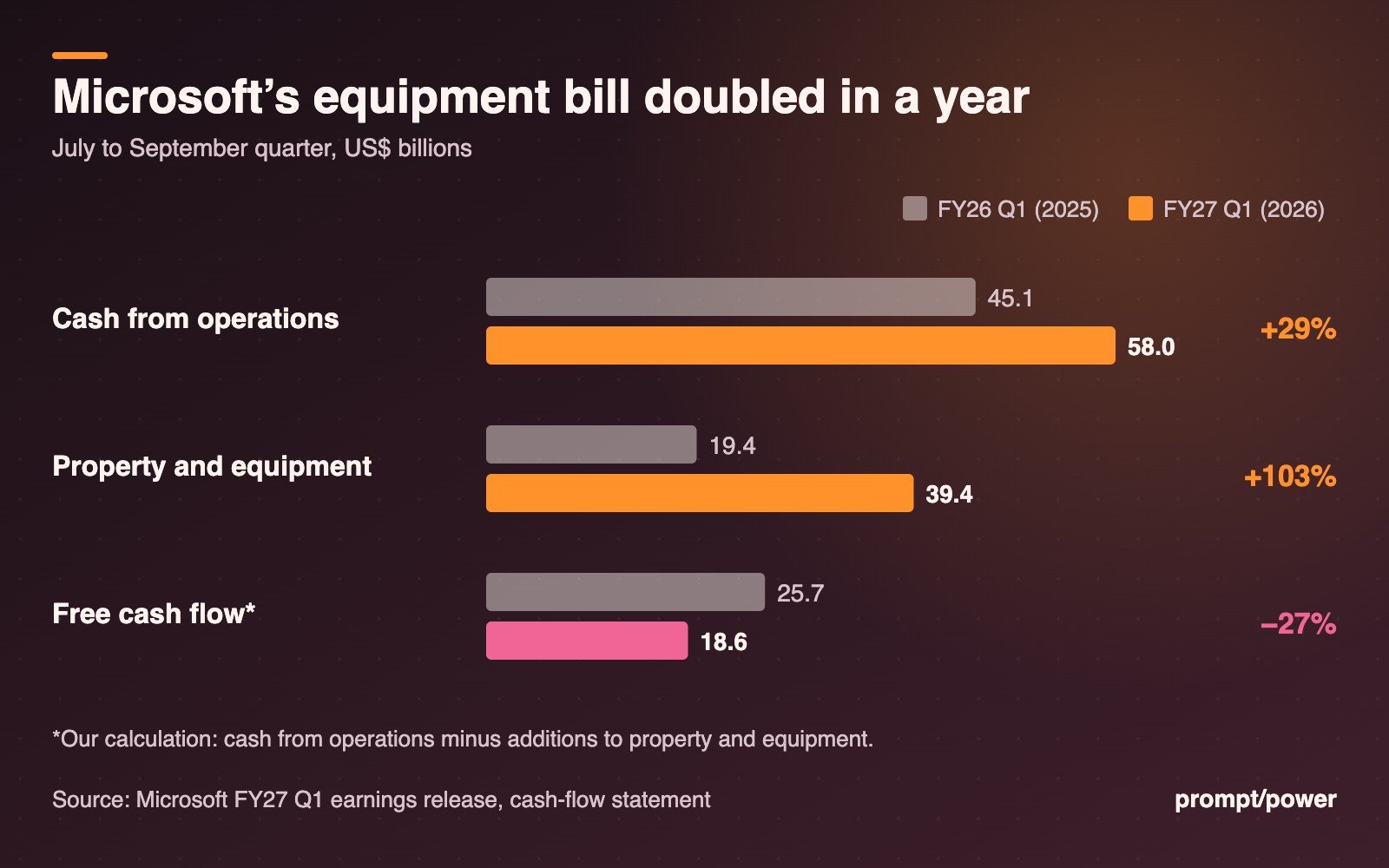
Here is the part the headline numbers hide. Cash from operations rose 29% to US$58.0 billion. Subtract the US$39.37 billion of property and equipment and you get roughly US$18.6 billion of free cash flow, by our calculation, down about 27% from roughly US$25.7 billion a year earlier. Equipment spending ate 43% of revenue this quarter; a year ago it was 25%.
Microsoft is still cash-positive, which is more than Meta could say: Meta’s third-quarter free cash flow went negative on Oct. 21. But the direction is the same. Microsoft says it returned US$10.2 billion to shareholders through dividends and buybacks in the quarter, about a quarter of what it put into equipment. (The cash-flow statement shows about US$11.1 billion actually paid out; the release does not explain the gap.)
The release carries no spending outlook. Microsoft gives that on its earnings call, which ran at 2:30 p.m. PT on Oct. 28. Part of it funds Microsoft’s own chips; see our Maia 300 explainer.
The 60,000 buyouts, and who is excluded
Microsoft confirmed to TechCrunch on Oct. 26 that it is offering buyouts to about 60,000 employees at vice-president level and below, on select teams in the US, Canada, India and the UK. Bloomberg reported that Xbox, Windows, Copilot and Finance are among the divisions included, according to TechCrunch. TechCrunch reported that data centre staff and sales and marketing are among those excluded, and that the package is similar to Microsoft’s standard severance. Headcount was about 223,000 at the end of June, which makes the offer about 27% of the workforce.
In a note to staff, chief people officer Amy Coleman wrote that “the Voluntary Exit Offer is new for us,” TechCrunch reported. It follows a July 6 cut of about 4,800 roles, roughly 2.1% of the workforce, and an earlier retirement program that Microsoft says more than 30% of eligible employees took.
The exclusions are the tell. Microsoft is keeping the people who build and sell its infrastructure. Xbox and Windows, two of the divisions named in the reports, sit in the one segment that shrank. The reports we read give no country breakdown of the 60,000, so how many are in Canada or the UK is not public.
What it means for you
Investors should watch the recast segments and the cash line, not the 32% profit jump. If you work at Microsoft on an eligible team, TechCrunch reported that offer details were due by email on Oct. 26; read them against the standard severance terms, since Microsoft says the two are similar. More business coverage is on our business and startups page.
One figure to keep. Microsoft’s equipment bill for the quarter, US$39.37 billion, was about 2.5 times the revenue of its whole Devices and Consumer segment. Windows, Xbox and search advertising together brought in US$15.48 billion.

Marcia Okonkwo covers the business of technology for prompt/power: venture capital, startups, IPOs and earnings. She treats a valuation as a mood rather than a number until the S-1 says otherwise.
Keep reading

Anthropic S-1 Explained: US$16.3B Revenue, US$80.7B Loss, Who Controls ANT

Amazon Promises 30,000 UK Entry-Level Jobs by 2030. What AI Means for Them

Netflix Cuts Its 2026 Ad Forecast to US$2.7B as Price Hikes Hold

Tesla Q3 Earnings: SpaceX Out-Earned It Nearly 4 to 1 as Merger Talks Begin
Latest from prompt/power
- SK hynix Memory Is Sold Out Through 2029. PCs and Phones Pay the PriceOct 29
- GPT-6.1 Terra Price: US$1 In, US$5 Out. What Agents Cost Now, and the CatchOct 29
- Australia’s Chatbot ‘Intimacy’ Ban Is for Kids Only. Canada’s Bill Isn’tOct 29
- Cohere Caught Qwen Trying a Beijing Upload. How to Lock Down AI AgentsOct 29
- Cloudflare’s AI Leaked Other Customers’ Data in 155 Replies. What to CheckOct 29
Leave a Reply