
Amazon says it will offer 30,000 entry-level jobs to young people in Britain between 2026 and 2030, aimed at areas with the fewest opportunities, under a “Youth Promise” published on 20 October. The roles are warehouse jobs, picking, packing and shipping, with no CV or previous experience required and pay starting at more than £31,000 a year pro rata (about US$41,200). The package also pledges more than 10,000 work experience placements and signs Amazon up to the government’s Youth Guarantee, working with the Department for Work and Pensions.
The release contains no investment figure. Read it against the latest youth unemployment numbers and Amazon’s own robotics claims, and the 30,000 looks less like new jobs than a commitment about who gets jobs Amazon already fills.
Amazon Youth Promise: what’s new and what isn’t
Several of the pieces were already running. The release folds in the JOBS Project with Barnardo’s, which will reach 2,000 young people from 2027 to 2030, and DFN Project SEARCH, a supported-employment programme Amazon had already said earlier in 2026 it would quadruple to more than 1,000 young people by 2030. The AI element, an AWS Skills to Jobs Tech Alliance goal of preparing 100,000 learners with AI skills by 2030, belongs to an alliance that launched in the UK in 2025.
The genuinely new numbers are narrower. Work experience places are due to rise from about 900 in 2026 to more than 3,000 a year by 2030, which Amazon describes as tripling, with more than 6,000 new places created under the Youth Promise itself. Unsuccessful applicants aged 18 to 24 will get a follow-up email pointing them to other help.
John Boumphrey, Amazon’s UK country manager, framed it around the people on site: “When I visit our sites, I meet young people who had no idea where to start six months ago,” he said in the release.
30,000 jobs against 715,000 unemployed young people
Spread evenly over five years, 30,000 roles is about 6,000 a year. According to the House of Commons Library’s youth unemployment briefing of 20 October, which draws on Office for National Statistics data, 715,000 people aged 16 to 24 were unemployed in June to August 2026, a rate of 15.6%. That was down 28,000 on the quarter but up 54,000 on the year. In May to July the rate hit 16.4%, which the Library calls “the highest rate since 2014.”
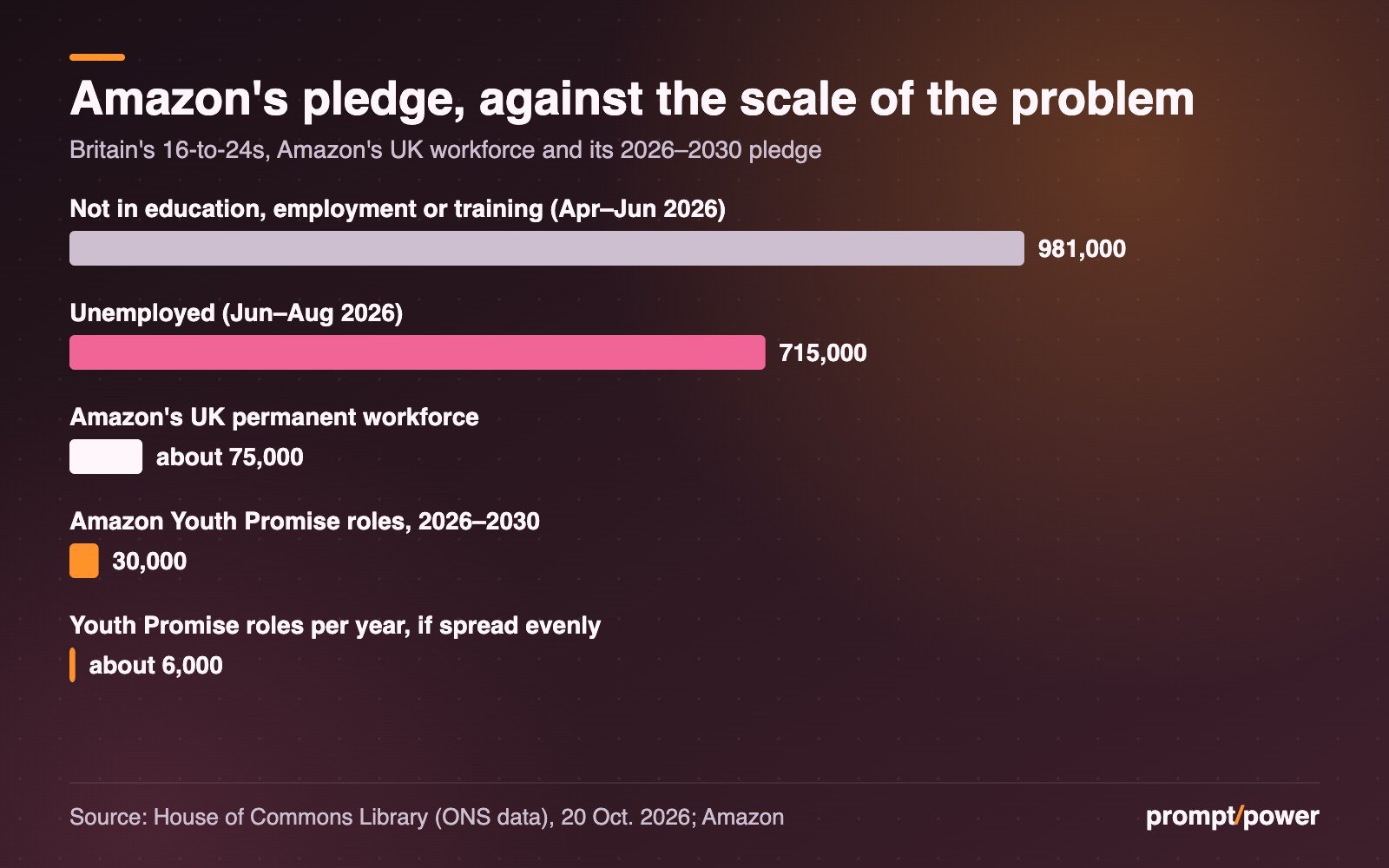
Amazon’s full five-year pledge equals about 4% of the young people unemployed in Britain right now.
The wider measure is worse. Some 981,000 young people were not in education, employment or training (NEET) in April to June 2026, a rate of 13.0%, after topping 1 million in January to March for the first time since 2013, the briefing says. It also warns that a data collection error “has affected data from May and June” and that the figures are “less reliable than usual.”
Then there is Amazon’s own size. Its UK economy page puts its total permanent workforce at “around 75,000 employees,” across more than 30 fulfilment centres, sort centres and delivery stations. A warehouse workforce that large hires constantly just to stand still. The release doesn’t say how many of the 30,000 roles are additional posts and how many are ordinary vacancies that will now be advertised to young people first. That’s the question Amazon should answer.
Which Amazon warehouse jobs AI and robots will change
The jobs on offer, picking, packing and shipping, are the ones Amazon has spent years automating. In July 2025 it said it had deployed its one millionth robot across more than 300 facilities worldwide, alongside an AI model called DeepFleet that it says improves the travel time of its robot fleet by 10%. The Youth Promise release itself doesn’t mention robots or automation once.
Amazon’s own account of what automation does to staffing points two ways. At its Shreveport, Louisiana, fulfilment centre, the company says, advanced robotics need 30% more employees in reliability, maintenance and engineering roles. That is a claim about one site’s skilled jobs, not about total headcount, and Amazon doesn’t publish the picker-and-packer side of that ledger.
Our read of where the change lands for a 19-year-old starting in 2027:
- Most exposed: walking a warehouse to pick items, and repetitive packing at fixed stations. These are the tasks mobile robots and robotic arms are built for.
- Changing, not disappearing: stowing, problem-solving at exception desks and loading, where people increasingly work alongside machines.
- Growing: maintenance and robotics technician work, the route the Shreveport figure describes, which needs training Amazon would have to provide.
That last line is where the AWS skills target could matter, if it connects to Amazon’s own warehouse floor rather than to the wider tech job market. The release doesn’t link the two.
What to watch next
The Department for Work and Pensions partnership is the piece with public accountability attached. If Amazon reports Youth Promise hires through Youth Guarantee channels, the numbers can be checked against what the government publishes. Without that, the 30,000 is a figure only Amazon can verify.
For more on Britain’s AI skills drive, see our story on Google’s free AI training for UK teachers, our explainer on the depth cameras that let warehouse robots see, and our report on UK non-compete reform. More on our business page.
The starting salary in the release is £31,000. The briefing’s figure for young people out of work is 715,000. Amazon has put a number on one side of that gap, and the government’s figures will show whether it moves the other.

Felix Strauss covers tech policy and regulation for prompt/power, from Brussels and Ottawa to Washington and Sacramento. He reads the 400-page regulation so you don't have to, and highlights the one sentence that actually matters.
Keep reading

Microsoft Q1 Earnings: Azure Up 48%, Capex Doubles, 60,000 Offered Buyouts

Anthropic S-1 Explained: US$16.3B Revenue, US$80.7B Loss, Who Controls ANT

Netflix Cuts Its 2026 Ad Forecast to US$2.7B as Price Hikes Hold

Tesla Q3 Earnings: SpaceX Out-Earned It Nearly 4 to 1 as Merger Talks Begin
Latest from prompt/power
- SK hynix Memory Is Sold Out Through 2029. PCs and Phones Pay the PriceOct 29
- GPT-6.1 Terra Price: US$1 In, US$5 Out. What Agents Cost Now, and the CatchOct 29
- Australia’s Chatbot ‘Intimacy’ Ban Is for Kids Only. Canada’s Bill Isn’tOct 29
- Cohere Caught Qwen Trying a Beijing Upload. How to Lock Down AI AgentsOct 29
- Cloudflare’s AI Leaked Other Customers’ Data in 155 Replies. What to CheckOct 29
Leave a Reply