What the FTC asked seven AI companies about kids and chatbot ‘companions’
The FTC's 6(b) orders to Alphabet, Character.AI, Instagram, Meta, OpenAI, Snap and xAI ask how companion chatbots are tested, monetized and kept safe for children.


When children treat a chatbot like a friend, who is responsible for what it says back? That’s the question behind one of the most significant U.S. inquiries into consumer AI. On Sept. 11, 2025, the Federal Trade Commission sent orders to seven companies that offer AI chatbots able to act as companions, demanding information about how they protect children and teens.
More than a year later, the orders remain the clearest map of what U.S. regulators think could go wrong. Here’s what they ask.
Who got the orders
The seven recipients were Alphabet, Character Technologies (maker of Character.AI), Instagram, Meta Platforms, OpenAI, Snap and xAI. The commission voted 3-0 to issue them.
The orders were issued under Section 6(b) of the FTC Act, which lets the agency run “wide-ranging studies that do not have a specific law enforcement purpose.” In other words, this is a fact-finding exercise, not a lawsuit. But what the FTC learns can shape later enforcement, and companies are legally required to answer.
What the FTC wants to know
The agency asked how the companies make money from user engagement, process what users type and generate responses, and develop and approve the characters their chatbots play. It asked how they measure, test and monitor for harms before and after launch, and how they reduce those harms, “particularly to children.”
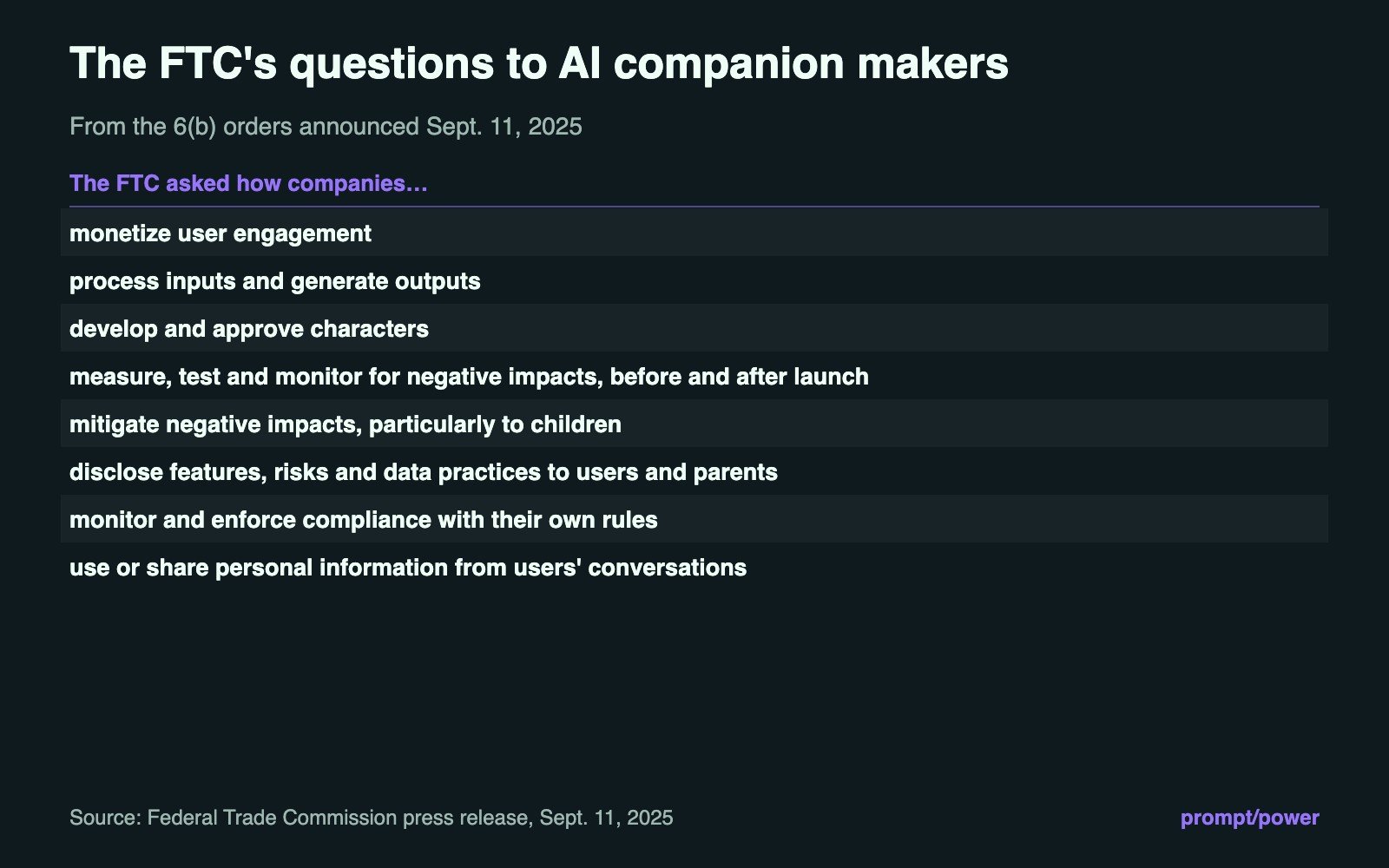
It also asked how the companies tell users and parents about features, risks and data practices; how they enforce their own rules and terms of service; and how they use or share personal information taken from users’ conversations with the chatbots.
“Protecting kids online is a top priority for the Trump-Vance FTC,” chairman Andrew Ferguson said when the orders were announced.
Why the monetization question matters
The first item on the list may be the most revealing. A companion app that earns more when users spend more time with it has an incentive to keep them talking. For an adult, that’s a design choice to be aware of. For a lonely 13-year-old, it can be a real risk. The FTC’s question goes to whether safety and engagement goals pull in opposite directions.
What parents can do now
You don’t need to wait for the FTC. Check whether the apps your kids use have teen accounts or parental controls, and turn them on. Look at the privacy settings for whether chats are used to train the model. Ask your child which characters they talk to and what about. And treat any app that encourages secrecy or long late-night sessions as a warning sign.
How does the U.K. handle chatbots?
Through its Online Safety Act, with legal duties rather than a study. In an open letter on Nov. 8, 2024, the regulator Ofcom said many generative AI services are covered: sites and apps where users share AI-generated content or create and share their own chatbots, including bots that mimic real or fictional people; AI tools that search the web; and services that can generate pornography. “The duties set out in the Act are mandatory,” Ofcom wrote. Those duties include assessing the risk of illegal content and, for services children use, protecting them from harmful material, with age checks where the most harmful content is allowed. Character-style chatbot platforms, in other words, can’t treat the U.K. as a study in progress.
Canada has no equivalent law in force. Its online harms bill died when Parliament was prorogued in January 2025, so for now Canadian parents are relying on the companies’ own settings and on U.S. and U.K. pressure.
Other governments are moving too. Australia has restricted chatbots’ emotional intimacy features for children, and Illinois has limited what AI can do in therapy. The FTC’s findings, if it publishes them, will show how far the industry’s own safeguards actually go.
Last checked Nov. 24, 2026.
Sources
- Federal Trade Commission, FTC launches inquiry into AI chatbots acting as companions, Sept. 11, 2025
- Ofcom, Open letter to UK online service providers regarding generative AI and chatbots, Nov. 8, 2024
More from prompt/power: AI chatbots and your teen: a parent’s guide · Australia’s chatbot ‘intimacy’ ban is for kids only · ChatGPT for teens rated ‘unacceptable risk’
Researched and drafted with AI tools, fact-checked against primary sources and approved by a human editor before publishing. Prices and dates are as of publication. Our standards →
Sources- ftc.gov — sent orders
- ofcom.org.uk — open letter

Jessie Isberg is a Toronto psychotherapist and musician. She also writes for Not An Atlas and The Remote.
All stories by Jessie →Keep reading




Latest from prompt/power
- Parental controls for ChatGPT, Gemini and Claude: what you can switch off, and what you can’t seeNov 28
- The EU AI Act’s next deadline is Dec. 2. Every date that applies now, after the delayNov 28
- Can AI help catch breast cancer? What Sweden’s big trial found, and what the NHS is testingNov 28
- Giving a tech gift card? The expiry and fee rules in Ontario and the U.S.Nov 28
- Is that image AI-generated? How to check with Content Credentials, SynthID and OpenAI VerifyNov 27
[…] Find out which apps your child actually uses. The controls are per app, and companion and character apps aren’t covered by any of these settings. The FTC’s questions to seven AI companies about children and chatbot “companions” are here. […]